Pheasant Shakshuka Breakfast Tacos: Wild Game Morning Recipe

From the first time those warm, vibrant, and comforting spices of shakshuka hit my tastebuds I was a fan. I was vacationing at a bed and breakfast in Santa Fe, New Mexico. I’m not a big fan of bed and breakfasts, I tend to shy away from dining with strangers and that is basically the goal of a bed and breakfast. The timidness I quickly develop with the introduction of unknowns also carries into unfamiliar foods. And I don’t know if there is much more foreign a breakfast experience than a spaghetti-looking egg dish for breakfast.

JUMP TO RECIPE

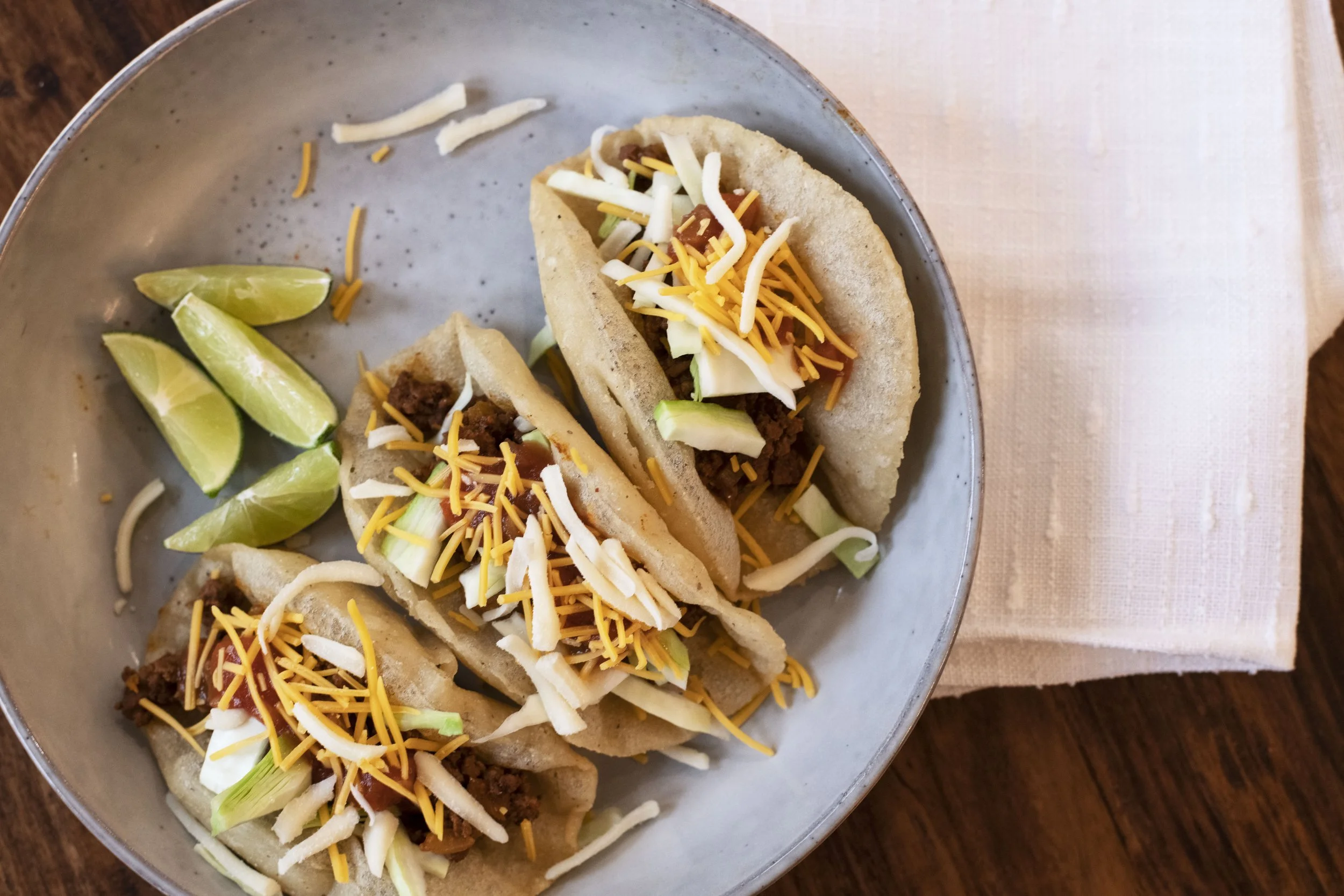
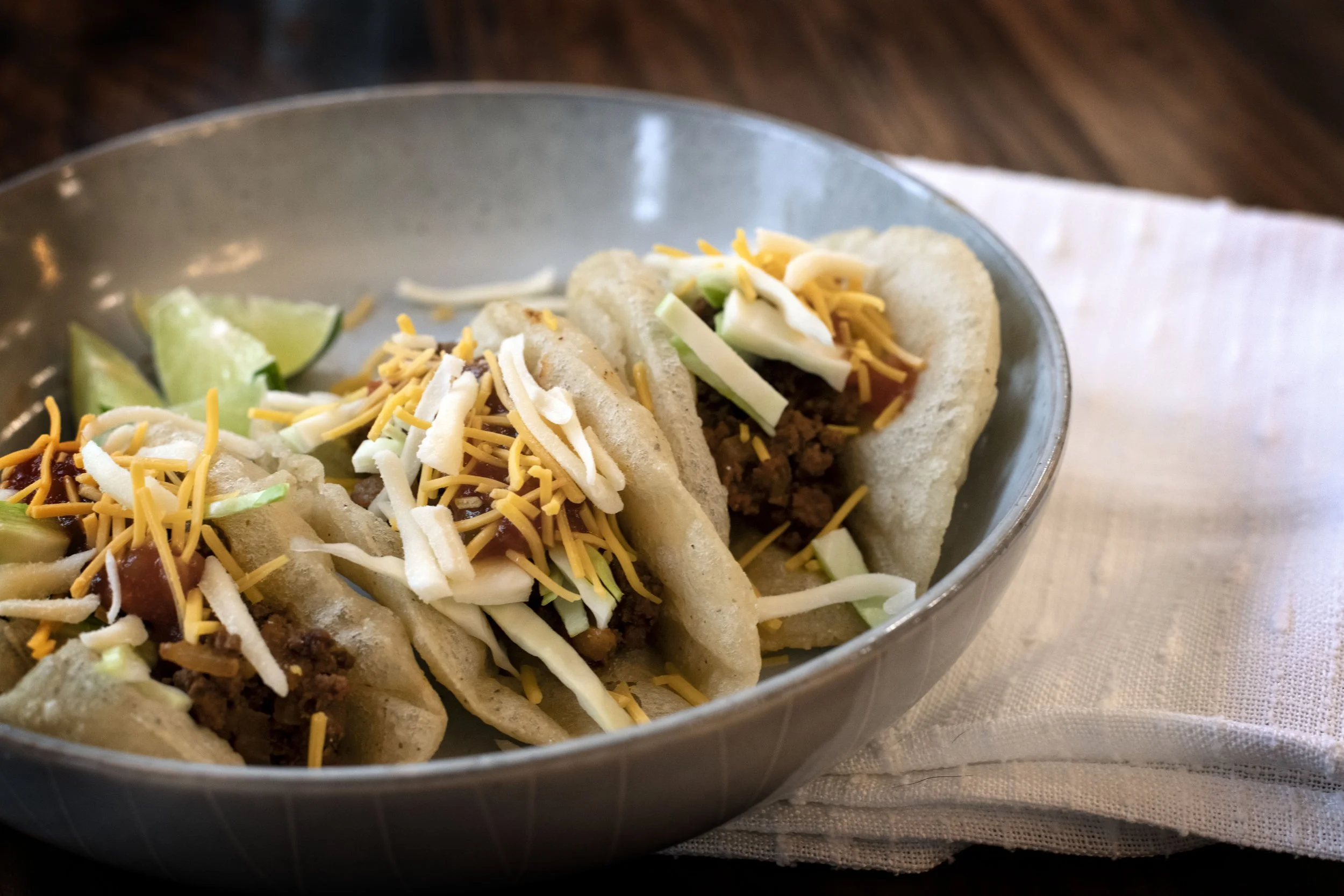
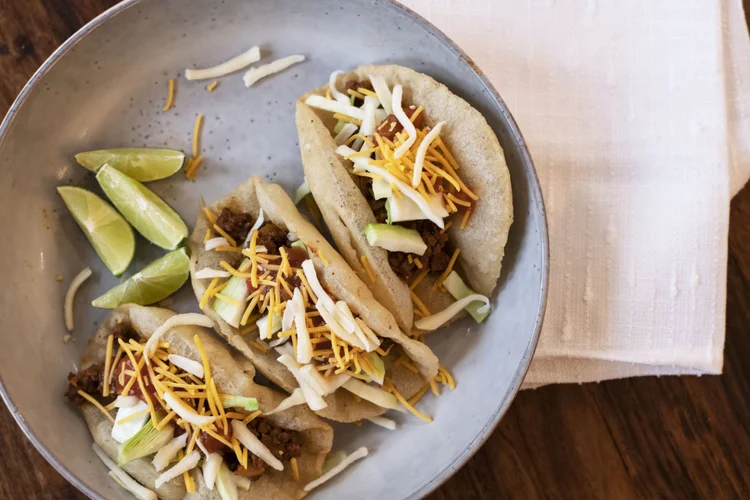
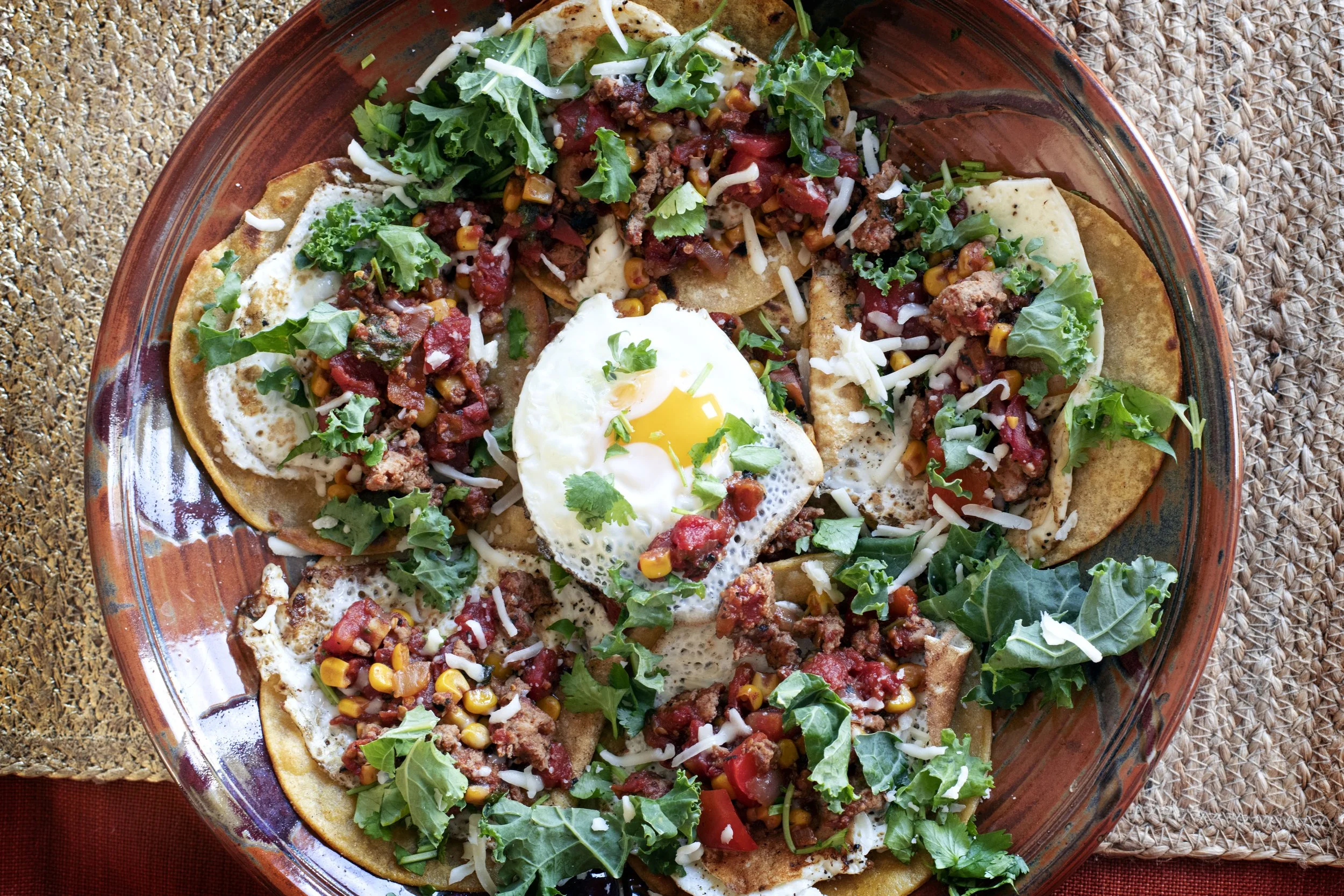
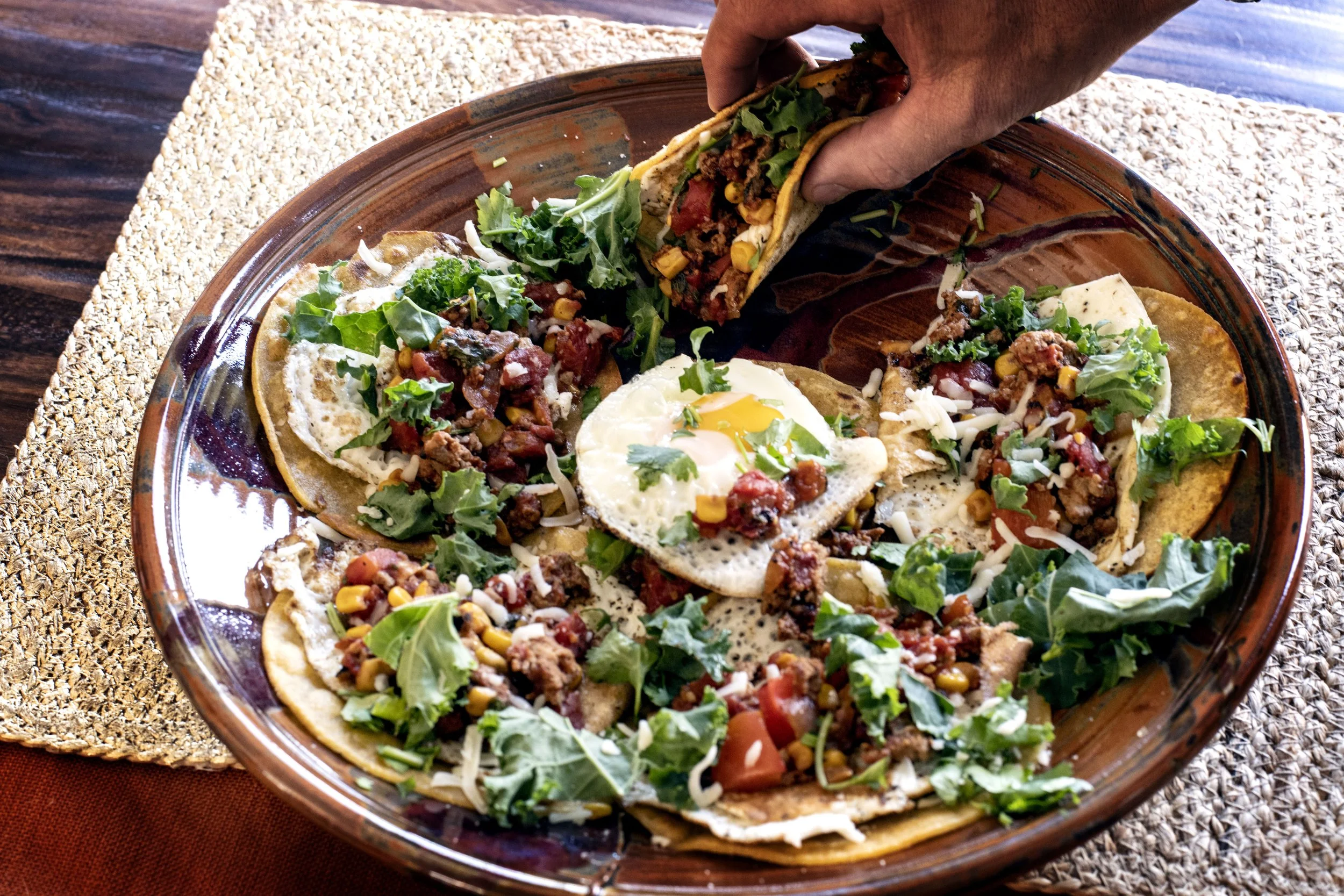
plate of shakahuka breakfast tacos with yellow corn tortillas, fried eggs, aromatic tomato stew, and homemade pheasant sausage

Don’t get me wrong, I do enjoy trying new things. I just find I am highly critical of the experience, and default to negative expectations. Even though my expectations tend to be proved wrong, my baseline mindset seems to rest at critical and negative. So, when the bed and breakfast host placed a large, heavy cast-iron skillet in the center of the table, steam still rising from the stewed tomatoes and bright, vibrant yellow yolks bathing in the crimson liquid, I was very skeptical.

 And of course, as always, those negative expectations evaporated with each bite. I was quickly convinced tomato stew should be nominated for inclusion on the list of breakfast staples. I also started thinking about how I could incorporate the comfy, roasted, rich egg dish into other recipes. I have been tossing the idea around on how to do just that for a few years, and I finally landed on this Pheasant Shakshuka Breakfast Taco. 

Making Ground Pheasant Sausage

Traditionally, shakshuka is a vegetarian dish, filled with tomatoes, peppers, onions, spices, and poached eggs; however, adding meat to the dish is easy and introduces another layer of flavor to the dish. I sat in front of my freezer for quite awhile debating protein choices and ultimately landed on pheasant this time around, but I think lots of other meats would work as well.

I always mix up my own sausage when working with wild game. I like to be in charge of the spices, the added fats, and the overall finished product. Making your own breakfast sausage is very easy. Start with selecting your protein, in this case pheasant, and running it through a meat grinder. I have this user-friendly electric meat grinder at home and use it anytime I want to make sausage, burger, or other ground meat varieties: Electric Meat Grinder

I didn’t add any fat to this sausage. I have gotten used to very lean meat and don’t miss the addition of a fat source; however, incorporating a fat can increase moisture, create a more pleasant textured meat, and enhance flavor. If you are interested in adding fat, I suggest using pork fat. 

First, decide the percentage of fat you want in your final product. So, if you want  20% fat content in your sausage, weigh out 3 ounces of pork fat and 13 ounces of pheasant, and you will end up with a one pound batch of ground sausage. Run both through the meat grinder, add them to a mixing bowl, sprinkle in your seasonings of choice, and thoroughly incorporate everything by hand. If you opt out of a fat source like I did, add a tablespoon or two of cold water to help bind the ingredients together

Creating the Pheasant Shakshuka Base for the Taco

The secret to a great shakshuka is the flavorful tomato stew that the other ingredients reside in. One key tip for amping up the flavor is to do all the cooking in a single, large, heavy cast-iron skillet. I like to use this one: Lodge Cast Iron Skillet

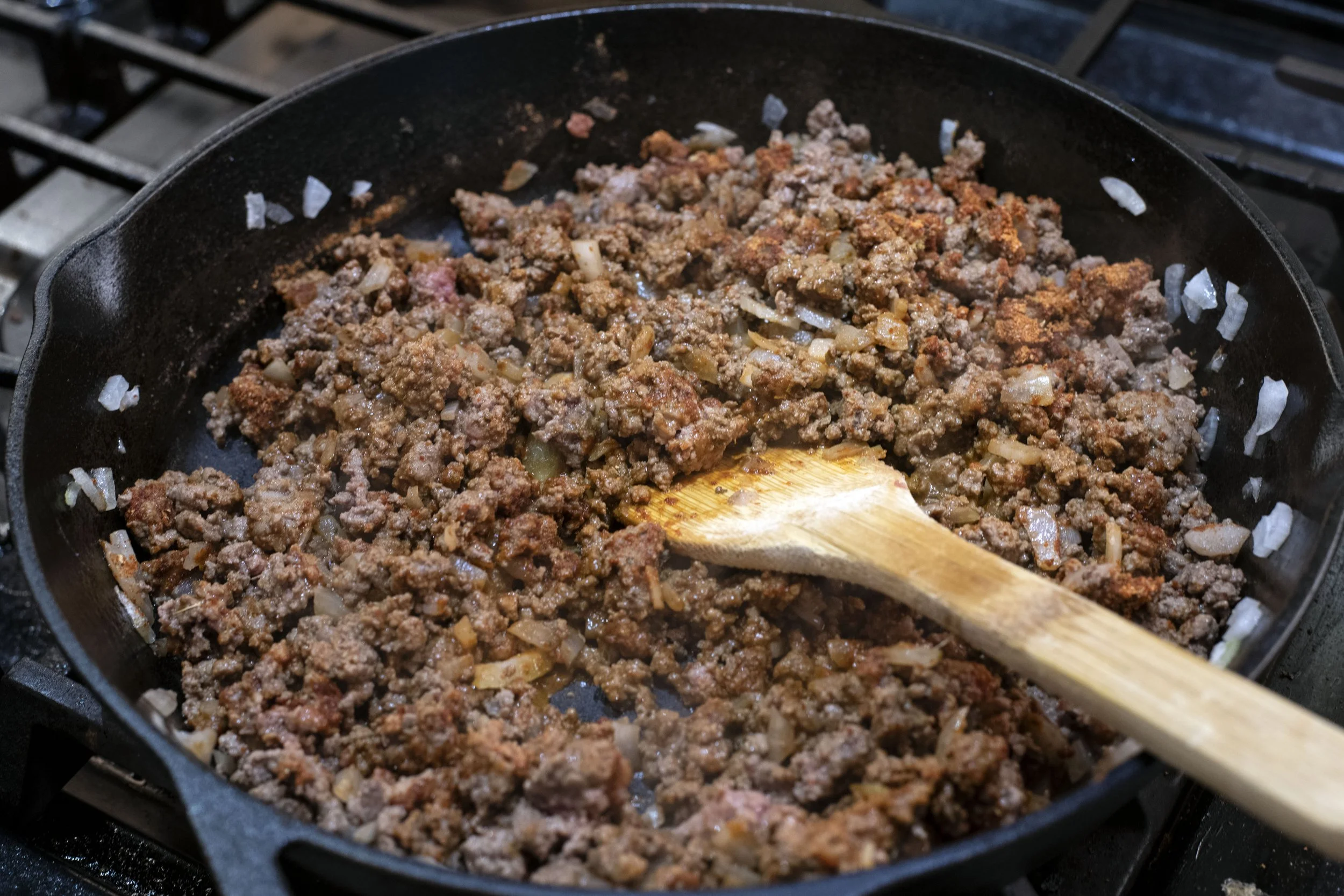
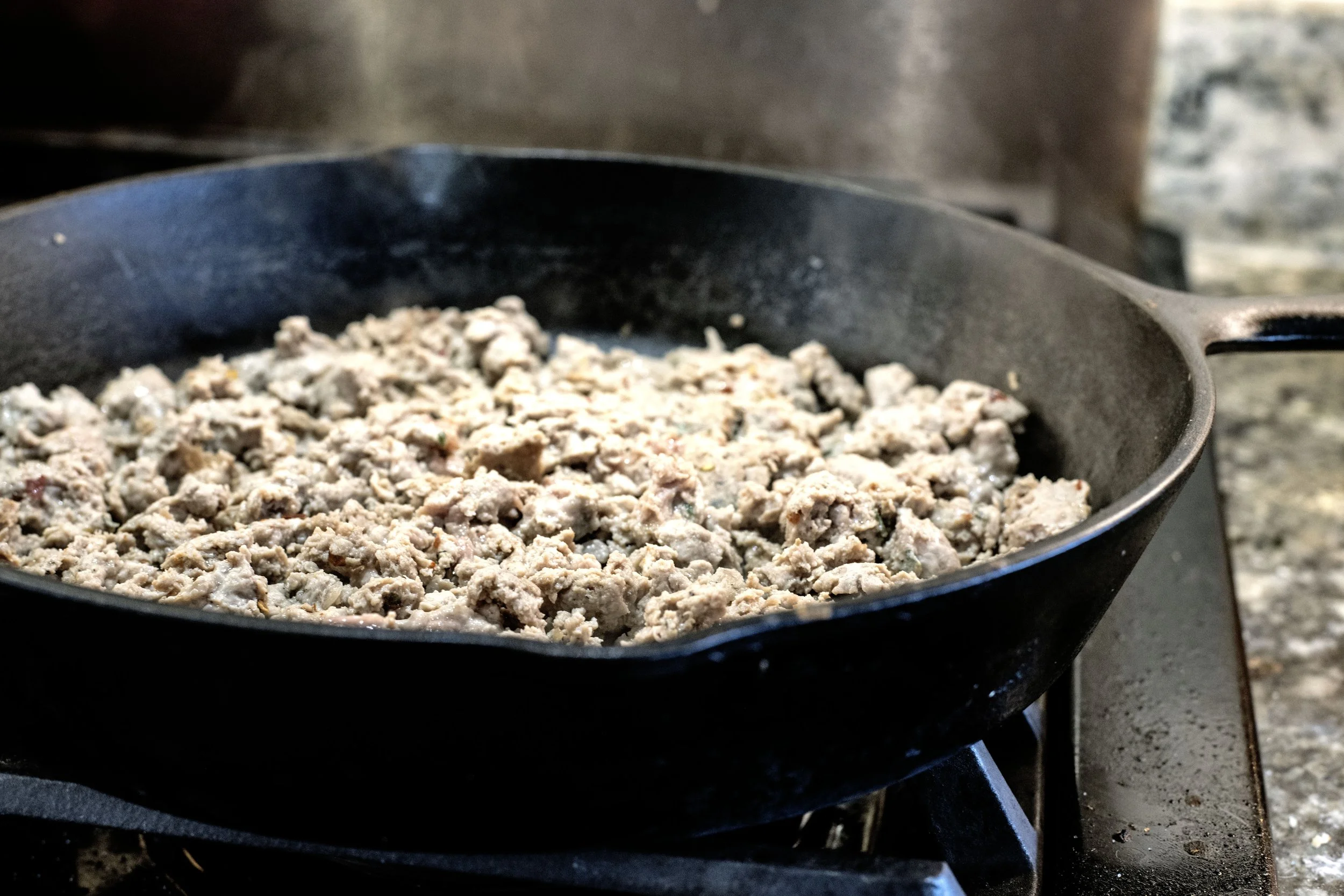
Begin by browning the pheasant sausage in the skillet. Once the sausage is cooked through, remove the meat and set it aside, but leave the drippings in the skillet. They will enhance the depth of flavor you are building for the tomato base.  

Ground Pheasant sausage browning in a heavy cast iron skillet

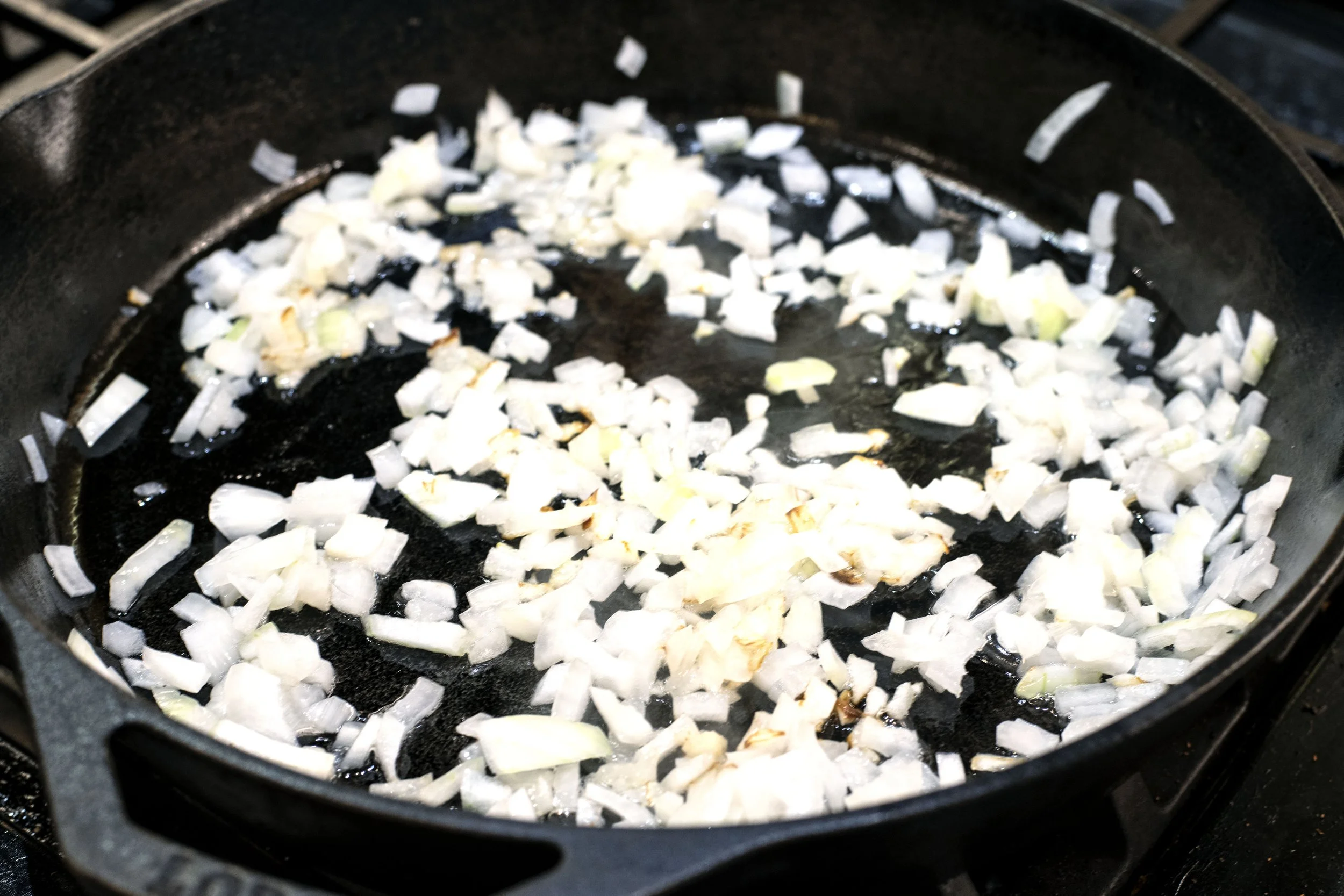
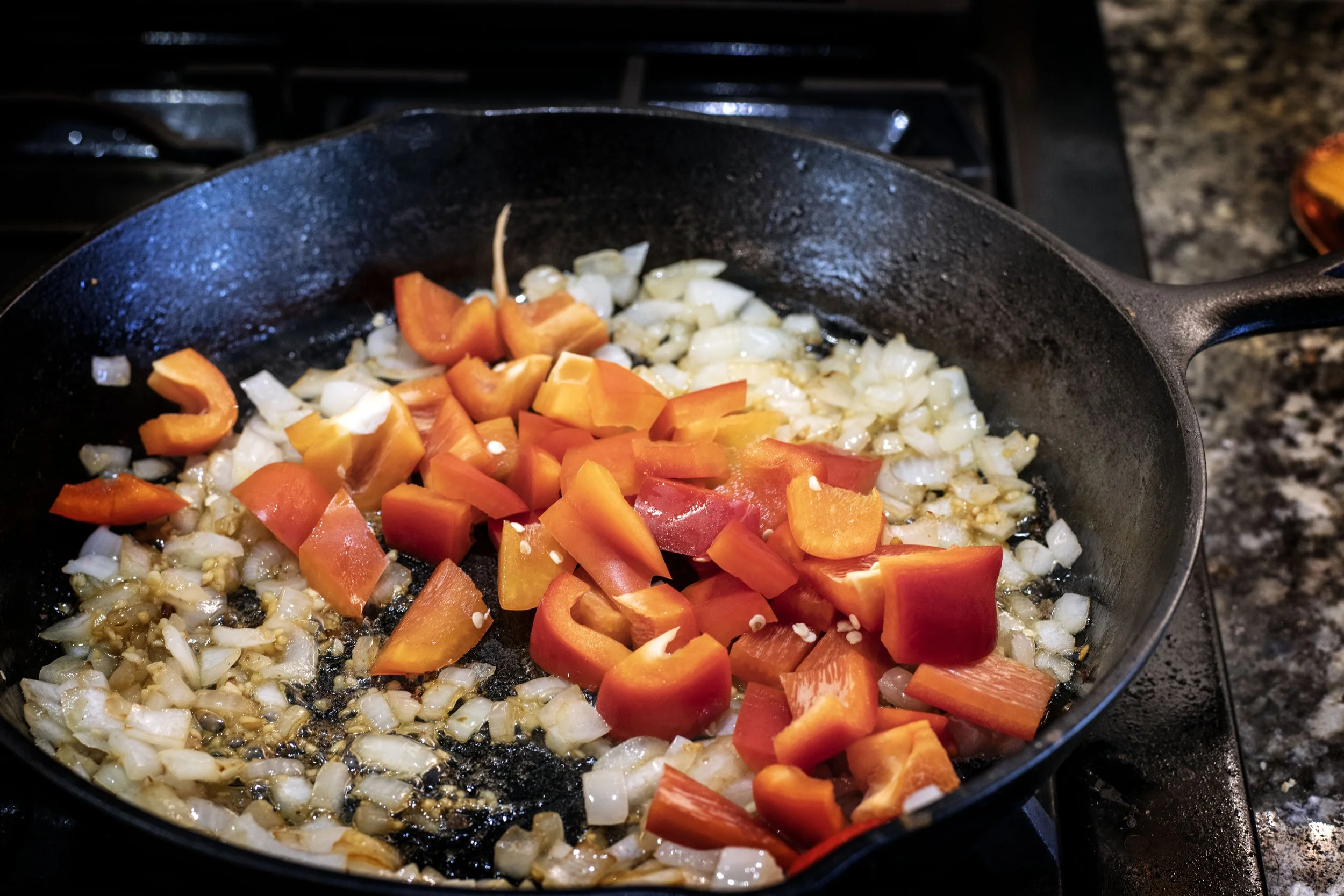
Next, add a tablespoon of cooking oil to the skillet, and saute the diced onions for three or four minutes before adding the red bell pepper. The color of the bell pepper isn’t important here. I went with red because I think they’re just a little bit sweeter, but orange, yellow, or green are all fine. Cook the bell pepper for three more minutes, and then stir in the minced garlic.

softened white onions and red bell peppers cooking in a heavy cast iron skillet

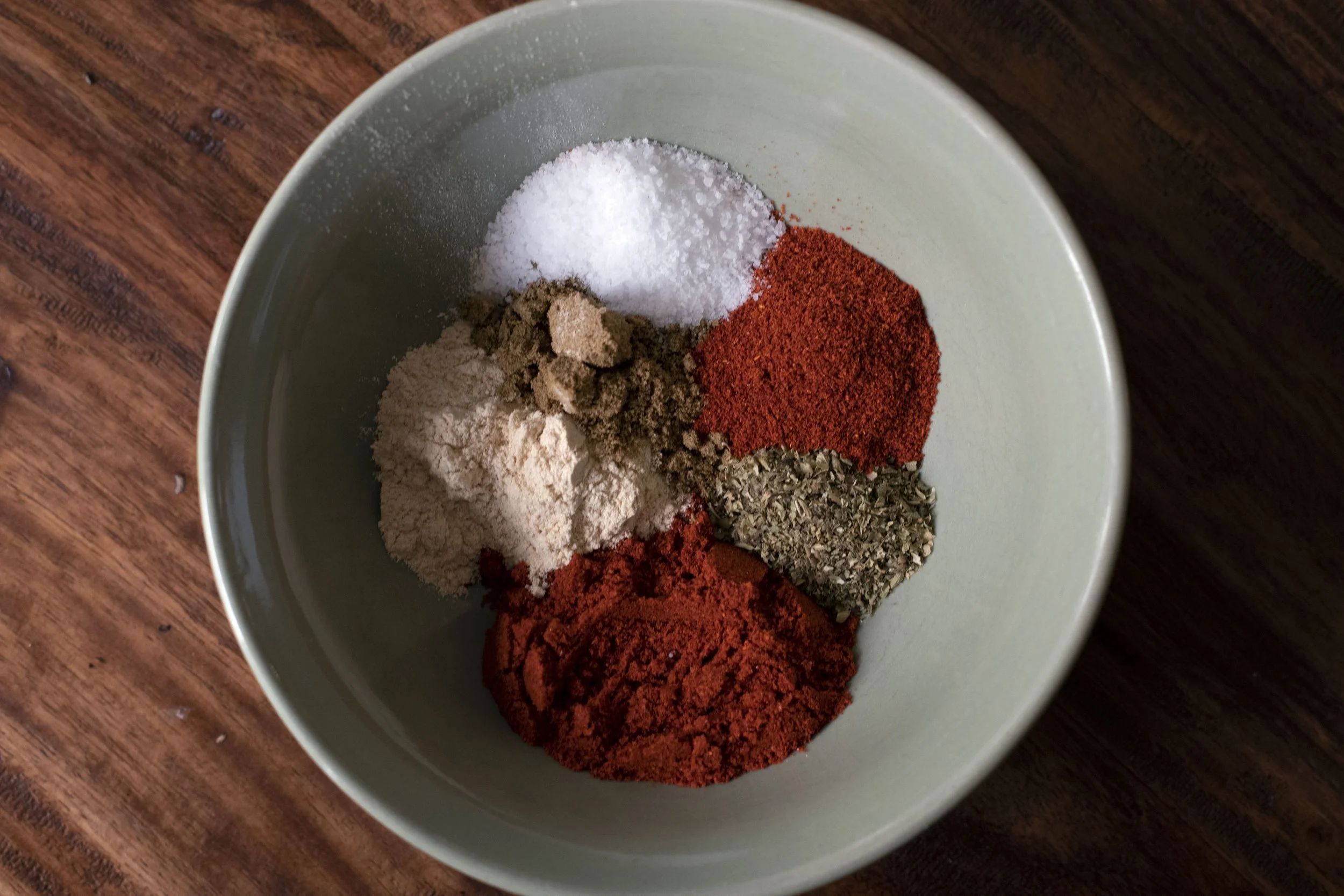
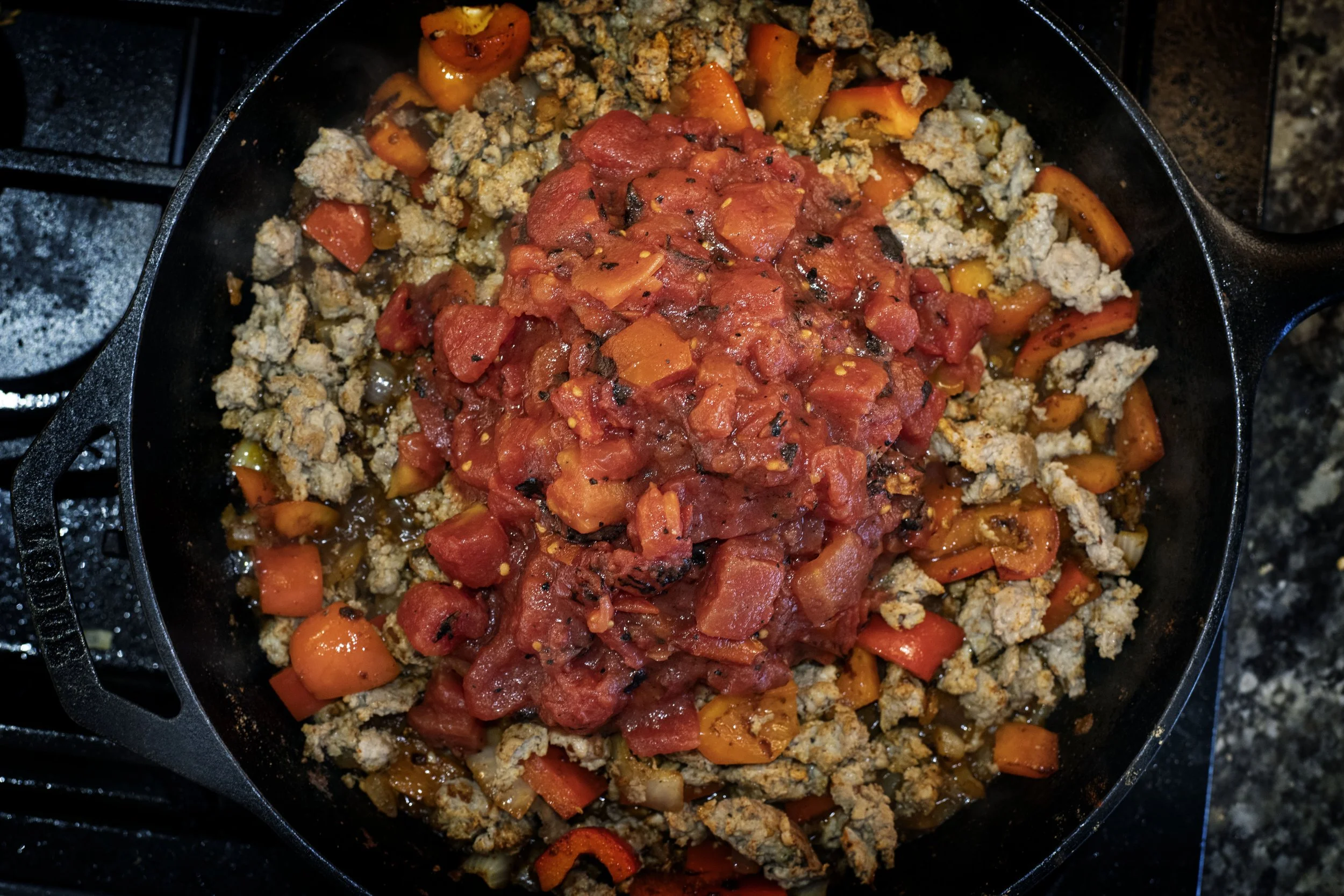
Return the browned pheasant sausage to the skillet and start adding in your shakshuka seasonings: a little chili powder (not too much, you aren’t making chili), some cumin, a decent amount of paprika (smoked or sweet both work), some floral-y coriander, and salt. Stir everything up real good - making sure to get the spices all over everything! - and then add the can of fire-roasted tomatoes.

If you want to really up the ante, you could roast fresh tomatoes in the oven and crush them before adding them to the skillet. But these are tacos! And tacos are notorious for being a quick meal, so I have no regrets on going with canned, roasted tomatoes.

fire-roasted tomatoes on top of ground pheasant in cast iron skillet

Whatever tomato decision you reach, allow the mixture to simmer and reduce for five to seven minutes. 

Prep the Toppings

These wouldn’t be shakshuka, or breakfast, tacos if there wasn’t the lead actor of the show: the egg. Shakshuka eggs are traditionally poached directly in the tomato stew, but that wouldn’t work well for a taco. The delicate egg would be too messy for handling in the tortilla. So, I had to go with fried eggs.

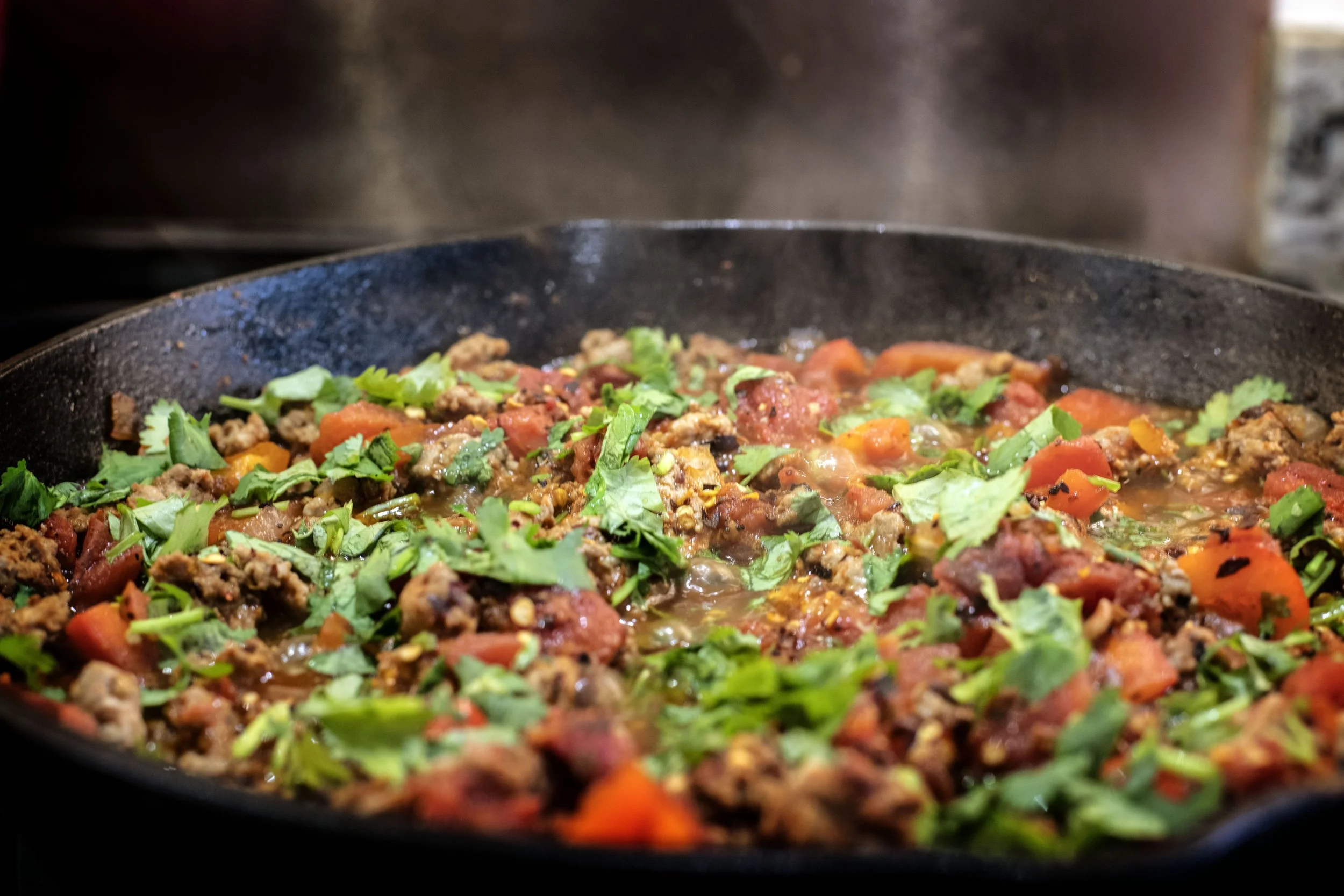
shakshuka taco meat with green kale and cilantro on top and fire roasted tomatoes with red bell pepper

While the taco base is simmering, fry one egg per taco. in a separate pan. At the same time, you can warm your corn tortillas. Other toppings to prepare include finely chopping fresh cilantro and a bit of kale. I loved the addition of kale to this taco. It not only added a crisp, fresh bite to the dish, but the vibrant red and green color contrast was highly appealing.

Finishing up the Tacos and It’s Time to Plate

To finish up the taco base, drain a can of corn and stir it into the mixture. Let the skillet heat for a few more minutes, maybe three or four, so the corn warms up. 

hand grabbing a taco from a plate of shakshuka tacos with corn tortillas, fried eggs, kale, tomatoes, red bell peppers, and ground pheasant sausage

To plate, add a heaping serving of ground pheasant meat mixture to a warmed tortilla. Top with a fried egg, minced cilantro, chopped fresh kale, and mozzarella cheese. 

Happy Hunting!

Yield: 4-6
Author: a 12 Gauge Girl
Pheasant Shakshuka Breakfast Tacos: Wild Game Morning Recipe

Pheasant Shakshuka Breakfast Tacos: Wild Game Morning Recipe

Cook time: 20 MinTotal time: 20 Min

Craving a unique breakfast taco? Try these Shakshuka-inspired ground pheasant tacos! Savory homemade game sausage simmered in fire-roasted tomatoes and sweet corn, topped with a fried egg—delicious for breakfast, brunch, or dinner.

Ingredients

For Ground Pheasant Breakfast Sausage
  • 1 pound ground pheasant
  • 1 teaspoon dried sage
  • 1/2 teaspoon thyme
  • 1/2 teaspoon fennel
  • 1 teaspoon garlic powder
  • 1 teaspoon onion powder
  • 1 teaspoon salt
For Shakshuka Taco Meat
  • 1 tablespoon cooking oil (such as avocado, canola, vegetable, or olive oil)
  • 1 medium onion, diced
  • 1 red bell pepper, seeded and diced
  • 2 cloves garlic, minced
  • 1 teaspoon chili powder
  • 1 teaspoon cumin
  • 2 teaspoons paprika
  • 1 teaspoon coriander
  • salt and pepper to taste
  • 1 can (14.5 oz) can diced roasted tomatoes
  • 1 can (15 oz) can corn
For Serving
  • Eggs, one per taco
  • Corn tortillas, warmed
  • Bunch fresh cilantro, minced
  • 1 bunched kale, chopped
  • Shredded mozzarella cheese

Instructions

  1. Season Pheasant In a large bowl, combine the ground pheasant with sausage seasonings - sage, thyme, fennel, garlic and onion powders, and salt. Use your hands to thoroughly incorporate the seasonings into the meat.
  2. Brown the Sausage Heat a large skillet over medium high. Brown the ground pheasant, breaking it up with a spoon, until meat is no longer pink, about five minutes. Remove the cooked pheasant and set aside.
  3. Saute Other Ingredients Maintaining the temperature in the skillet, add a tablespoon of cooking oil of choice. I used avocado oil, but canola, vegetable, or even olive oil is fine.
  4. Once oil has heated, add the diced onion and cook for three minutes.
  5. Remove seeds from red bell pepper and dice into 1" pieces. Add to skillet with onions and saute for three minutes more, until slightly softened.
  6. Add Garlic Mince garlic cloves and add to onion mixture. Heat for a minute or two. Be sure to stir the mixture so the garlic does not brown, which results in a bitter flavor to the dish.
  7. Simmer Taco Meat Return the ground pheasant to the skillet. Season the mixture with the chili powder, cumin, paprika, coriander, and salt.
  8. Add the can of roasted diced tomatoes, stir, and allow mixture to stew for 5 to 7 minutes, or until the tomato juices reduce and slightly thicken.
  9. Prep the Toppings While the taco meat is simmering, fry one egg per taco. Also heat the corn tortillas.
  10. Drain the can of corn and add to the meat mixture. Cook for three more minutes.
  11. Assemble and Serve To plate, add a heaping serving of ground pheasant meat mixture to a warmed tortilla. Top with a fried egg, minced cilantro, chopped fresh kale, and mozzarella cheese.
  12. Enjoy!

Nutrition Facts

Calories

382

Fat (grams)

18 g

Carbs (grams)

26 g

Fiber (grams)

4 g

Protein (grams)

30 g

 Nutritional values are rough estimates based on standard ingredients and will vary depending on your specific cut of wild game, brands used, and actual serving sizes.
Did you make this recipe?
Tag @a12gaugegirl on instagram and hashtag it #huntingandcooking

????? FREquently asked questions ?????

Sweet and Savory: Apricot Venison Tacos with Pineapple Salsa

I am a huge fan of barbacoa tacos. Switching from the spicy, earthy flavor of traditionally seasoned taco meat to the sweet and tangy profile of barbacoa always makes for a wildly different taco eating endeavor. 

JUMP TO RECIPE

I am also a huge fan of pairing apricot with venison. Something about the fruit's tart, sweet, and floral notes perfectly complements the meat. Venison’s natural qualities as a lean, pure meat create a culinary scenario where the meat absorbs bold, distinct flavors, like apricot or other fruits, without losing its own rich, signature identity in the dish.  

So, since I like the pairing of apricot with venison and also enjoy a sweet, tangy taco recipe, I decided to marry the two ideas and make an Apricot Venison Taco with Pineapple Salsa dish. And instead of engaging in a lot of mindless talk with things like a history lesson about apricots or something like that, let’s just jump right into this recipe!

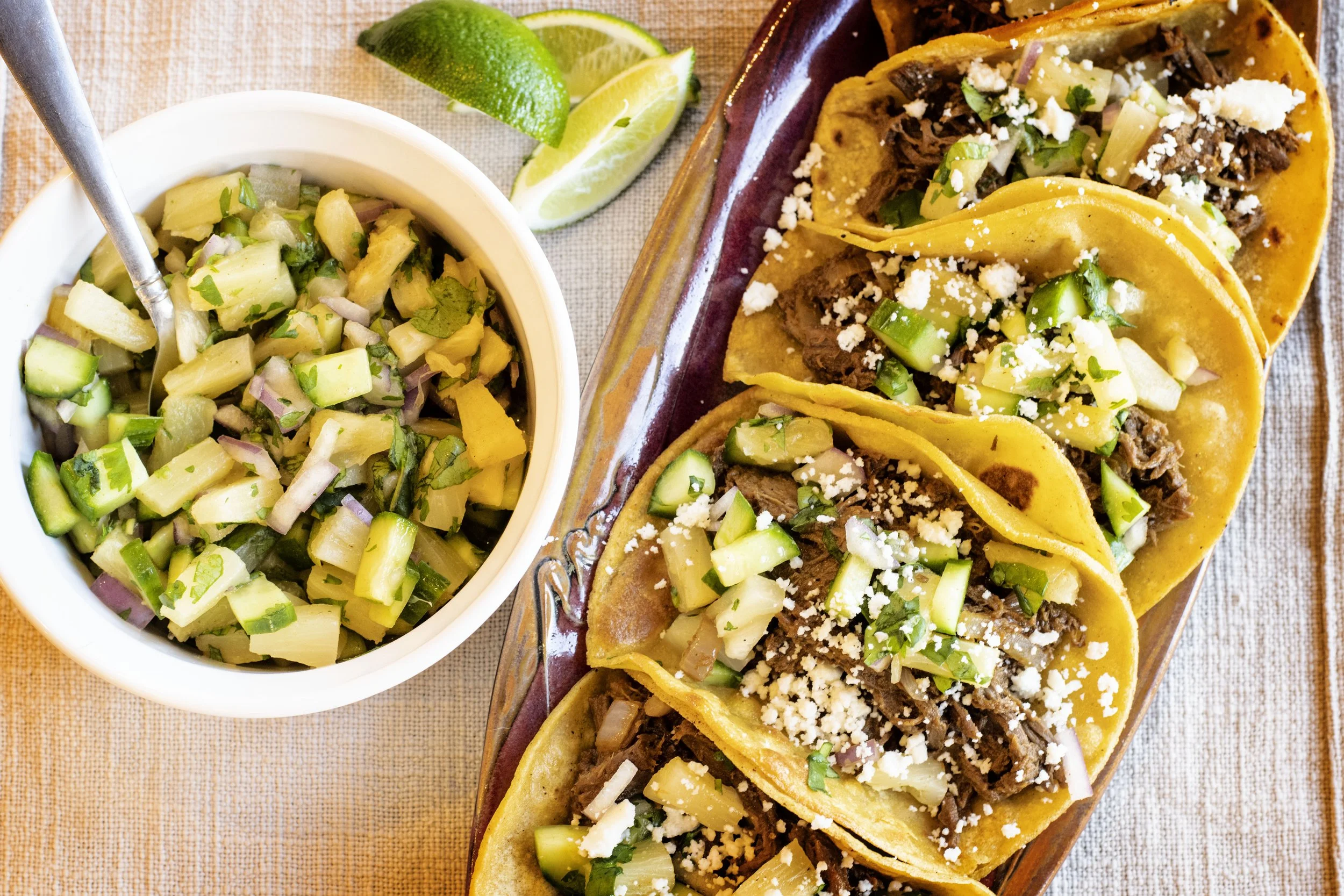
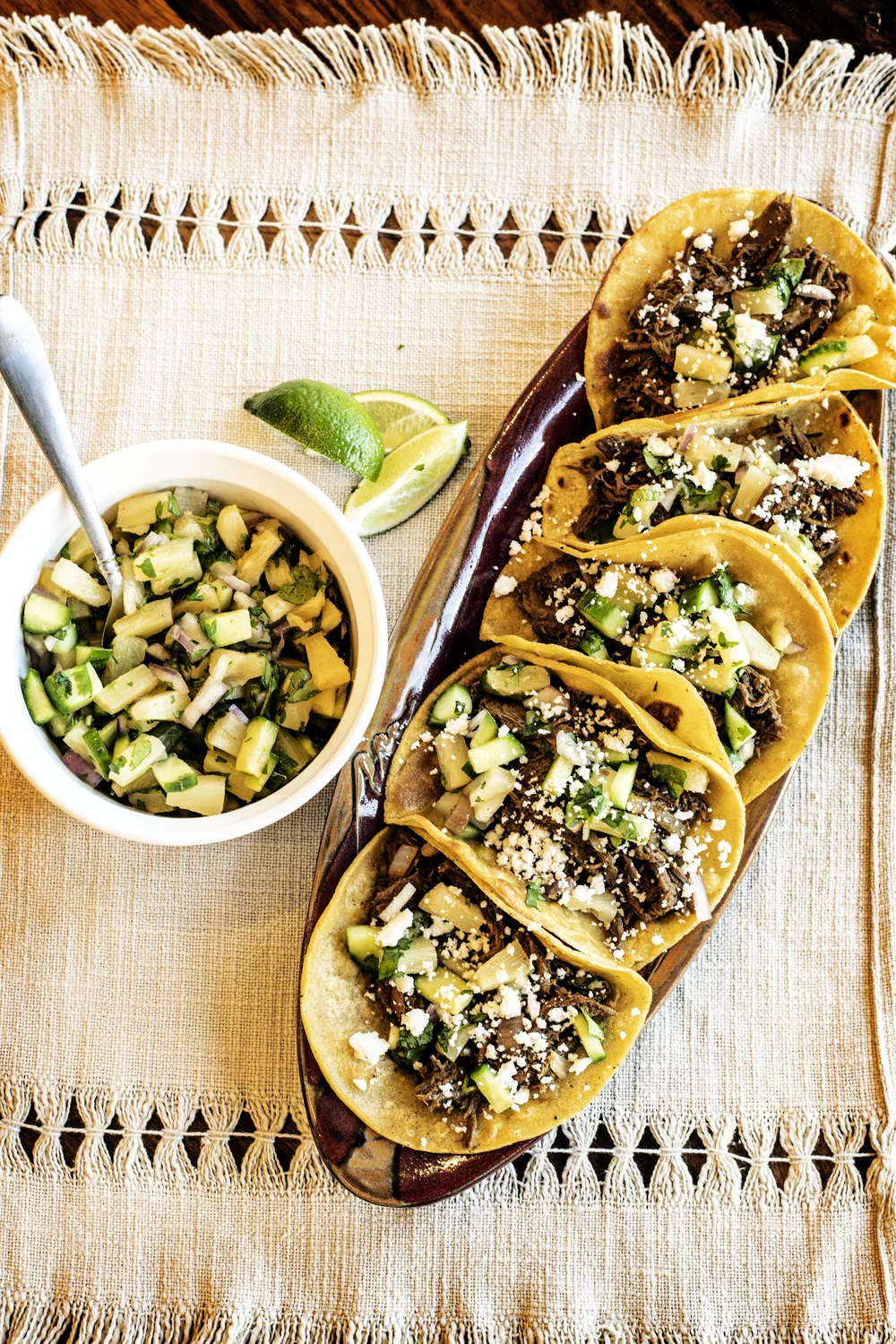
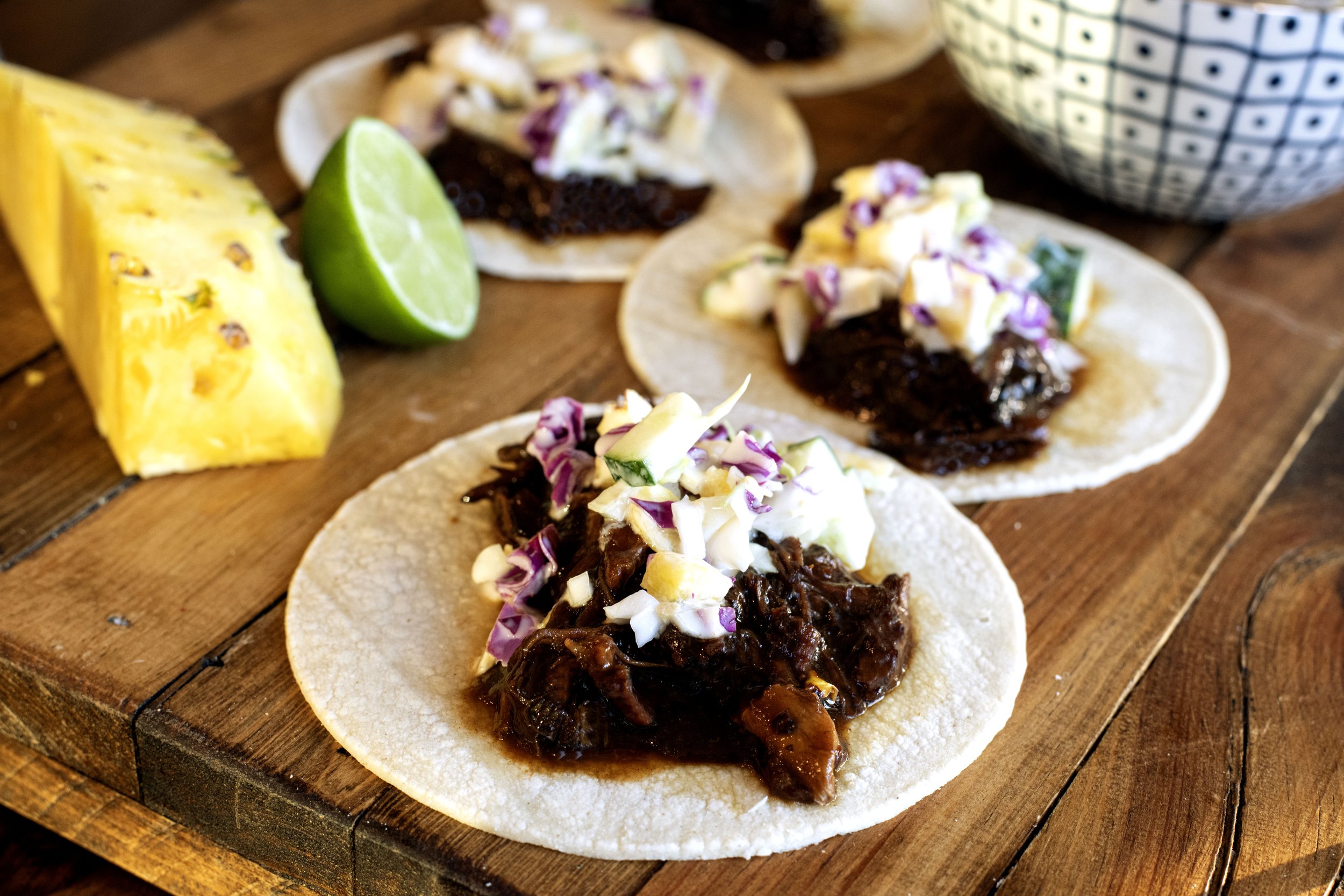
A plate of four tacos filled with apricot venison and served with a side of pineapple salsa

Pressure cooking the venison

Since this recipe calls for shredded meat, it is preferable to use a tougher cut of meat and break it down through slow cooking, or in this case pressure cooking, into a more tender, shredable form. I used a chuck roast, which comes from the heavily worked neck or shoulder region of the animal, and it is perfect shredded taco recipes.

Pressure cooking a large cut of meat is also an opportune time to engage in a little weekly meal prep. You can easily double the amount of meat and save plenty of venison for a second taco night with different toppings, a soup, or even some type of pulled venison sandwich. 

While there are many great pressure cookers on the market, I use a very basic model. I like it because there aren’t a ton of ways to screw things up. The settings are incredibly straightforward: sauté, high or low pressure cook, and warm. That’s it! If you want to check out the exact model I use, you can find it at this link: Pressure Cooker.

Cooking Instructions

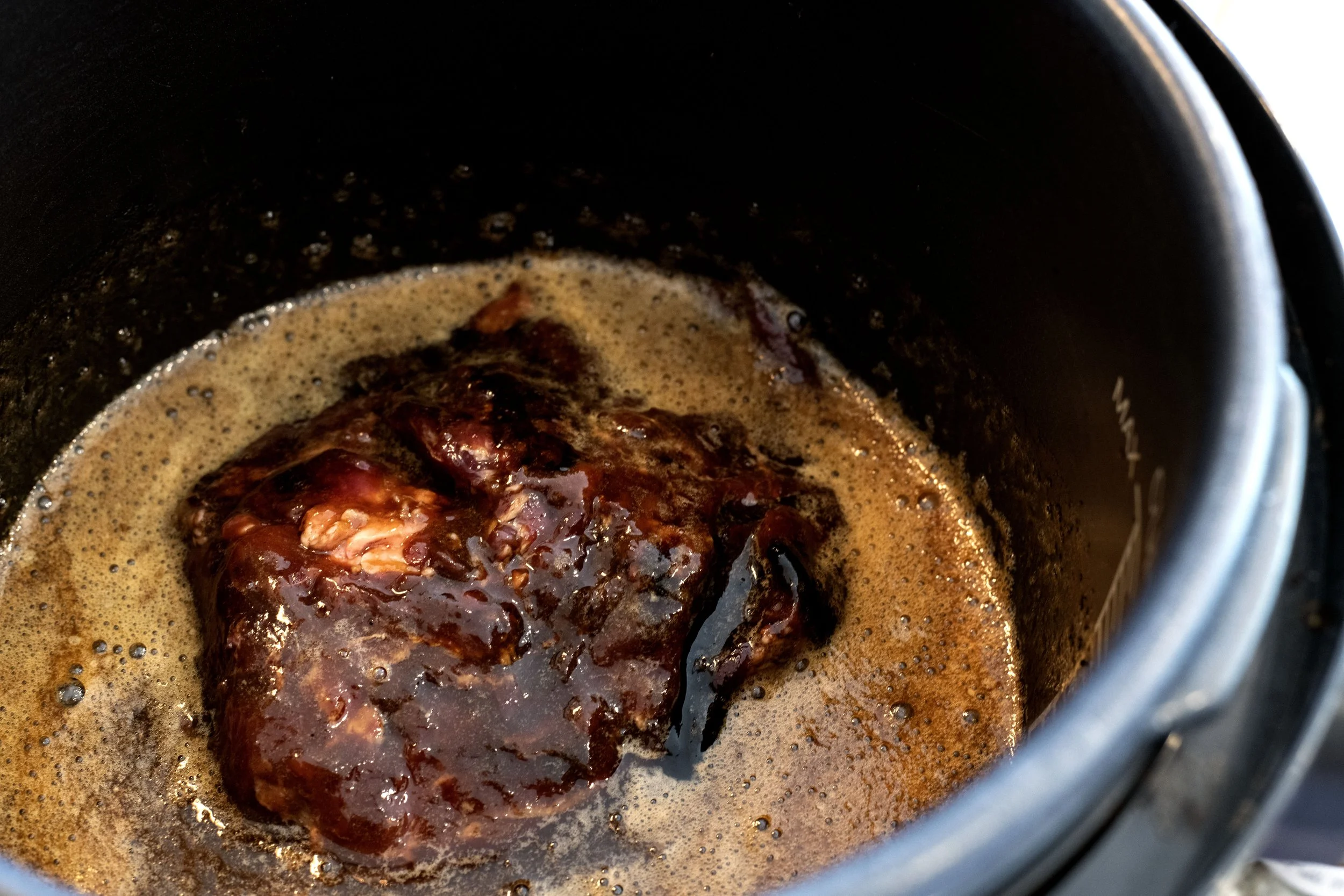
  1. Prep the meat: Roughly cut the roast into two-inch chunks. Consistency ensures the pieces cook evenly, but perfection is not required. Season the chunks with salt and pepper, then add them to the pressure cooker.

  2. Build the pressure: Pour a quart of vegetable stock over the meat. Close the lid and verify that the pressure release valve is securely set to the "sealing" position.

  3. Cook: Set the cooker to high pressure for 45 minutes.

  4. Release pressure: Once the timer goes off, allow the machine to naturally release its pressure for 15 minutes before manually opening the venting valve.

  5. Shred: After the cooker has fully depressurized, carefully open the lid and transfer the meat to a cutting board. Use two forks to shred the incredibly tender chunks into bite-sized pieces, then set them aside

Whipping Up the Apricot Venison Taco Meat

This taco meat concoction is best managed in a cast iron skillet. The heat is evenly distributed and the side walls are deep enough so mixing isn’t messy. Heat a tablespoon of cooking oil over medium high heat. I used an avocado oil because it can handle being heated to a higher temperature, but any high temperature oil will work. Great options include canola, vegetable, peanut, or coconut oil.

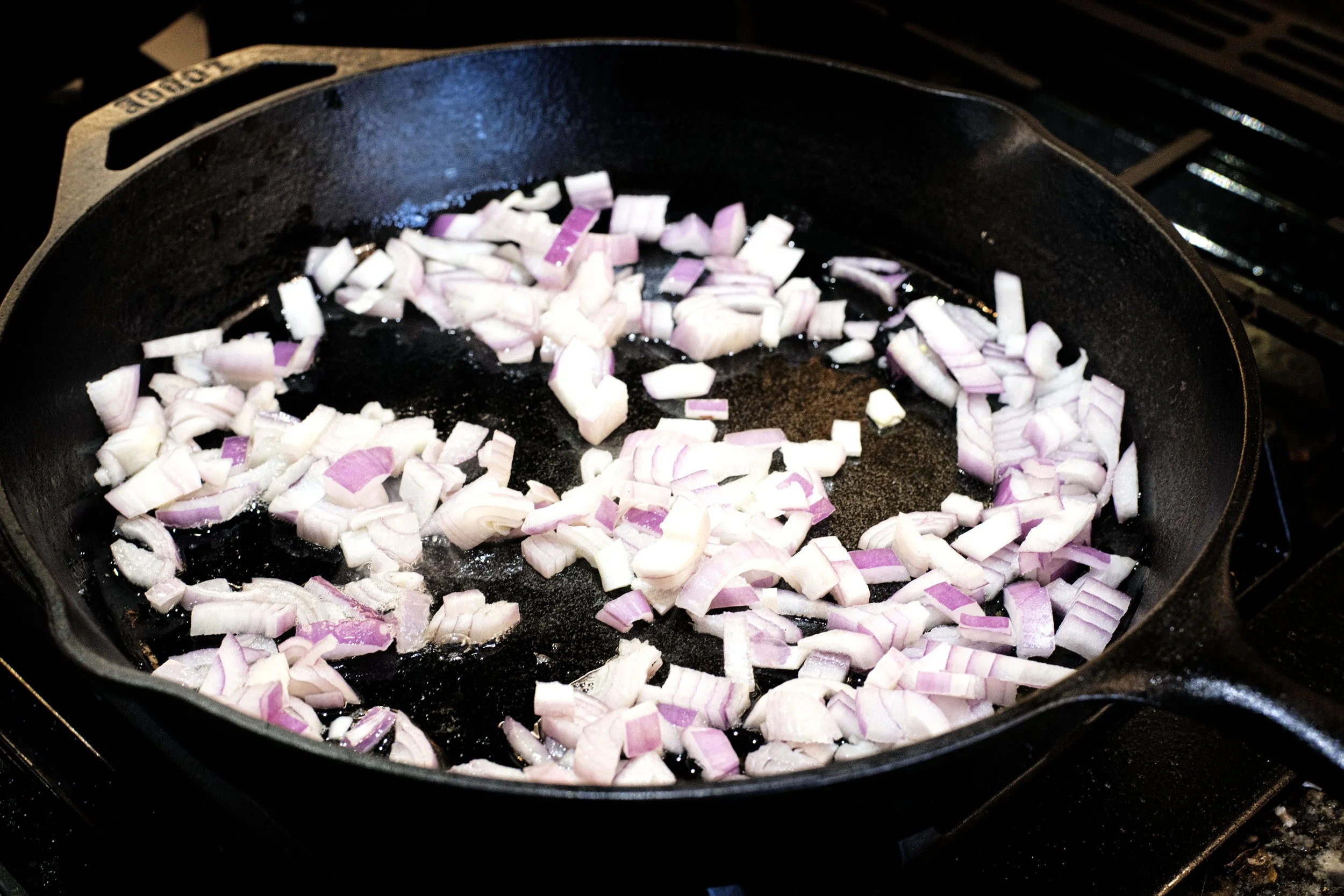
Add the diced red onion and minced shallot to the pan and saute for three minutes. The onions should start to soften. The shredded venison can make its entrance to the skillet at this point. Let the meat warm up a little and then pour the apricot juice into the pan.

Red Onions cooking in a cast iron skillet

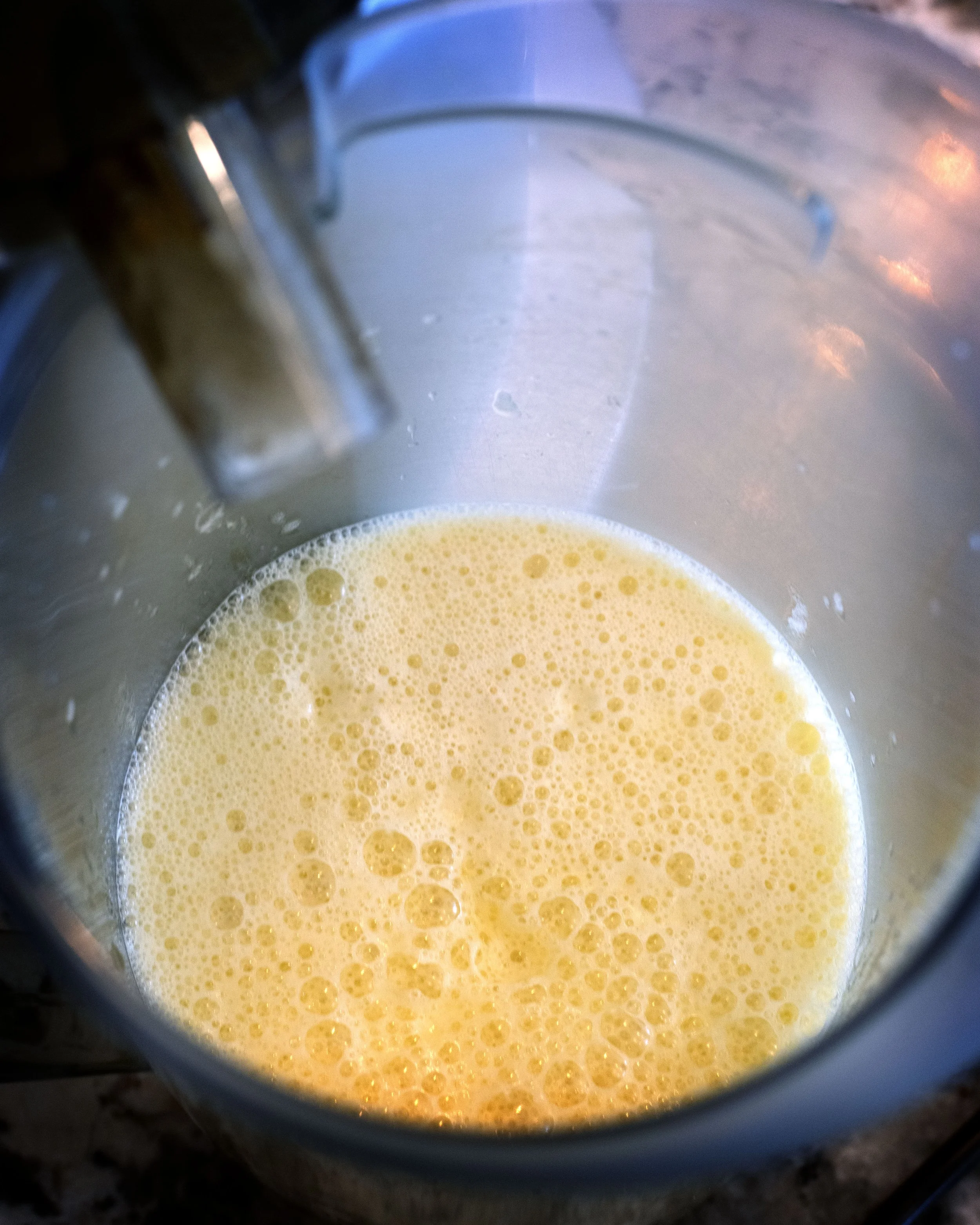
I harvest my own apricots for the juice in this recipe. Each summer, I pick bucketfuls of the vibrant round balls and process them through a juicer. I do a very quick and simple fruit processing with the following juicer: Breville Juicer

Quick Steps for Apricot Juicing

  1. Wash the fruit and remove all the pits.

  2. Run fruit through home juice processors. The fruit will be separated into juice and pulp. I reserve the pulp and use it to make breads or ice creams.

  3. Transfer the juice to quart mason jars and freeze for later use.

If you don’t have access to apricots for juicing, there are plenty of viable options at the supermarket. The juice will most likely be labeled as a nectar and be thinned with water, so it may require a little more time to use in the recipe, but it is still a great option. I would check for added sugar and try to find a product that doesn’t have any. 

Thoroughly stir the mixture once the juice has been added, scraping the bottom of the pan to remove any browned bits that have developed so far, and also coat the meat completely. Let the mixture simmer for five minutes.

Prepping the Pineapple Salsa

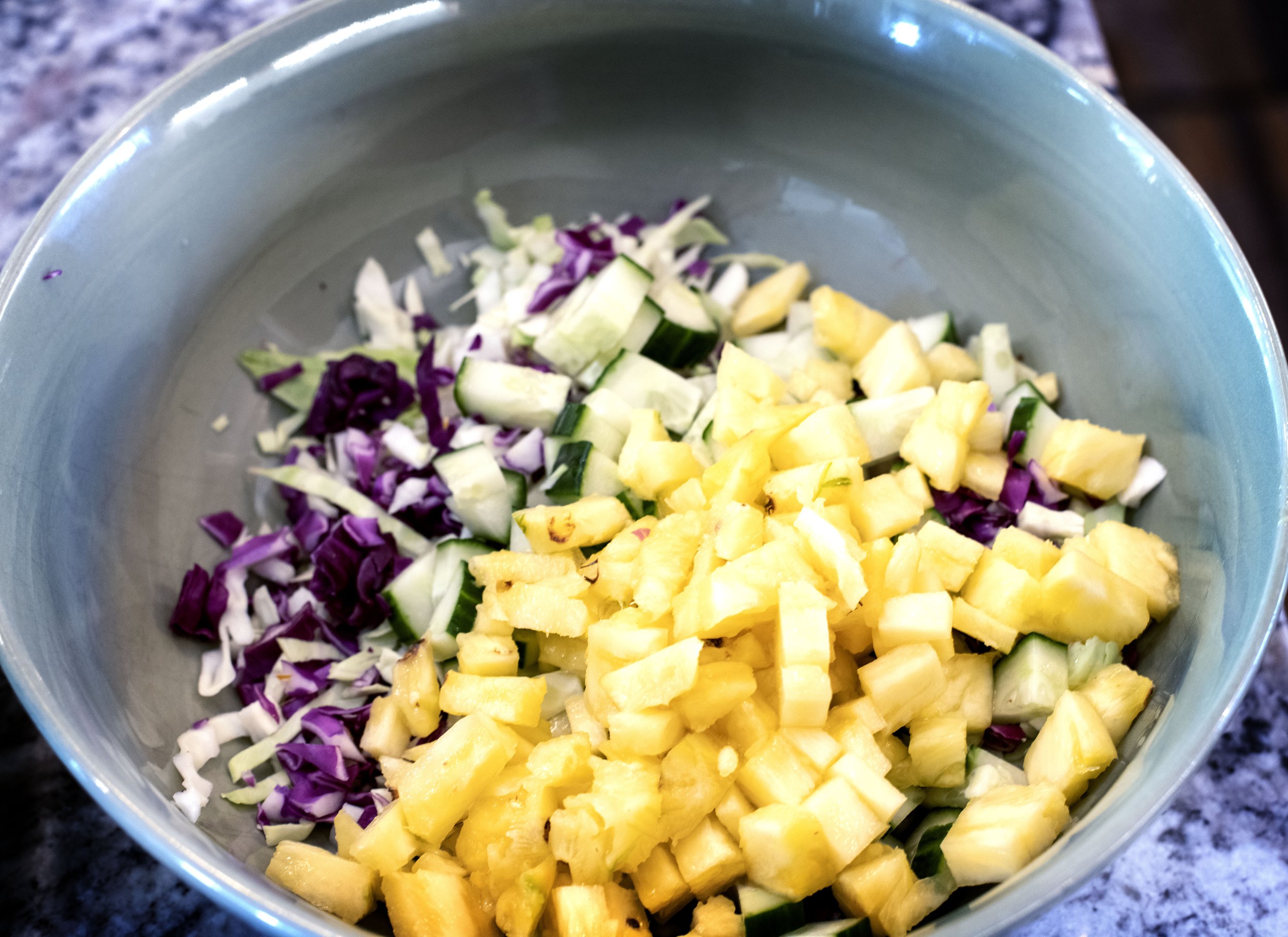
While your apricot juice is reducing, it’s time to knock out the pineapple salsa. This topping comes together fast, and it pairs beautifully with the rich apricot venison. The candy-sweet pineapple tidbits and crisp, cool cucumber bring a fresh crunch that cuts right through the tanginess of the apricots in a very tastebud pleasing way.

To get started on the salsa, dice your cucumber into tiny pieces—just a bit smaller than standard bite-size. Next, grab that remaining half of the large red onion you saved from the venison prep, and give it a fine dice, too. You want gentle hints of raw red onion here, not a sharp, biting chunk that overwhelms the whole palate.

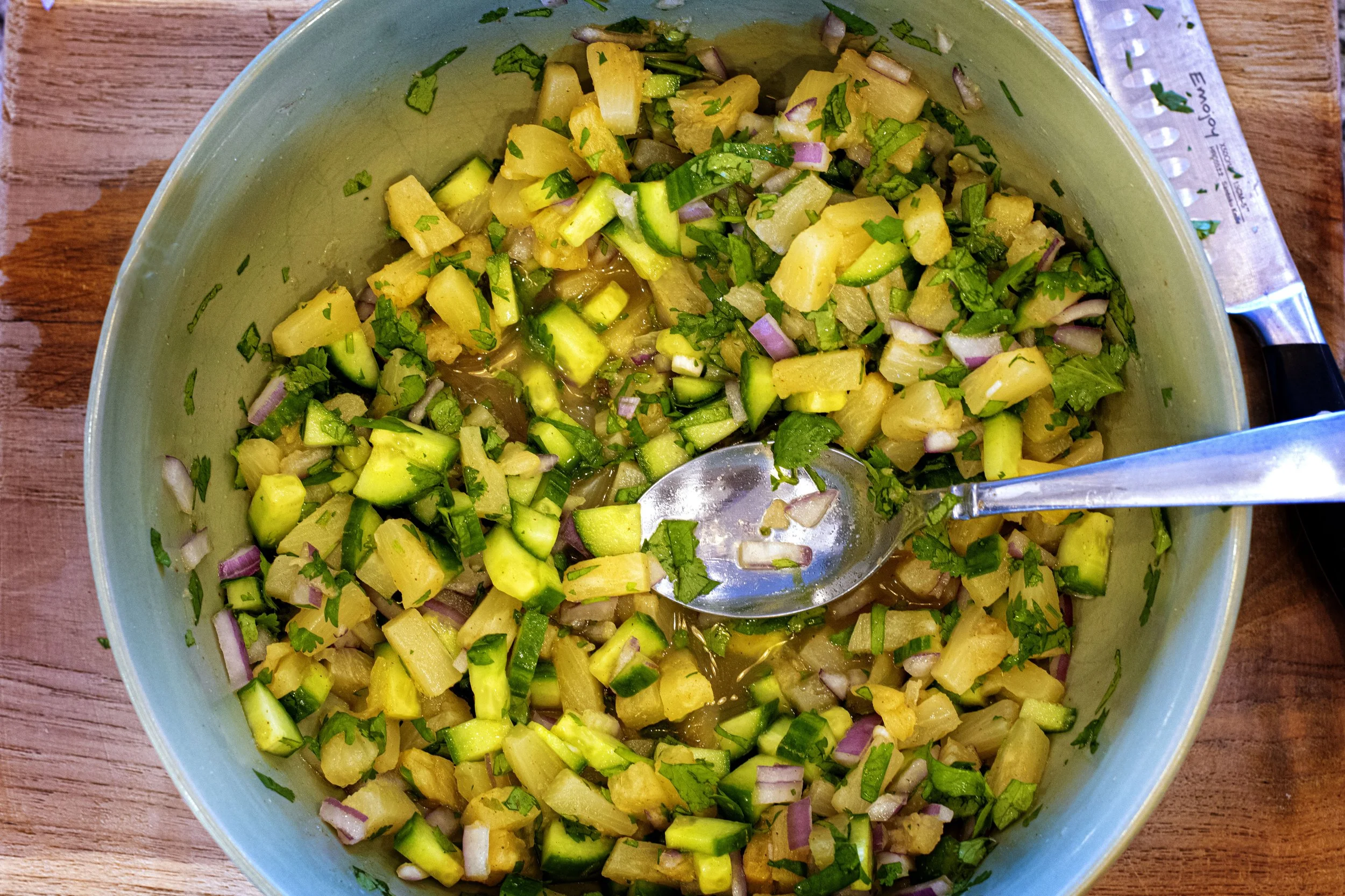
Bowl of fresh, crunchy, sweet pineapple salsa with cucumber, red onion, and cilantro.

Toss the drained pineapple tidbits, cucumber, and red onion into a small bowl. Season everything with a teaspoon of earthy ground cumin and a pinch of salt. Mince up your fresh cilantro, stir it in, and finish it all off with a generous squeeze of fresh lime juice. Give everything a good mix, then set it aside. Letting those flavors marinate for a few minutes while you finish up the taco meat is where the magic really happens.


Finishing and Assembling the Tacos

To finish up the taco meat, season the mixture with a bit of spicy chili powder, ground cumin, and earthy coriander. Let everything spend some quality time in the pan to develop and deepen in flavor. As it simmers, it creates a warm, comforting, and incredibly rich taco meat that is ready to hit those tortillas! 

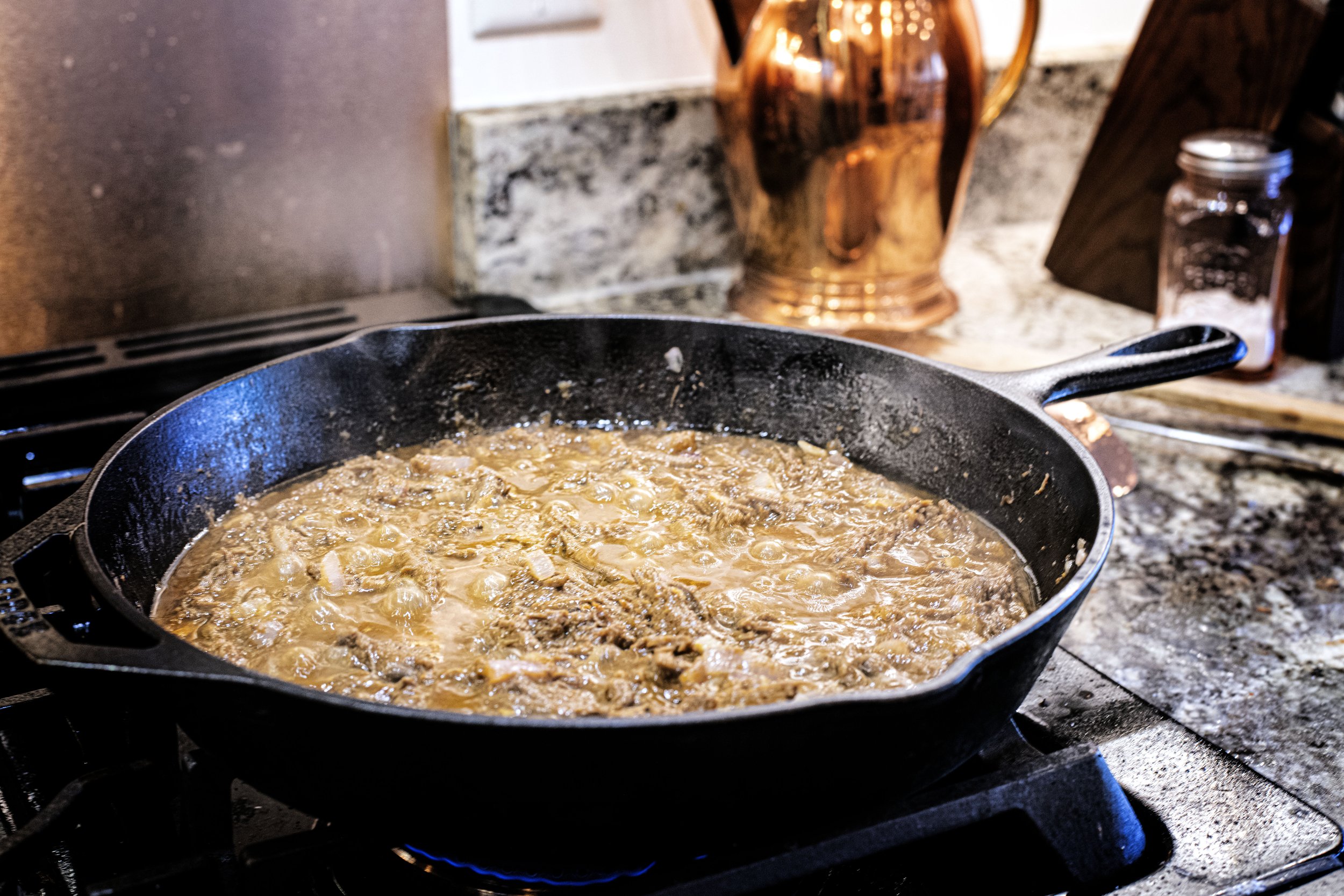
Cast iron skillet sits on the stove simmering apricot venison taco meat

Simmer the apricot venison meat for about five more minutes. While you wait, start heating the tortillas. Personally, I love to use corn tortillas for my tacos, but you can absolutely use flour—I promise not to judge too much! 

Heat a light dusting of oil in a small skillet over medium heat. Warm each tortilla for a minute or two per side until they are soft and pliable.

To assemble, add a very generous scoop of the apricot venison to a warm tortilla. Top it with a big spoonful of the pineapple salsa, making sure you get a bit of every component—the sweet pineapple, crisp cucumber, and sharp red onion—in every bite. Sprinkle some fresh, crumbled cotija cheese and an extra pinch of minced cilantro. Now all that's left to do is dig in and enjoy!

Happy Hunting!

Yield: 4-6
Author: a 12 Gauge Girl
Sweet and Savory: Apricot Venison Tacos with Pineapple Salsa

Sweet and Savory: Apricot Venison Tacos with Pineapple Salsa

Learn how to easily slow cook venison with sweet apricot for the most tender shredded tacos. Finished with a vibrant pineapple salsa that anyone can make!

Cook time: 1 H & 15 MTotal time: 1 H & 15 M

Ingredients

Apricot Taco Ingredients
  • One pound venison chuck roast
  • Quart vegetable stock
  • One tablespoon cooking oil
  • One half large red onion, finely chopped
  • Large shallot, minced
  • Two cups apricot juice
  • Two tablespoons chili powder
  • One tablespoon cumin
  • One teaspoon coriander
  • Salt to taste
  • Package corn tortillas
  • Cotija cheese
Pineapple Salsa Ingredients
  • One cucumber, diced
  • One half large red onion, finely chopped
  • One bunch fresh cilantro, chopped
  • One lime, juiced
  • One can (15 oz) pineapple tidbits, drained
  • One tsp cumin
  • Salt, to taste

Instructions

  1. Step 1: Pressure Cook the Venison
  2. Roughly cut the venison chuck roast into two inch chunks and season with salt and pepper. Add the seasoned meat and the quart of vegetable stock to your pressure cooker.
  3. Secure the lid and close the pressure release valve.
  4. Set the cooker to high pressure for 45 minutes.
  5. When the timer finishes, let the cooker naturally release for 15 minutes before venting any remaining steam.
  6. Transfer the venison to a cutting board and shred the meat using two forks.
  7. Step 2: Cook the Apricot Venison Taco Meat
  8. Heat the tablespoon of cooking oil in a large cast-iron skillet over medium-high heat.
  9. Add the diced red onion and minced shallot, sautéing for three minutes until softened.
  10. Stir the shredded venison into the skillet.
  11. Pour the two cups of apricot juice over the mixture and stir to evenly coat the meat.
  12. Bring the juice to a simmer for five minutes until it begins to thicken.
  13. Season with chili powder, cumin, coriander, and salt to taste.
  14. Continue reducing the mixture for an additional five minutes until the sauce coats the meat richly.
  15. Step 3: Prepare the Pineapple Salsa
  16. While the meat finishes thickening, grab a small bowl.
  17. Mix together the diced cucumber, finely chopped red onion, and drained pineapple tidbits.
  18. Add the minced fresh cilantro, sprinkle in the cumin and salt, and squeeze the fresh lime juice over the top.
  19. Stir well to coat everything evenly.
  20. Step 4: Assemble Tacos and Serve
  21. Warm the corn tortillas in a dry skillet (or with a splash of oil) until pliable.
  22. Place a generous scoop of the warm apricot venison filling onto each tortilla.
  23. Top with a spoonful of the fresh pineapple cucumber salsa.
  24. Finish with crumbled Cotija cheese and extra minced cilantro.
  25. Serve immediately with fresh lime wedges and jalapeño slices for heat.
  26. Enjoy and happy hunting!

Nutrition Facts

Calories

620

Fat (grams)

22 g

Carbs (grams)

82 g

Fiber (grams)

10 g

Protein (grams)

30 g

 Nutritional values are rough estimates based on standard ingredients and will vary depending on your specific cut of wild game, brands used, and actual serving sizes.
Did you make this recipe?
Tag @a12gaugegirl on instagram and hashtag it #huntingandcooking


Shredded Venison Tacos with Sweet Potato & Black Beans

I almost feel embarrassed disclosing how often I have tacos. It feels like an above-average amount, but maybe I’m wrong. Maybe everyone cooks tacos at least once a week at home, makes taco salad during that same week, and also visits Taco Bell the weekend of that same week they already had tacos at home in two different forms. And then, they also decide on Sunday morning that breakfast tacos sound like a must.

JUMP TO RECIPE

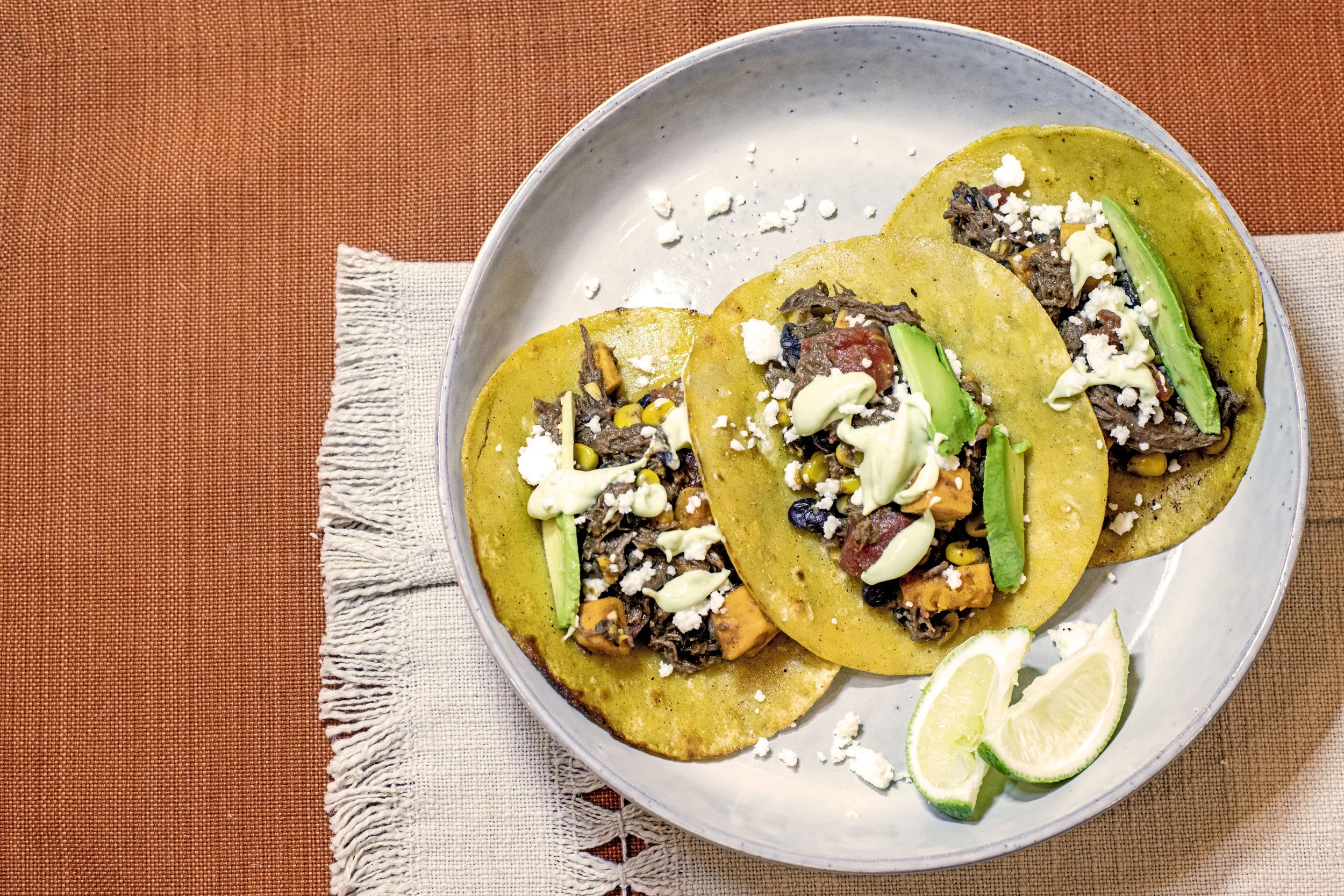
Plate of shredded venison tacos with sweet potatoes, black beans, corn and avocado crema.

How delicious is this plate of Venison Sweet Potato and Black Bean Tacos?

Tacos are my go-to meal, especially when the freezer is packed full of wild game. They just seem to lend themselves as the correct answer to any question. What should we make with this trout we just caught? Fish tacos! I wish I could think of a new way to prepare this pheasant—any ideas? Oh, how about adobo pheasant tacos! Man, I sure am feeling lazy and don’t want to cook—any ideas on a quick meal? Uh, duh, deer tacos!

See what I mean? Tacos are always the answer. And I can’t be the only one who knows it. We have nationwide celebrations dedicated to them! October 4th marks the official single day honoring the taco, but we also dedicate every single week to them with my favorite day: Taco Tuesday. So, if you’re interested in celebrating the taco every Tuesday like I am, I suggest you give this Venison, Sweet Potato, and Black Bean Taco dish a run in your kitchen.

Pressure cooking the venison

A tougher cut of meat is actually perfect for a shredded taco recipe. The generic term for this cut is a chuck roast, which comes from the heavily worked neck or shoulder region of the animal. Because the shoulder is a high-movement area, the meat is tough and packed with connective tissue. While these qualities are not desirable for a quick-cooking steak, they are absolutely ideal for slow-cooking methods that break down the fibers into tender, juicy taco meat.

For this recipe, I used my pressure cooker. I easily could have used a slow cooker—which is actually my preference for shredded meats— but I decided mid-day  instead of in the morning I wanted tacos. Since I didn't have the six to eight hours required for a low-and-slow braise, the pressure cooker saved the day.

Begin by roughly cutting the roast into two-inch chunks. Perfection isn’t required here, but keeping the pieces relatively consistent in size ensures they cook evenly. Season the chunks with a little salt and pepper, and add them to the pressure cooker. Pour a quart of vegetable stock over the top, close the lid, and make sure the pressure release valve is set to the sealing position.

Set the cooker to high pressure for 45 minutes. When the timer indicates that the cooking time is up, allow the machine to naturally release its pressure for 15 minutes before opening the venting valve. Once the cooker has fully depressurized, carefully open the lid and transfer the meat to a cutting board. The chunks should be incredibly tender and already starting to fall apart. Simply use two forks to shred the meat into bite-sized pieces, and set it aside.

Prep the Sweet Potatoes

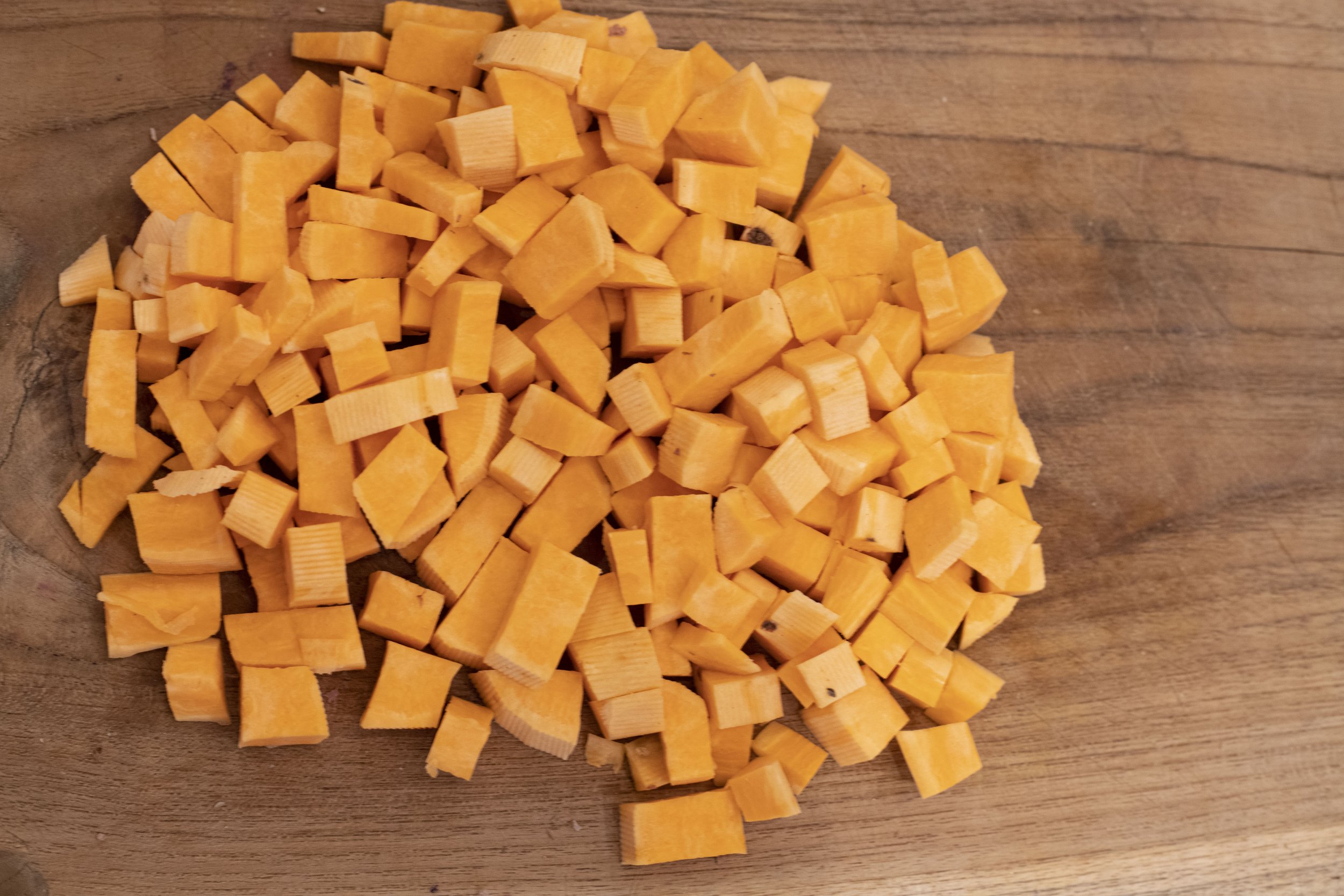
Chopped sweet potatoes for venison tacos

Heat a large skillet over medium-high heat. You will want to grab the biggest skillet you own, because between the shredded meat, sweet potatoes, and black beans, this makes a massive amount of taco filling!

Add a tablespoon of cooking oil to the skillet to preheat. I like to use avocado oil because it has a high smoke point, but other great options include canola oil, vegetable oil, or even rendered bear fat. Once the oil is hot, toss in your diced sweet potato. When prepping the sweet potato, try to keep the cubes relatively uniform in size so they all finish cooking at the same time.

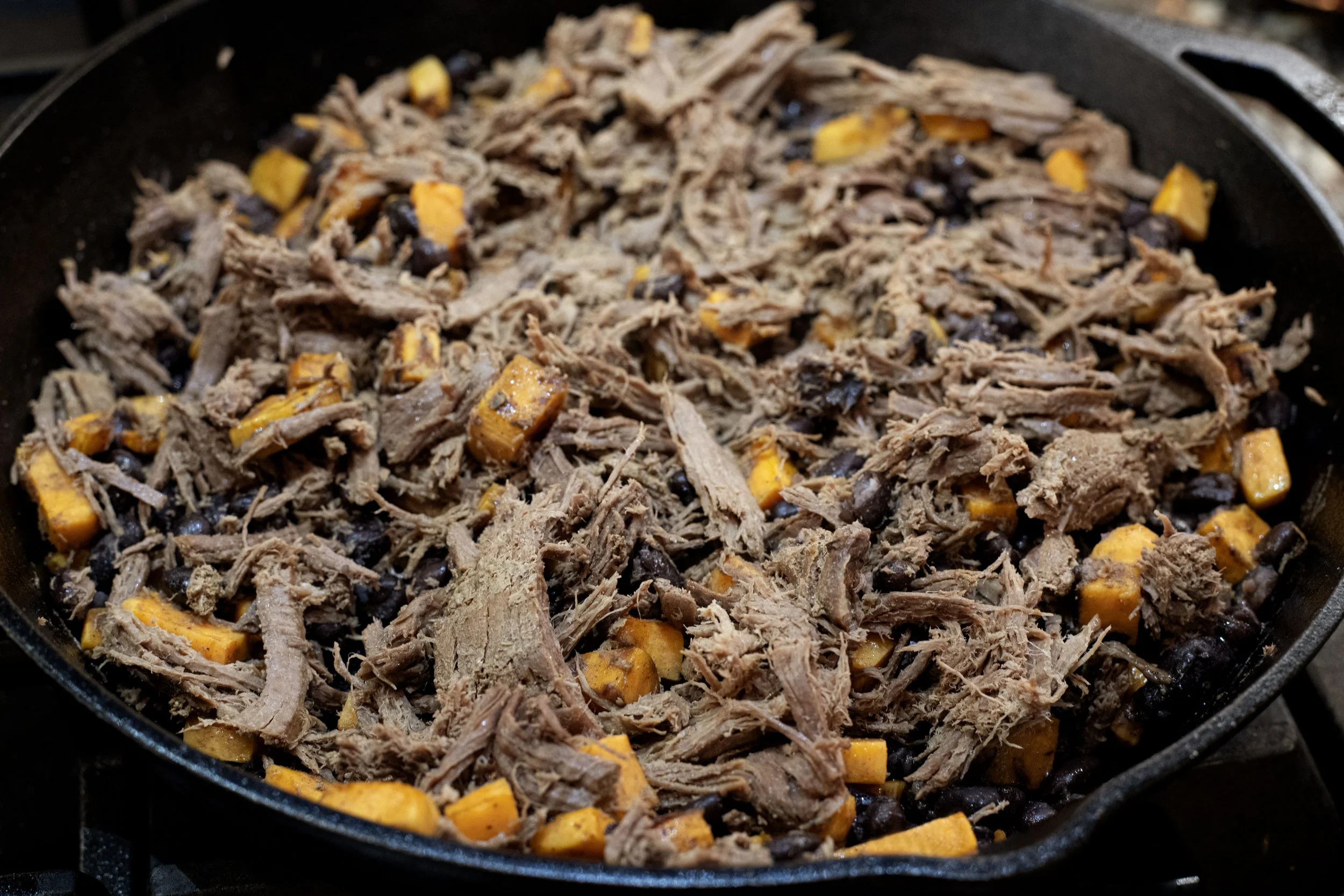
Let the sweet potatoes soften on their own for about five minutes before stirring in the drained black beans. After the beans and sweet potatoes have cooked together for about three minutes, slide your shredded venison into the mix. Things are starting to get good, huh?

Shredded venison meat over sweet potatoes and beans for tacos

Deglaze and season

I have a handful of cooking moments that I absolutely indulge in when the time comes. One is sautéing onions in butter. It smells so good that every single time, I spend a few zen moments just breathing in the sweet steam. A second one is deglazing a pan. I have no preference on the liquid—whether it’s beer, wine, stock, or water—I just love the sound of the cool liquid clashing against the hot pan and watching as it bursts into tiny, simmering bubbles.

Anyway, not to get too far off-topic here, but the next step is to use a can of beer to deglaze your skillet. The actual beer choice is up to the chef. I highly recommend a crisp lager, but really whatever you have on hand will work. If you prefer not to cook with alcohol, some chicken or vegetable stock will do the job perfectly. Pour it in, and be sure to use a spatula to scrape the bottom of the pan for any browned goodies left over from the potatoes or beans.

Once deglazed, season the taco mixture with the tomato paste, cumin, and chili powder. Let the beer simmer for about three to five minutes, or until the liquid has reduced by half.

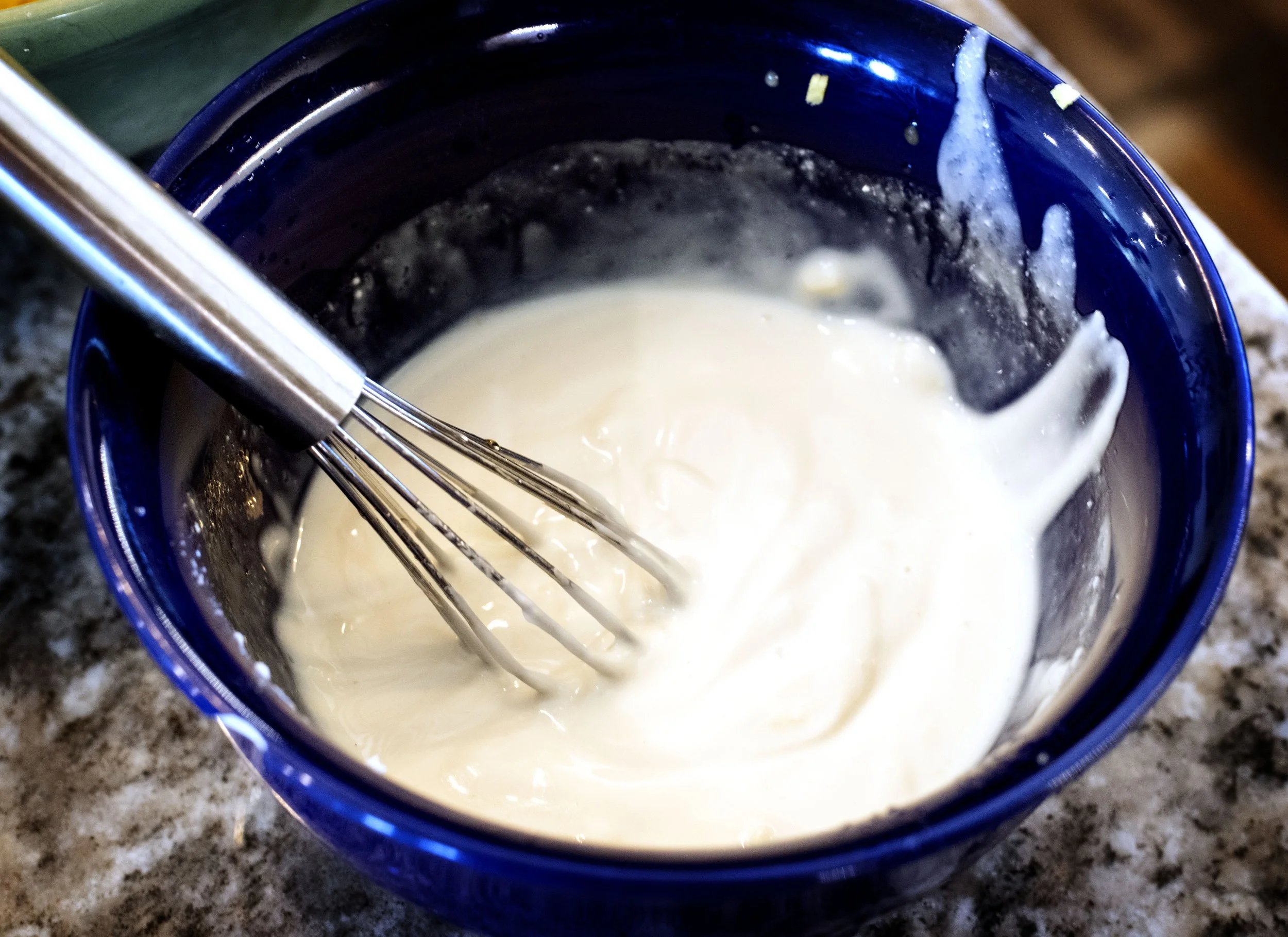
While the beer is reducing, you can multi-task by prepping the avocado crema. Using a fork, smash your avocado into a smooth mash. Transfer it to a small bowl and mix vigorously with the Mexican crema. Sour cream or even plain Greek yogurt will also work beautifully here. Add the juice of one lime, a pinch of cumin, and a little chili powder. Whisk everything together into a smooth sauce and set it aside for plating.

Another quick task to knock out during the reduction phase is charring the corn. To remove the kernels from the cob, I use a handy trick I saw on a cooking show. Place a small bowl upside down inside a much larger bowl. Use the "island" created by the bottom of the smaller bowl to stand your corn cob upright. Then, simply run your knife down the sides of the cob; the kernels will fall safely into the larger bowl for mess-free collection. Toss the kernels into a separate small skillet over medium-high heat and char them for a few minutes, taking care to stir often so they don't burn.

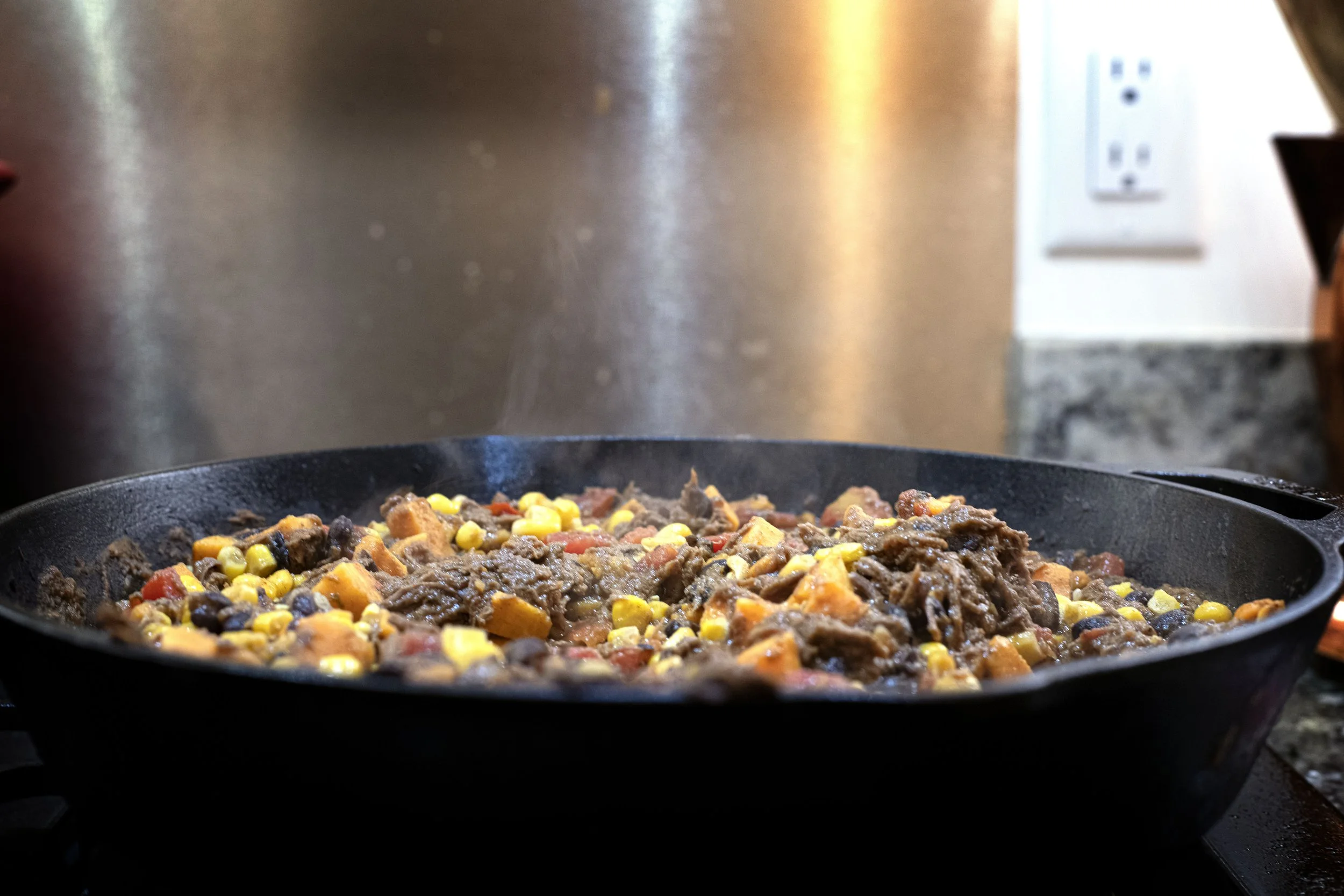
Once the beer in your main skillet has sufficiently reduced, stir in the can of roasted diced tomatoes and your beautifully charred corn. Cook for three minutes more, and just like that, your taco meat is ready to go!

Venison taco meat in skillet ready for plating

Assembly Time

When it comes to serving these tacos, a proper delivery vessel is required—which means it is time to warm up a few tortillas. I always prefer corn tortillas for my tacos, but you can absolutely use flour if you prefer (and I promise not to judge you too much!).

Wipe out that small skillet you just used to char the corn, add a light dusting of cooking oil, and set it over medium heat. Warm each tortilla for a minute or two per side until soft and pliable.

To plate, pile a generous scoop of the venison, sweet potato, and bean mixture right into the center of your warm tortilla. While garnishes are always a personal decision, I found that crumbled cotija cheese, freshly minced cilantro, and a couple of thin slices of fresh avocado pair beautifully with the flavors in the meat. Drizzle your homemade avocado crema over the top, finish it all off with a bright squeeze of fresh lime juice, and enjoy!

Venison Sweet Potato Taco

Venison Sweet Potato Taco

Yield: 4-6
Author: a 12 Gauge Girl
Cook time: 1 H & 20 MTotal time: 1 H & 20 M

Try these Venison Sweet Potato Tacos with black beans, charred corn, and avocado crema. A fast pressure cooker meal with slow-roasted flavor!

Ingredients

Ingredients Venison Sweet Potato Tacos
  • One pound venison chuck roast
  • Quart vegetable stock
  • One tablespoon avocado oil
  • One large sweet potato, peeled and diced into 1” pieces
  • One can (15oz) can black beans
  • One can lager beer
  • One tablespoon tomato paste
  • Two teaspoons cumin
  • Two tablespoons chili powder
  • One can (14.5oz) roasted diced tomatoes
  • Two ears sweet corn, kernels removed from cob (can be substituted for a 15oz can of corn)
  • Salt and pepper
  • Corn tortillas
  • Garnishes: cotija cheese, avocado slices, minced cilantro, lime wedges, diced jalapeno
Ingredients Avocado Crema
  • One avocado
  • ½ cup crema
  • Juice one lime
  • One teaspoon cumin
  • Salt and pepper

Instructions

  1. Step 1: Pressure Cook the Venison
  2. Roughly cut the venison chuck roast into two inch chunks and season with salt and pepper. Add the seasoned venison chunks and quart of vegetable stock to the pressure cooker.
  3. Secure pressure cooker lid and ensure pressure release valve is closed. Set cooker to high pressure for 45 minutes.
  4. Once the timer goes off, allow pressure cooker to naturally release for 15 minutes before turning the pressure valve to venting. Once fully released, transfer venison to a cutting board and shred meat using two forks.
  5. Step 2: Prep the Sweet Potatoes
  6. Heat a large skillet over medium-high heat with a tablespoon of cooking oil. Once heated, add the diced sweet potato chunks and cook for five minutes.
  7. Drain liquid from the can of black beans and then add beans to the skillet and cook for three minutes.
  8. Add shredded venison to the sweet potato and bean mixture and continue to heat for three more minutes.
  9. Step 3: Deglaze and Season
  10. Deglaze the skillet with the beer and let liquid reduce by half, or about three to five more minutes.
  11. Meanwhile: While the beer is reducing, remove the sweet corn kernels from the cob and lightly toast for three to five minutes over medium heat in a small skillet. Be sure to stir the corn kernels often to prevent burning.
  12. Season the meat mixture by mixing in the tomato paste, cumin, and chili powder.
  13. Add the can of roasted diced tomatoes and simmer the mixture for three more minutes.
  14. Add the corn to the venison and sweet potato mixture. Stir and let warm for a few minutes.
  15. Step 4: Make the Avocado Crema
  16. Make the avocado crema in a small bowl. Mash the avocado with a fork. Mix avocado together with the crema, juice from a lime, a teaspoon of cumin and salt to taste.
  17. Step 5: Assemble and Serve
  18. Lightly warm the corn tortillas in a dry skillet or with a splash of oil, if desired.
  19. Place a generous scoop of the venison and sweet potato filling onto each warmed tortilla.
  20. Drizzle with the homemade avocado crema.
  21. Top with additional fresh avocado slices, crumbled cotija cheese, and minced cilantro.
  22. Serve immediately with fresh lime wedges and optional jalapeño slices for heat. Enjoy and happy hunting!

Nutrition Facts

Calories

687

Fat (grams)

31 g

Carbs (grams)

68 g

Fiber (grams)

18 g

Protein (grams)

36 g

 Nutritional values are rough estimates based on standard ingredients and will vary depending on your specific cut of wild game, brands used, and actual serving sizes.
Did you make this recipe?
Tag @a12gaugegirl on instagram and hashtag it #huntingandcooking

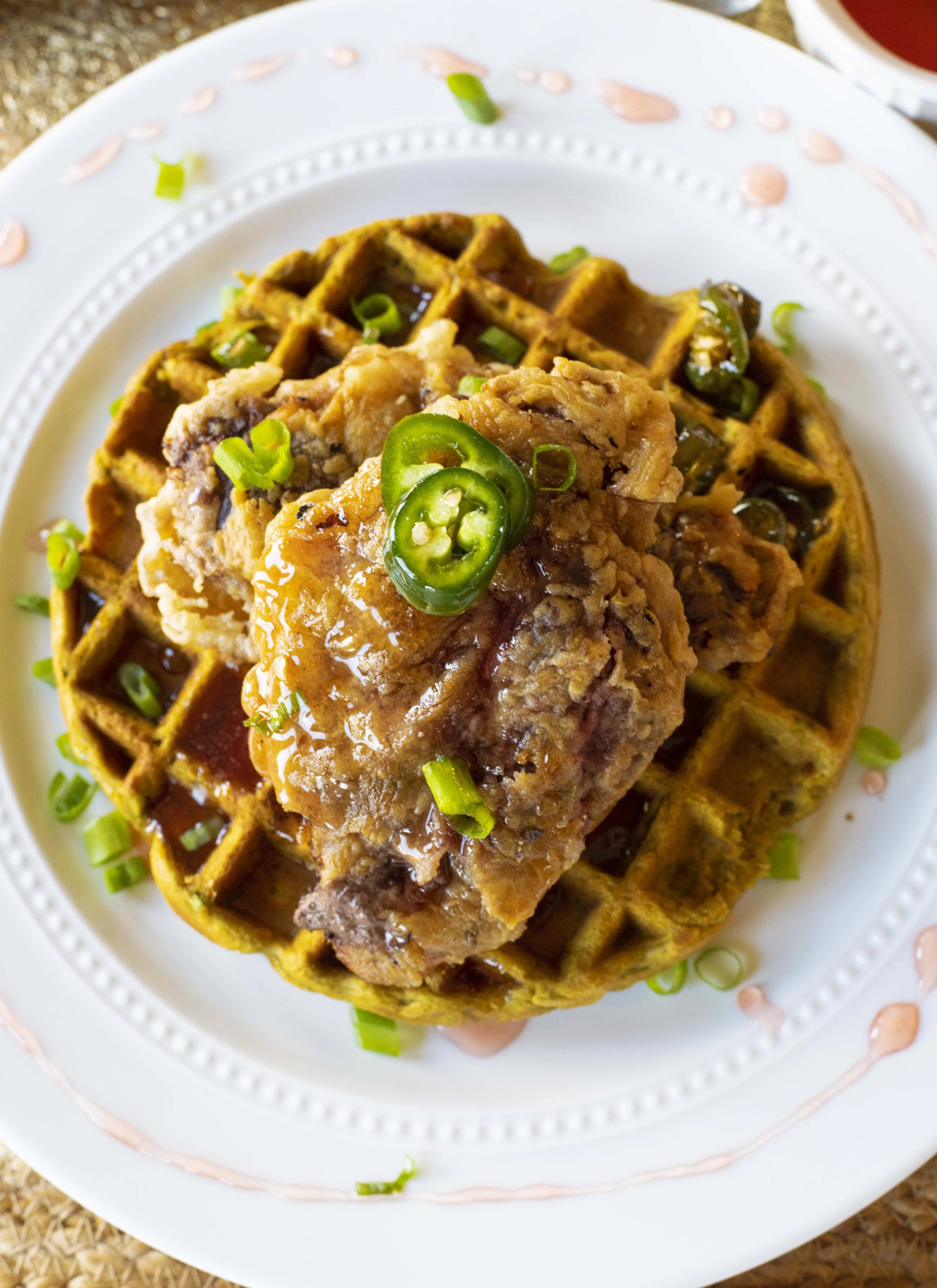
Fried Sage Grouse with Blue Corn Waffles and Hot Chokecherry Honey

Fried Sage Grouse with Blue Corn Waffles and Hot Chokecherry Honey

Create a fun twist on a brunch classic with these fried sage grouse and pumpkin blue corn waffles. Crispy crunchy sage grouse cutlets sit over a savory pumpkin and blue corn waffles filled with green onions and jalapeno bites. The entire thing is drizzled in spicy and sweet chokecherry honey.
Pheasant Marsala Meatballs

"You can't teach an old dog new tricks," everyone has heard the saying. Normally I tend to agree. I have a thirteen-year-old yellow lab and she has no desire to even perform her old tricks, much less learn any new ones! I do have an exception to the rule though. Sienna is my seven-year-old chocolate lab. She is a typical lab: likes to eat no matter the time of day or if she just finished eating, hyper, puppy-like attitude complete with chewing on random objects. Once she chewed the end off a highlighter and pulled the marker out. She proceeded to draw on the bedspread. My niece was blamed, until the empty highlighter casing was found with suspicious chew marks.  Potty trained is an inconsistent term for her even though she appears to know better, and birds are an obsession. Now, while birds are an obsession, actually participating in a bird hunt as a contributing party member was not a strong point for Sienna. She contributed mostly headache.

JUMP TO RECIPE

Sienna is a very obedient animal; however, while she aims to please, she is not the brightest. She spends her time trying to figure out what you want from her, which results in her usually sitting at, or more accurately on, your feet, staring at you as you trip over her, waiting for a command that she most likely does not understand. So, while bird hunting, Sienna spends her time on your feet and staring. I have tried getting her off my feet with, "Go get the bird!" Her ears perk a little and her head will drop to the side, almost posing a question. Sometimes she will even throw out an enthusiastic bark. But she immediately returns to sitting and staring in confusion. Definitely not a bird dog.

Sienna's time on hunts for the last six years has been spent trudging along on the heels of anyone who hasn't been annoyed by how closely she follows. She occasionally sniffs bushes, but I think it has mostly been because she seems to like sweet smells. She occasionally perks her ears when a gun is fired. Every once in awhile she will watch a bird fall from the sky, rush to its location, give if a good sniff, and come trotting back to your heels, tongue dragging but not much else. Definitely not a bird dog.

After six entirely worthless bird hunting seasons, Sienna the seven-year-old lab, which is the age veterinarians recommend switching your dog to geriatric dog food, decided to learn a new trick. She decided to become a bird dog. I don't know why, and I am not sure how she learned it, but she did it. Opening morning of the pheasant season, Sienna hoped out of her kennel, put her nose to the ground, and actually jumped a bird. No one shot it of course because that had never happened before and no one was prepared. She spent the rest of the day tracking down roosters, jumping, and even retrieving them (that's her in the picture). I still can't explain it, except for to say never write off an old dog for a new trick.

As for the recipe, I have not worked a ton with pheasant, but I get really excited every time I get the opportunity. Pheasant populations in Utah have been very low for quite a few years, but have been making a strong comeback for the past two years. Typically, I batter the breasts in a salty cracker and deep fry it, kind of a like a twist on fried chicken. After having such an abundant harvest this season, I have really been experimenting with some new recipes.

This recipe is a twist on chicken marsala, which is an Italian-based dish of chicken pieces covered in a Marsala wine and mushroom sauce. Instead of using chicken cutlets, I made up some ground pheasant meatballs and served them in a Marsala wine sauce. To start, turn on the oven broiler and put the pheasant, fat included although there probably won't be much, through a meat grinder. I purchased an inexpensive meat grinder last year, and it has been worth every penny.  I use it all the time to make my own elk burger, breakfast sausage, and ground turkey and now pheasant. I used the pheasant breasts for this recipe, but you could use the thigh meat as well. Anyway, after the pheasant has run through the processor it is time to create the meatballs.

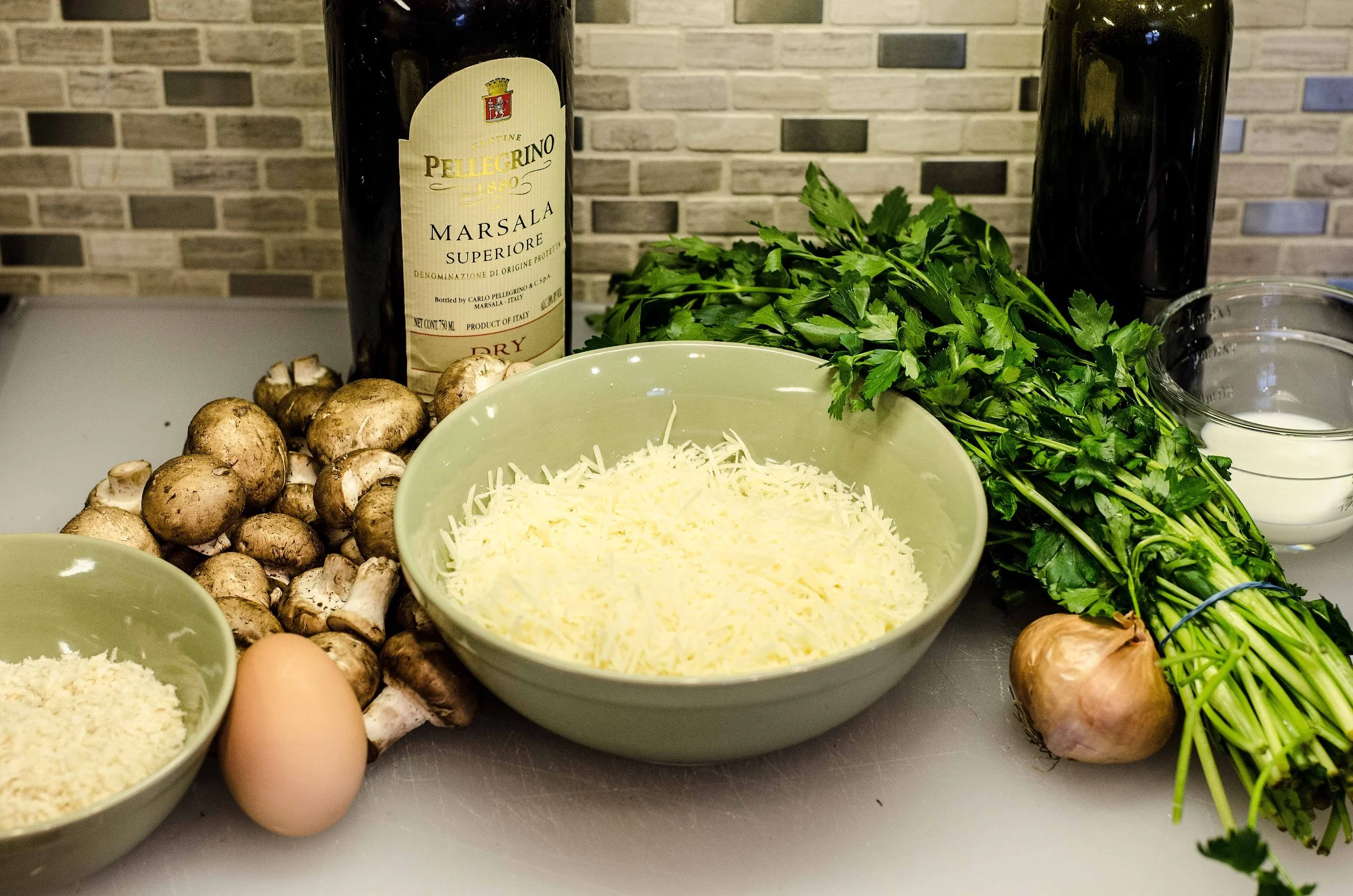
In a large bowl, add the pheasant, panko bread crumbs, cheese, parsley, ground nutmeg, salt, pepper, milk, and egg. Using your hands, really work everything together to ensure that every meatball will have a taste of each ingredient. In case you don't have panko bread crumbs, you can always use Italian or plain bread crumbs. You could also just tear up some old bread and work that in as well. The crumbs are just there to give some substance to the meat mixture. Also, if you don't have pecorino cheese, or you don't want to spend the money on it because it is more expensive than some of the other cheeses available, you can add parmesan or Romano. This recipe would also work well with shredded mozzarella cheese.

Before I continue, I have to make a comment about these meatballs. Normally I don't think about raw meat as I am mixing it. I kind of just put my hands in, mash things around, and use the time to day dream. However, this time the aromas from the mixture caught my attention. I will admit, I usually skip on adding parsley to things. I don't think it has much flavor, and have always considered it a garnishment rather than an actual ingredient. I think this recipe changed my mind. The parsley mixed with the hint of nutmeg and the cheese smelled really fresh and actually got me even more excited for dinner. Just an observation, and I would be curious if anyone else experiences this when they work with fresh parsley?

Anyway, Roll the meat into balls about the size of your palm. Place them on a baking sheet coated with a little bit of oil. For easier clean-up, I lined my sheet with aluminum foil too. Put the meatballs under the broiler for five minutes. Set yourself a timer for these meatballs! Pheasant, like most wild game, is a very lean meat. It is much leaner than chicken or turkey you buy at the store. These meatballs will dry out much quicker than store bought meat, and then you will be sad because you are eating a dry meatball. Nobody likes a dry meatball! So, set the timer for five minutes and pull the tray out. At this point, don't worry about if the meatballs are cooked all the way through because they will actually finish cooking in the marsala sauce.

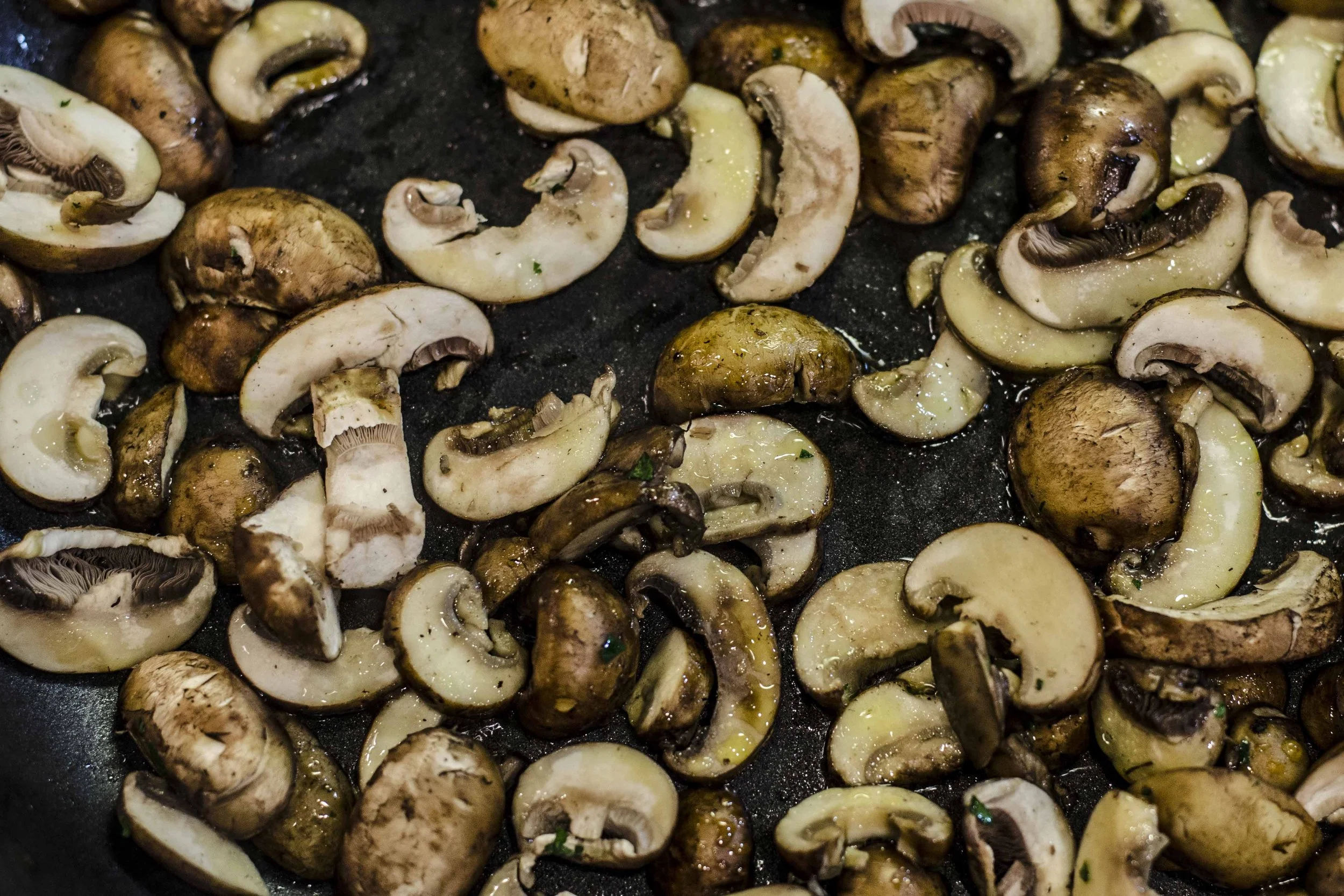
While your meatballs are browning, place the mushrooms in a preheated pan with some olive oil. Allow the mushrooms to brown for about five minutes. I used cremini mushrooms this time, but I think next time I will use baby portabellas. The creminis were perfectly fine in this sauce, I just happen to prefer baby portabellas to all other mushrooms and I only mentioned it to show that you can substitute different kinds of mushrooms for the this sauce. After the mushrooms have browned, add the minced shallot and cook an additional two to three minutes.

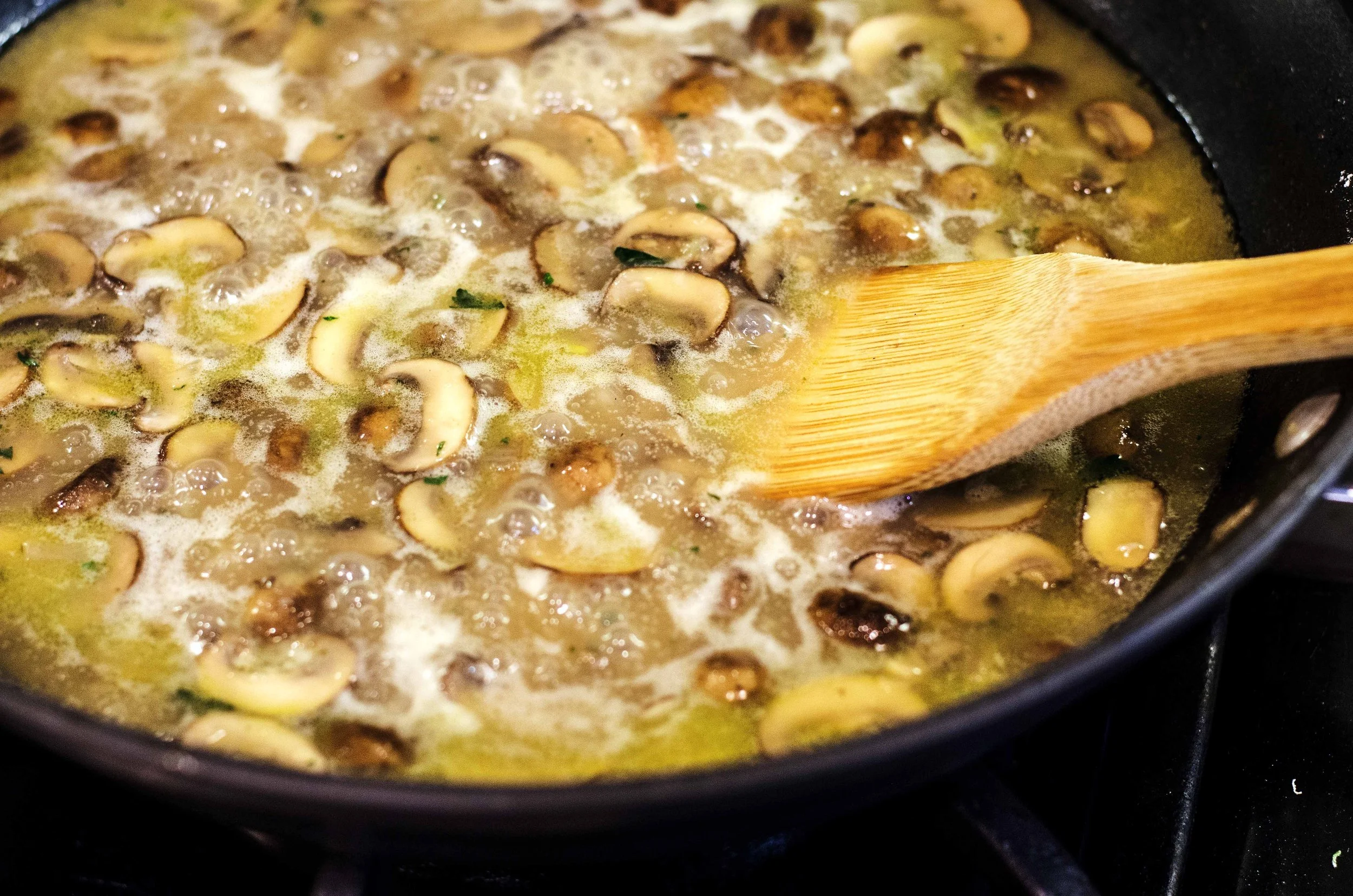
While browning the mushrooms, the burner should be on a medium-high heat. At this point, drop the heat down a bit to around medium and sprinkle the flour over the mushrooms. Pour in the remaining olive oil and start whisking the flour around the pan. Slowly add the marsala wine and continue whisking until you have a very smooth almost paste in the pan. This paste will act as the thickening agent for the sauce. Cook the flour and wine mixture for a minute or two to remove the flour taste, and then start adding the chicken broth. Continue whisking the entire time. I always get a bit scared when I try to thicken sauces. I think this fear comes from cream sauces, because if you do not continue stirring or if the heat is wrong the sauce will break and your cream will separate into chunky gross things and thin liquid that resembles the sauce you were trying to accomplish. Stock based sauces like this one are a little bit easier. The trick is to just keep stirring, and not freak out, as I tend to do.

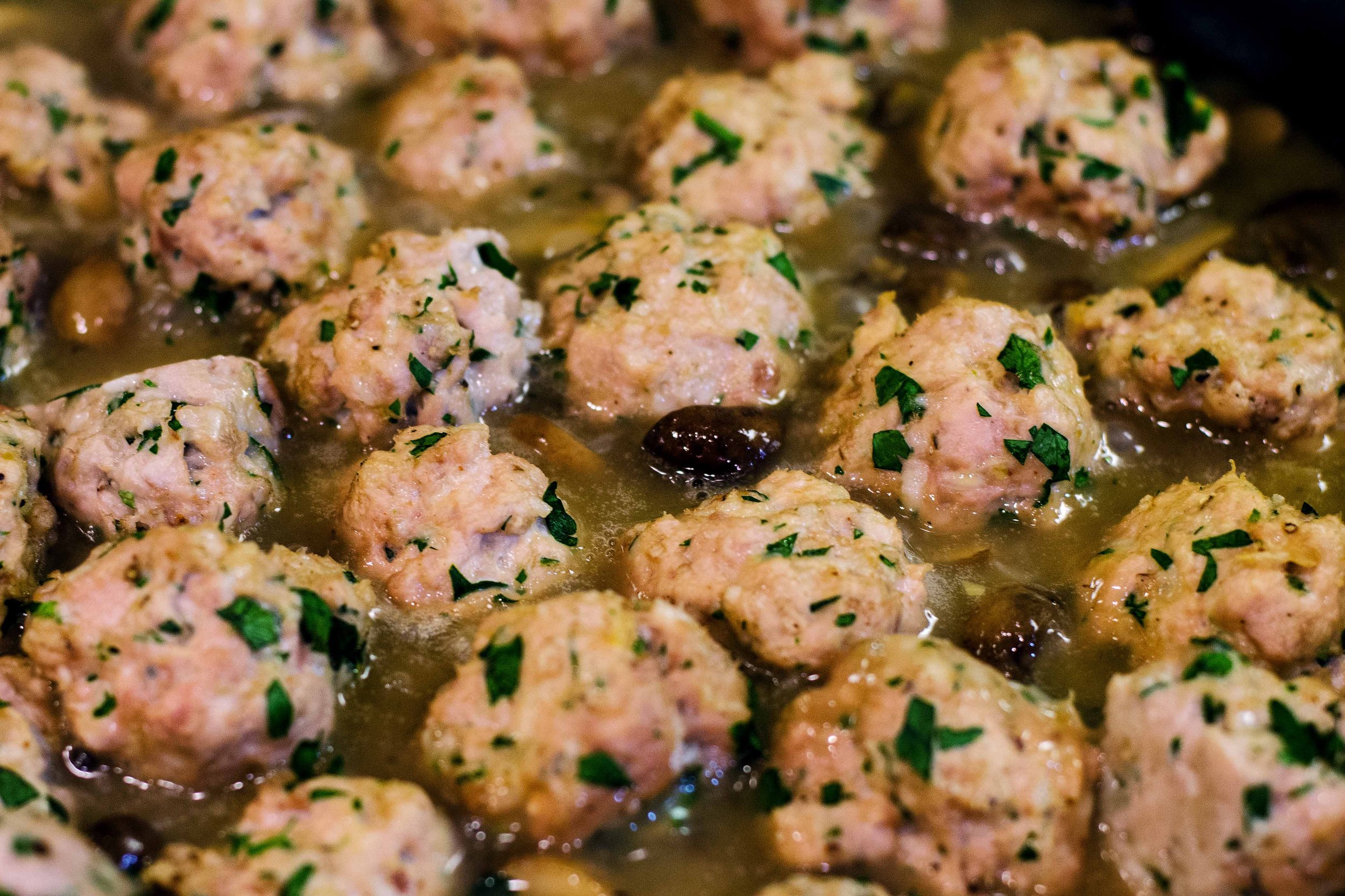
Let the sauce simmer for about five minutes. Stir it occasionally, if for no other reason than to bask in your triumph as the sauce continues thicken as it simmers. After about five minutes, drop your meatballs into the sauce and allow the entire glorious concoction to continue simmering for another five minutes. This will finish the meatballs to cooked perfection and allow the flavors to meld together.

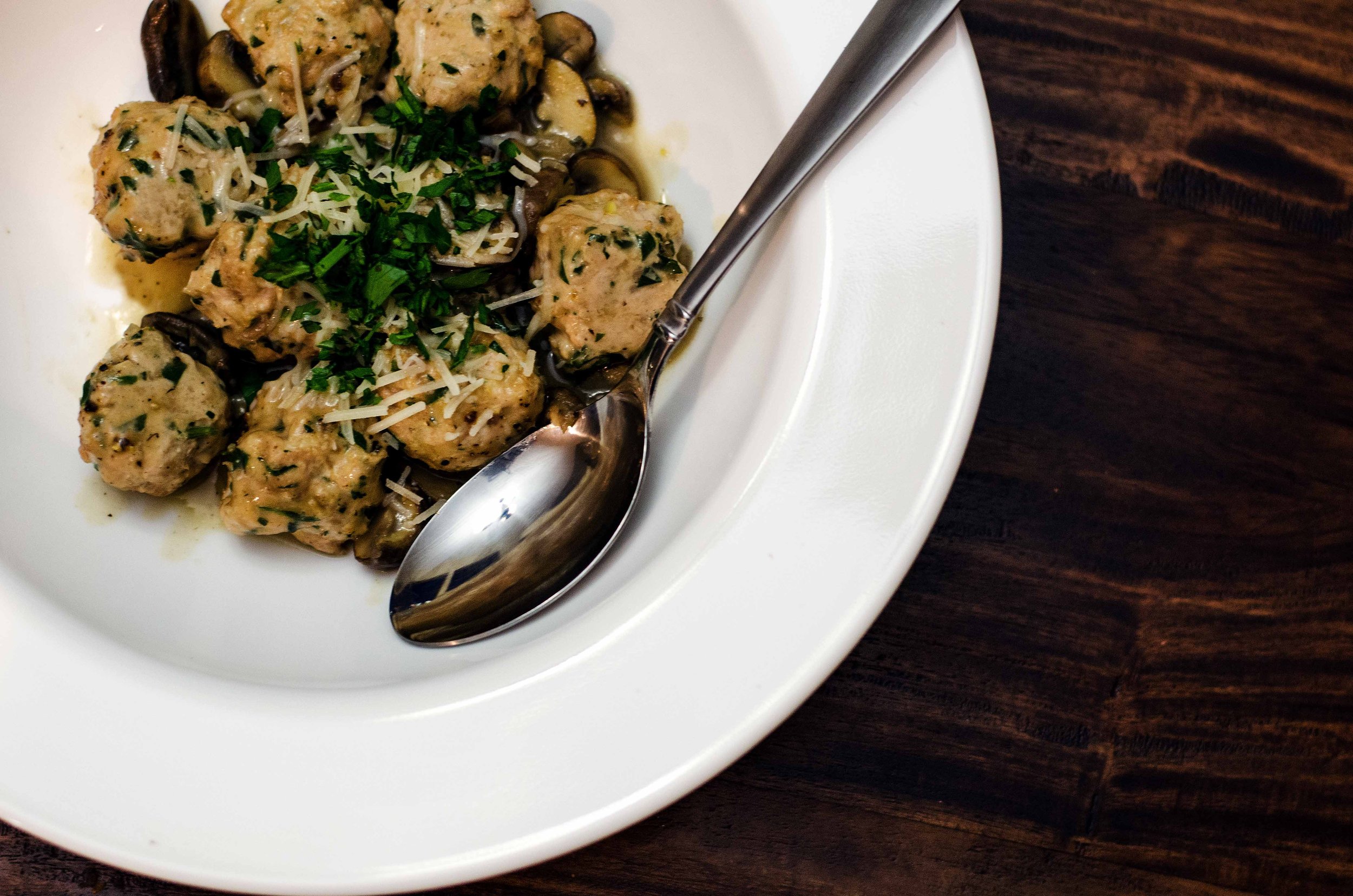
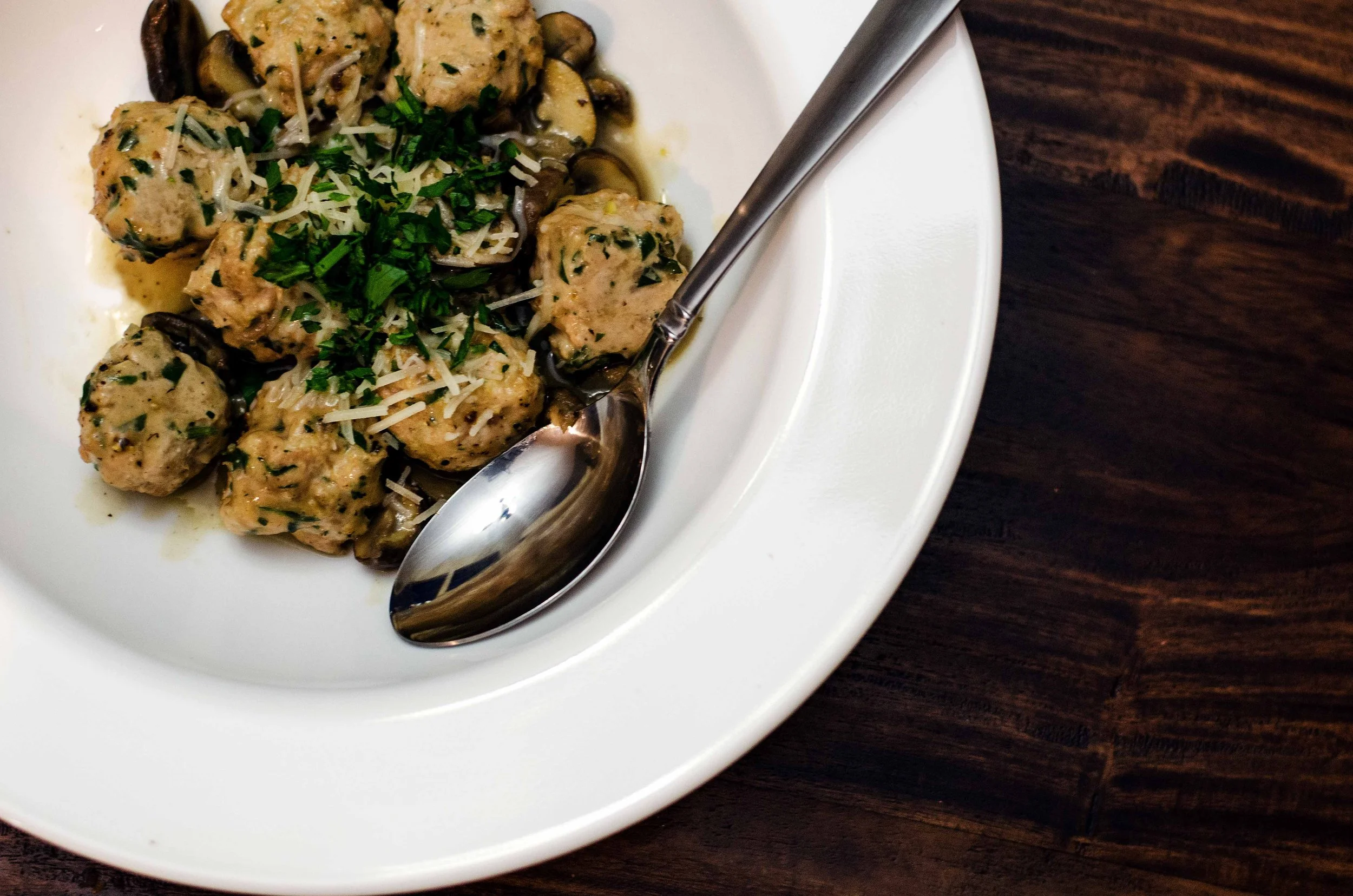
To serve, put the meatballs and mushrooms in a bowl and scoop out all of the sauce to cover everything. Garnish (there that is again!) with fresh chopped parsley and most cheese. The result is a very earthy, rich, and slightly sweet dish. Pheasant is a very mild flavored meat and pairs very nicely with the thick, slightly sweet marsala sauce. The mushrooms add the earthy tones and are enhanced by the sweet and salty touches of the cheese. I definitely licked my bowl clean!

For sides, I made a very simple arugula salad. Any kind of vegetable would work, such as sauteed asparagus, brussels sprouts, or a steamed leafy green. Bread for sopping up sauce would definitely help with licking the bowl clean. I think this would also be great served over rice, egg noodles, or mashed potatoes.

Before I sign off, this recipe would not have been possible without the work of a little chocolate lab. Don't worry, I shared a meatball with her.

Happy Hunting!

Yield: 4-6
Author: a 12 Gauge Girl
Pheasant Marsala Meatballs

Pheasant Marsala Meatballs

Tired of preparing pheasant the same way? Pheasant meatballs are great to add to any sauce for a different approach to upland game. These cheesy meatballs are amazing soaked in a creamy and silky marsala sauce and serve well over rice, noodles, or just by themselves.

Prep time: 5 MinCook time: 20 MinTotal time: 25 Min

Ingredients

Pheasant Meatballs
  • One pound ground pheasant
  • One cup panko bread crumbs
  • Half cup shredded cheese, pecorino, mozzarella, parmesan, Romano (Your choice)
  • Quarter cup fresh chopped parsley
  • One teaspoon nutmeg
  • Salt and Pepper to taste
  • Two tablespoons milk
  • One egg, beaten
Marsala Sauce
  • One third cup Marsala wine
  • Three tablespoons olive oil
  • Eight ounces mushrooms, cremini, portabella, shitake (Your choice)
  • One large shallot, minced
  • One teaspoon flour
  • One and a half cups chicken broth

Instructions

Meatballs Instructions
  1. Preheat the broiler.
  2. Mix together the pound of ground pheasant, panko bread crumbs, cheese, parsley, salt and pepper, nutmeg, milk and egg. Use your hands to incorporate everything really well.
  3. Roll the meat mixture into balls about the size of the palm of your hand, or around a tablespoon size. Place on lightly greased cookie sheet and bake for five minutes. Set aside to cool.
Marsala Sauce Instructions
  1. Using two tablespoons of the olive oil in a preheated pan, cook the mushrooms for five minutes and until lightly browned.
  2. Add the shallots and cook an additional two to three minutes.
  3. Sprinkle the flour over the mushrooms and add remaining olive oil. Whisk together, creating a thin buttery paste. Add the marsala wine and whisk. Cook for two or three minutes.
  4. Slowly add the chicken broth to the pan, stirring continuously to thicken sauce. Bring to light boil and then let simmer for five minutes
  5. Add meatballs and simmer for additional five minutes.
  6. Serve with fresh chopped parsley and extra shredded cheese.
Did you make this recipe?
Tag @a12gaugegirl on instagram and hashtag it #huntingandcooking

Italian Stuffed Elk Meatloaf

Italian Stuffed Elk Meatloaf

Serve up a thick slice of the loaf with roasted baby red potatoes simply dressed in olive oil, salt and pepper and crisp, steamed green beans. So delicious, your stomach's heart will melt.

Grilled Pike Skewers

Grilled Pike Skewers

Meaty pike skewers are marinated in zesty lemon and aromatic fresh rosemary, resulting in a hearty and rustic grilled fish perfect for serving at the next family barbeque night.

Salmon Burgers and Fresh Cut Fries!

Salmon Burgers and Fresh Cut Fries!

Easy to prepare but sensational tasting, this salmon burger whips up incredibly quick and is packed with spicy wasabi and hearty salmon!

Morel Mushroom and Asparagus Risotto

This Morel Mushroom and Asparagus Risotto was not just delicious to eat. It was also an adventure just to get the ingredients. I found these morel mushrooms on the North facing slope of a burn scar on my hometown mountain. The previous summer a fire had devastated much of the forest area. As many people do feel when natural disasters strike, the town felt helpless, afraid, filled with anger they were unable to direct, and at the end of it all just sadness.  


Looking up at the charred, blackened shadow of where the forest trees once stood, I wasn’t interested in walking through the forest just to be reminded of the life that once filled the area. I wondered how long people would stay away. 


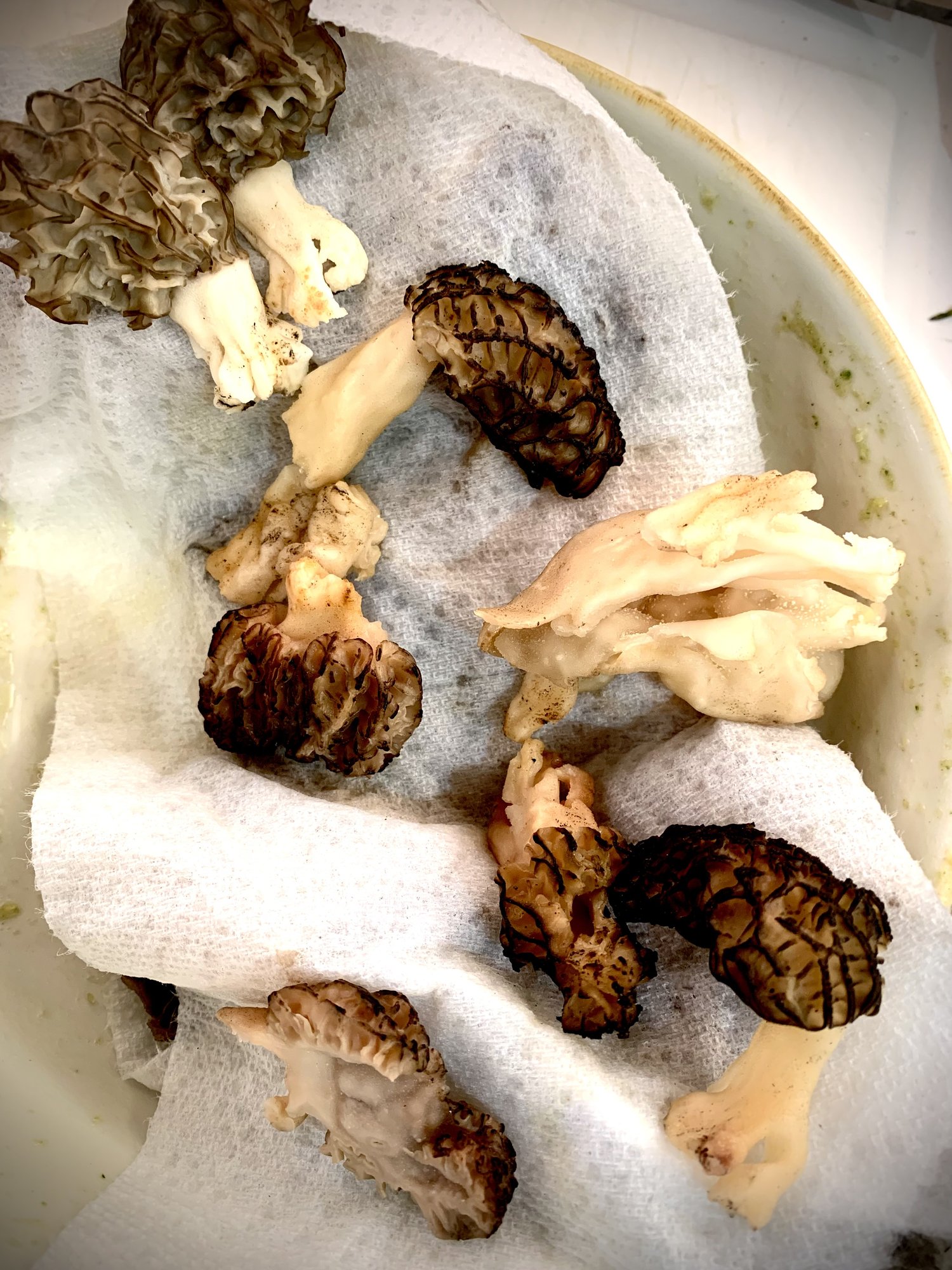
A few weeks ago, I saw an Instagram post about morel mushrooms. These fungi emerge from the ground after their symbiotic partner, the tree, has died. After a fire, when nothing is left of a tree but the burnt base and naked branches, the morels sprout from the dark soils of the tree’s roots in order to reproduce. Burn scars are prime morel hunting country, and I had one right in my own backyard. 


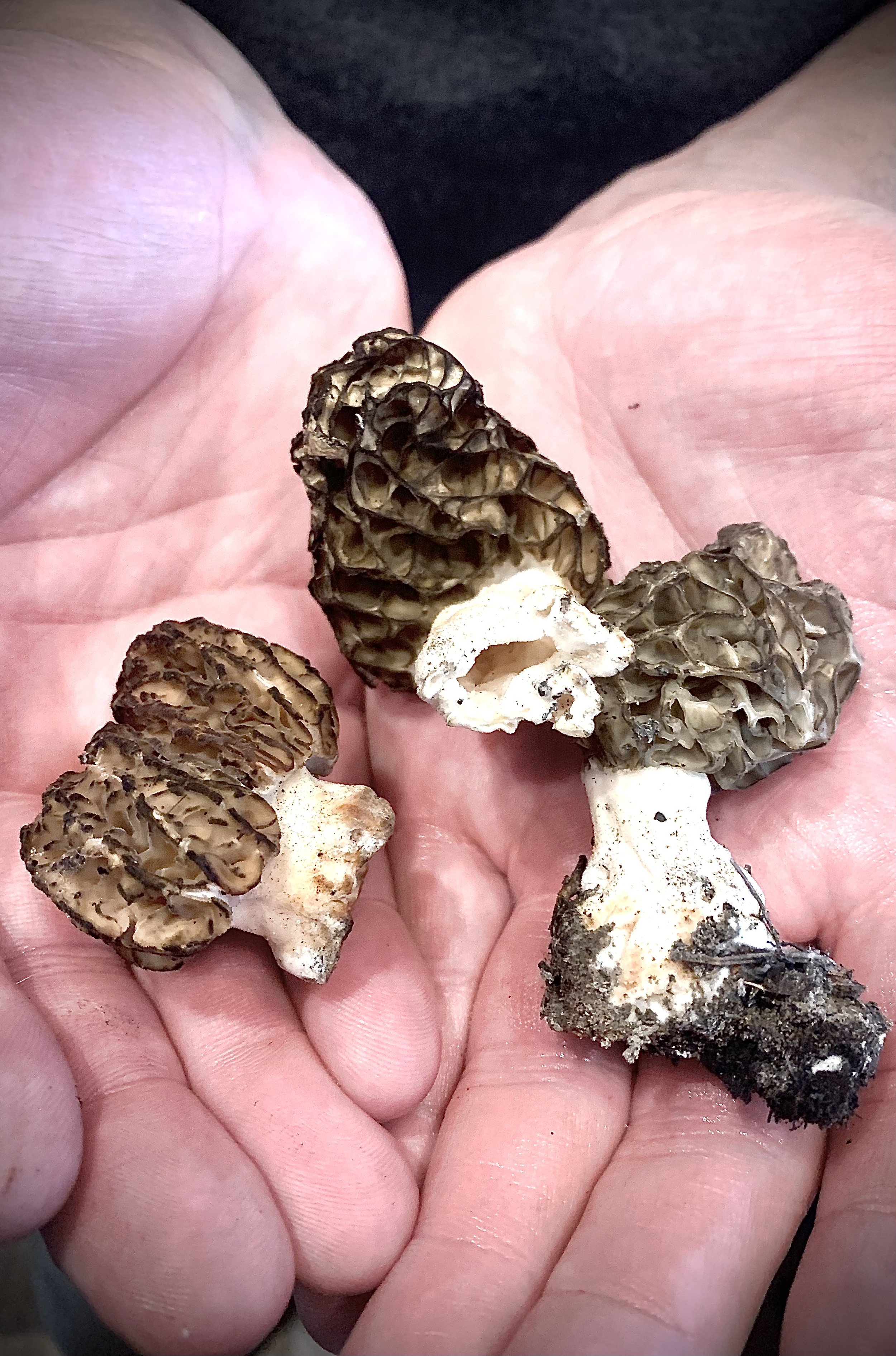
I had never hunted morel mushrooms before but looking online they seemed like a good starting point for fungi harvesting. Their distinctive look makes them the perfect beginner’s mushroom for hunting. More information on morel hunting can be found here: Morel Mushroom Hunting Tips


Once I was walking around the burn, it took a while before I actually found any mushrooms. Like with the start of most hunting outings, I grew impatient and frustrated, thinking I was wasting my time, within the first five minutes. I always start there. But once the forest starts feeding you with its information and you block out the noise of your daily life, the purpose no longer becomes to find mushrooms. The purpose becomes to take in the moment around you: the slight smell of ash from the fire still filtering through the air, the rich, dark soil at your feet contrasted by emerging baby greens, the crows noisy discussing amongst each other somewhere in the distance, the wind meandering through the cracks of the burnt trees, and the taste of the light mountain breeze against your lips.  


It also is that much better when you find morels! 


I found about a pound of morels, which was the perfect amount for making this Morel Mushroom and Asparagus Risotto. Let’s get started cooking it! 


Morel Mushroom and Asparagus Risotto

Risotto is a somewhat time-consuming meal, but I enjoy it. Like mushroom hunting, it is a time to unwind and just take a moment to yourself. It is not overly complicated to make, just requires a little patience and the engagement of your stirring muscles. To start, clean the morel mushrooms with water, removing all the dirt, and then slice into quarters. 


In a small saucepan over low heat, warm a quart of vegetable stock. The stock should be kept at a simmer. You will use this for your risotto here in a bit. 


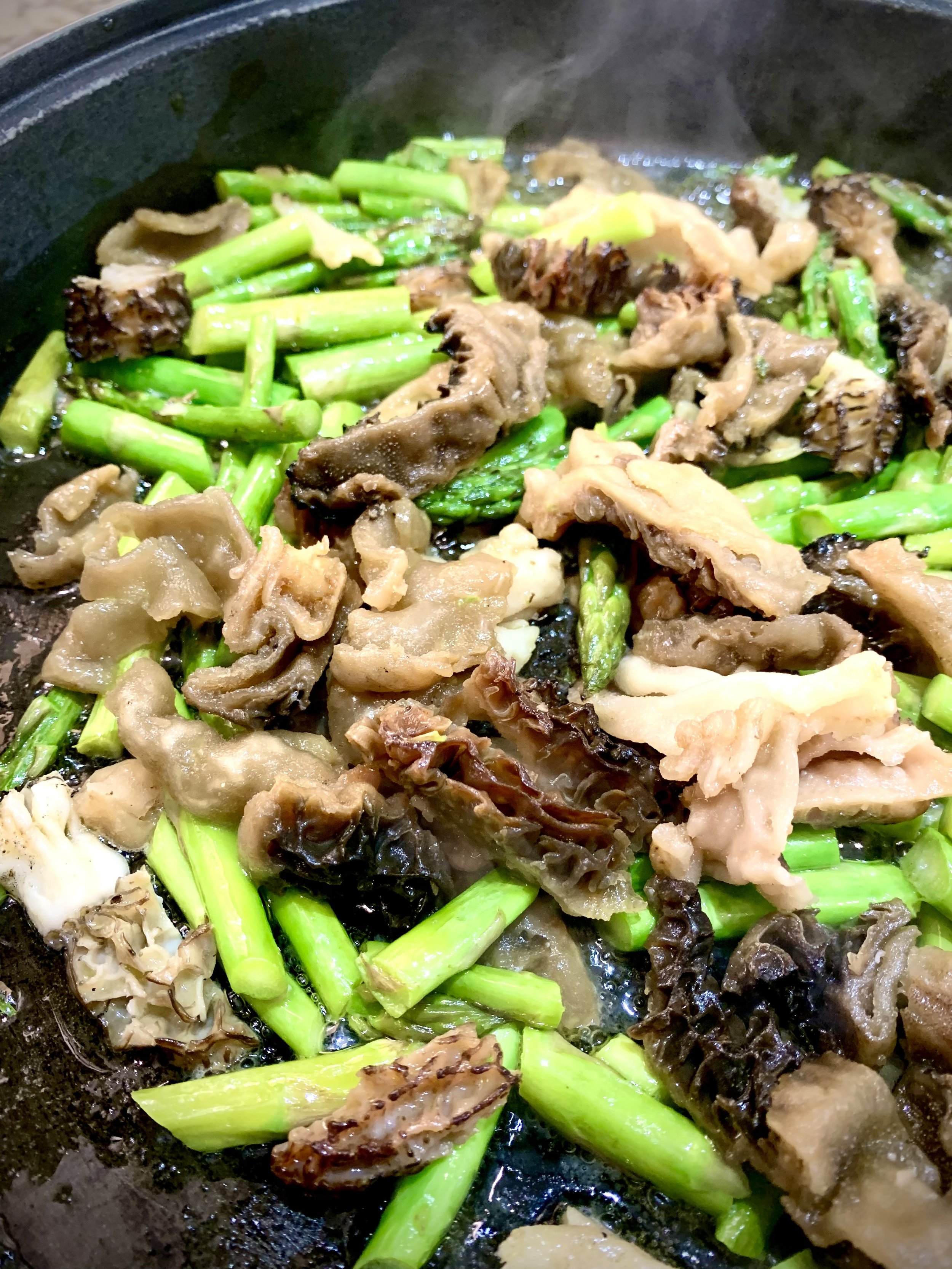
In a large skillet or even a dutch oven, add two tablespoons of olive oil and a tablespoon of butter over medium heat. Once the butter has melted, add your morels and asparagus. I cut the asparagus into two- or three-inch pieces for this recipe. Saute the mushrooms and asparagus until just starting to turn tender, about five minutes. Remove from the skillet and set aside. 


To the same skillet, add another two tablespoons of oil and one more tablespoon of butter. Add a medium size diced shallot and cook for two minutes. Pour in a cup of arborio rice and toast for another minute, stirring to keep it from browning too much. Add a few sprigs of fresh thyme. You can add the entire sprig and remove it after cooking, or just add the leaves. I just added the leaves.  


Pour in a half cup of Marsala wine and let it simmer until completely evaporated. It is now time to start making the risotto! This part of the recipe takes between 12-17 minutes and is the relaxing part of the meal. Add between a quarter and half cup of the warm vegetable stock to the skillet. Ensure your heat is at a level where the liquid is just simmering and not boiling. You want the rice to slowly absorb the liquid and if the heat is too high the liquid will just burn off before the rice has a chance to work its magic.   


Keep slowly stirring until the rice has absorbed all the liquid from the pan and then add another scoop full and keep stirring. Repeat this low and slow cooking method until the rice no longer is absorbing liquid. It should take the entire quart of vegetable stock. I have had times where I add another half cup of water to finish at the end, but not often. You will know the rice is finished when it is soft and chewy. There should also be a very light, starchy sauce surrounding the rice by the end. It shouldn’t be dried out like when you steam rice. 


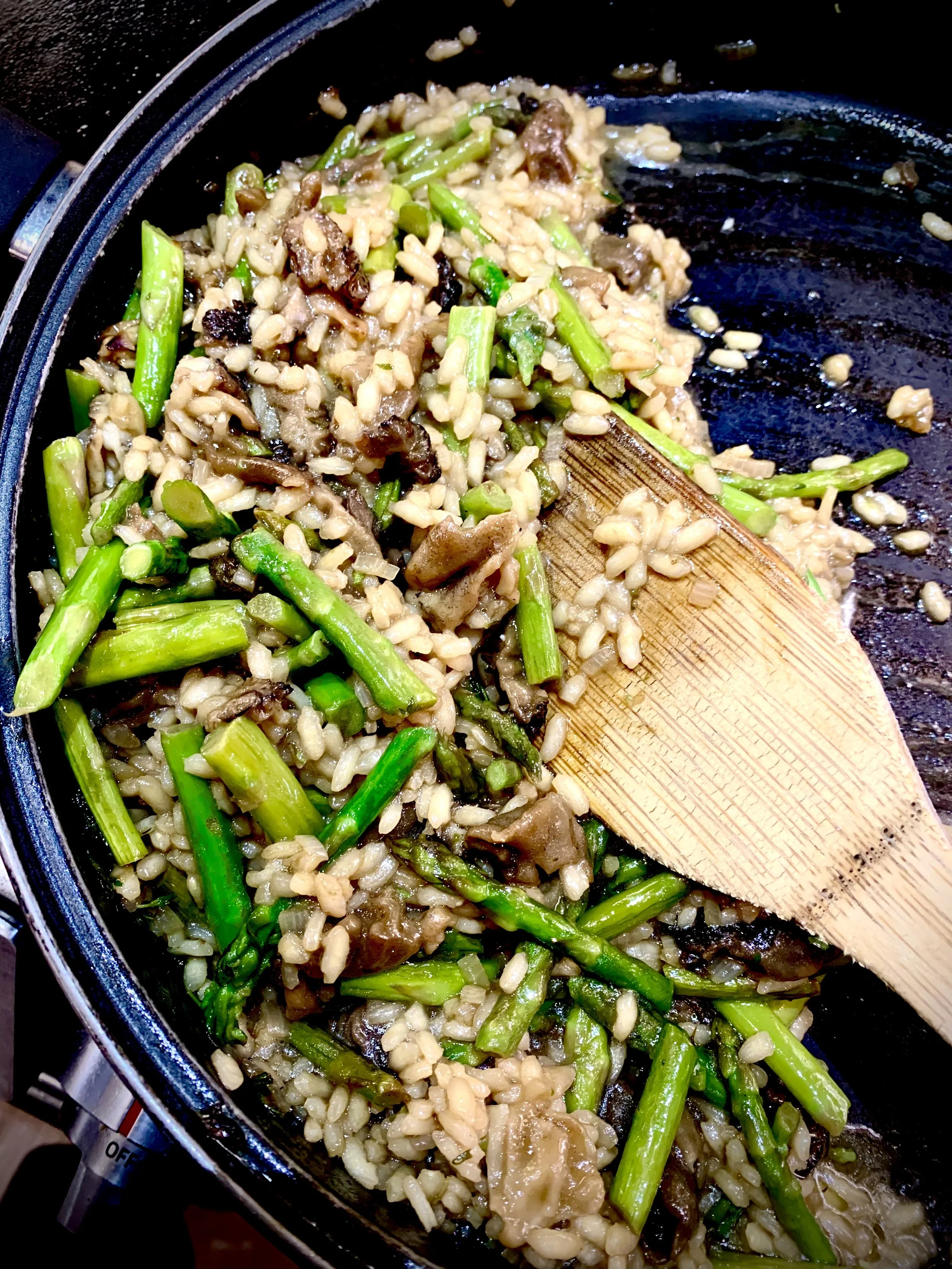
Once the rice is finished, add back in the morels and asparagus along with another tablespoon of butter for a little extra creaminess. Warm for another two to three minutes.  


To plate up this delicious meal, add a heaping scoop of the Morel Mushroom and Asparagus Risotto to a bowl. Sprinkle fresh chopped parsley and some shaved Parmesan over top. Drizzle with a little olive oil or balsamic vinegar glaze if so desired. Season with some salt and fresh cracked pepper. And there you have it! 


Happy (Mushroom) Hunting 

Hello, World!

Author: a 12 Gauge Girl
Morel Mushroom and Asparagus Risotto

Morel Mushroom and Asparagus Risotto

Nutty and buttery morel mushrooms are sauteed with fresh asparagus and served over a bed of creamy, cheesy risotto.
Prep time: 5 MinCook time: 30 MinTotal time: 35 Min

Ingredients

  • 1/2 pound fresh morel mushrooms, washed and quartered
  • 1 pound asparagus, cut into 2 - 3 inch pieces
  • 1 quart vegetable stock
  • 1/4 cup olive oil
  • 1/4 cup butter, cut into tablespoons
  • 1 medium shallot, minced
  • 1 cup arborio rice
  • 1/2 cup Marsala wine
  • 2 teaspoons fresh thyme
  • Shaved Parmesan cheese
  • Fresh parsley, chopped
  • Salt and pepper to taste
  • Optional garnishes: olive oil, balsamic vinegar glaze

Instructions

  1. In a small saucepan over low heat, warm a quart of vegetable stock This will be for building your risotto. Keep it warm while preparing the mushrooms and asparagus.
  2. In a large skillet or even a dutch oven, add two tablespoons of olive oil and a tablespoon of butter over medium heat. Once the butter has melted, add your morels and asparagus.
  3. Saute the mushrooms and asparagus until just starting to turn tender, about five minutes. Remove from the skillet and set aside.
  4. To the same skillet, add another two tablespoons of oil and one more tablespoon of butter. Add a medium size diced shallot and cook for two minutes.
  5. Pour in a cup of arborio rice and toast for another minute, stirring to keep it from browning too much. Add the fresh thyme leaves. Stir everything to coat in oil.
  6. Pour in a half cup of Marsala wine and let it simmer until completely evaporated.
  7. Add between a quarter and half cup of the warm vegetable stock to the skillet. Ensure your heat is at a level where the liquid is just simmering and not boiling. You want the rice to slowly absorb the liquid and if the heat is too high the liquid will just burn off before the rice has a chance to work its magic. Keep stirring often.
  8. Repeat this low and slow cooking method until the rice no longer is absorbing liquid. It should take the entire quart of vegetable stock. Sometimes additional water needs to added if the rice isn't quite soft and chewy after using all the vegetable stock.
  9. Once the rice is finished, add back in the morels and asparagus along with another tablespoon of butter for a little extra creaminess. Warm for another two to three minutes.
  10. To plate up this delicious meal, add a heaping scoop of the Morel Mushroom and Asparagus Risotto to a bowl. Sprinkle fresh chopped parsley and some shaved Parmesan over top. Drizzle with a little olive oil or balsamic vinegar glaze if so desired. Season with some salt and fresh cracked pepper
Did you make this recipe?
Tag @a12gaugegirl on instagram and hashtag it # huntingandcooking

Smoked Trout and Pear Grilled Cheese Sandwiches

Did I really just suggest fish on grilled cheese? Yes I did! Now wait a moment before you leave this recipe and just hear me out. I too was hesitant and distrusting of this notion of fish on a grilled cheese sandwich. Fish and cheese has never been a pairing that comes to my mind, but this Smoked Trout and Pear Grilled Cheese Sandwich is amazing!

Every summer, I smoke large batches of any fish I didn’t prepare fresh after catching. The freezer bounty has ranged from rainbow trout to kokanee and salmon to albacore tuna. Smoked fish makes a great backing snack, presents beautifully on a charcuterie, and also pairs amazingly well with pears for a grilled cheese sandwich.

I first shared this recipe on Harvesting Nature and you can find the link for the recipe here: Harvesting Nature Smoked Trout and Pear Grilled Cheese. If you haven’t checked out this website, I suggest you head over there right now. The site has a large collection of wild game recipes, a podcast, and tons of articles about hunting and fishing. It’s a great site.

I am going to share some pictures and a recipe card for my Smoked Trout and Pear Grilled Cheese right here too (Just to keep things easy for ya)!

Happy Hunting!

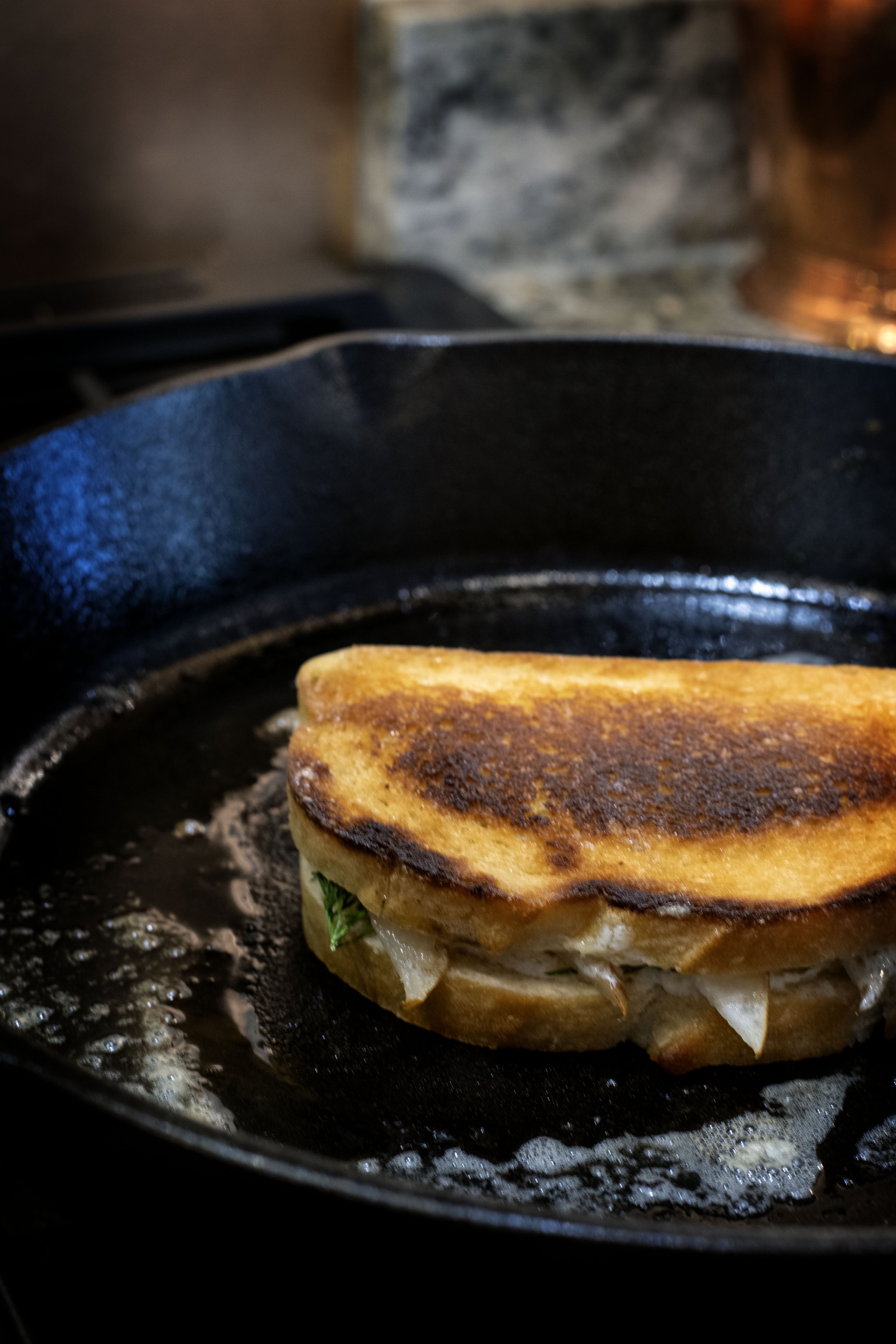
Butter the sourdough bread and then top with a generous smear of mascarpone cheese. Top with some pear slices and plenty of fresh dill sprigs.

Next, add the smoked trout (or smoked fish of your choice) and then a add a thin layer of horseradish on top of the mascarpone cheese for the second slice of bread.

Grill the sandwich on medium high for three to four minutes per side.

And then dig in!!!!!


Smoked Trout and Pear Grilled Cheese Sandwich

Smoked Trout and Pear Grilled Cheese Sandwich

( 0 reviews )
Yield: 4
Author: a 12 Gauge Girl
Did I just say fish on grilled cheese? Yes, I did! This smoked trout and pear grilled cheese is cheesy, smoky, and has a little kick of horseradish! Give it a try!

Ingredients

Ingredients for Smoked Trout
  • 10-12 large trout or fish of choice, can be left on bone but skin removed
  • 1 cup salt
  • 1/2 cup brown sugar
  • 1 cup sugar
  • 2 quarts water
  • 1 can Old Bay Seafood seasoning
  • 3 bay leaves
  • 3-4 sprigs rosemary
  • 1 bottle Cavit Pinot Grigio
  • 2 pounds brown sugar
Smoked Trout and Pear Grilled Cheese Ingredients
  • Two filets smoked trout
  • 8 slices sourdough bread
  • 1 pear, thinly sliced
  • fresh dill sprigs
  • Prepared horseradish
  • Mascarpone cheese
  • Butter

Instructions

How to Smoke the Trout
  1. You can leave the fish on the bone but should remove the head and skin.
  2. Mix the fish brine by filling a gallon freezer bag or large glass bowl with the water, salt, sugars, Old Bay Seasoning, bay leaves, and rosemary. Mix until the salt and sugars have dissolved.
  3. Submerge the fish completely in the brine and refrigerate for ten to twelve hours.
  4. Once finished brining, rinse the brine off the fish with cold water.
  5. Mix the bottle of Cavit Pinot Grigio, or other white wine of your choice, with the two pounds of brown sugar in a large pot. Bring to a gentle boil and stir until sugar has completely dissolved.
  6. Marinate fish in the wine and sugar mixture for one hour.
  7. Once the fish has marinated, place the filets on a drying rack and let dry until a glossy pellicle develops. I use a small fan to make the coating dry extra solid. Drying time varies, but it takes about an hour.
  8. Set the smoker to 180 degrees Fahrenheit. Fish should smoke somewhere between 165 and 225 degrees. If you go on the higher end, you tend to cook the fish instead of slow smoke, so I try to keep the temperatures lower. I also put aluminum foil on the grate below my rack to keep the fish from burning.
  9. For pellets, I used hickory, but there is a large variety of woods available. Fish tend to be paired with woods the produce a lighter smoke, including alder, maple, pecan, and apple.
  10. Smoke fish between 8 to 10 hours. The time depends on the thickness of your fish, so around hour six I start checking the filets with a meat thermometer. The fish is ready when it has reached an internal temperature of 145 degrees Fahrenheit.
Preparing the Grilled Cheese
  1. Preheat a skillet or cast iron pan over medium high heat.
  2. Spread a thin layer of butter on one side of each slice of bread.
  3. Generously slather each slice of bread with the mascarpone bread.
  4. Start stacking the sandwich! To one side of bread for each sandwich add a single layer of thinly sliced pears.
  5. Tear apart the smoked fish in bite size chunks and add to the top of the sliced pears.
  6. Add a healthy number of fresh dill sprigs.
  7. Finally, spread a thin layer of horseradish on the leftover slice of bread and then top the sandwich.
  8. Grill in the skillet for three to four minutes per side, or until the bread is golden brown and slightly crunchy.
  9. Enjoy!
Did you make this recipe?
Tag @a12gaugegirl on instagram and hashtag it # huntingandcooking

Speckled Trout Scampi

You never know what you are going to have on the other end of your pole when Texas bay fishing. Growing up in the Rocky Mountains, I am accustomed to catching a small handful of various fish. Typically there are rainbow or brown trout. Sometimes you find a lake someone got a wild hair while stocking and added arctic graylings. For the most part, you are certain that when the tip of your pole makes that arching dip towards the water you know what is on the other end. Not true in salt water fishing.

During my week of fishing the bays of the Gulf of Mexico in Texas I pulled up fish I had never even heard of before. Just off a pier in the shallow bays near Corpus Christi with nothing but mullets for bait, which also were foreign to me before this trip, I pulled up sheepshead, speckled trout, lady fish, croakers, gafftops, and even a sting ray. Obviously not everything is suitable for the dinner plate, but that doesn’t affect the fun had when reeling in the line, wondering what could possibly be emerging from the salty waves.

What is suitable for the dinner plate is an entirely other adventure. I created a rice dish with a groundberry and macadamia topping from the sheepshead I caught in the first few days of the trip, and for this post I am using the speckled trout I caught a few days later.

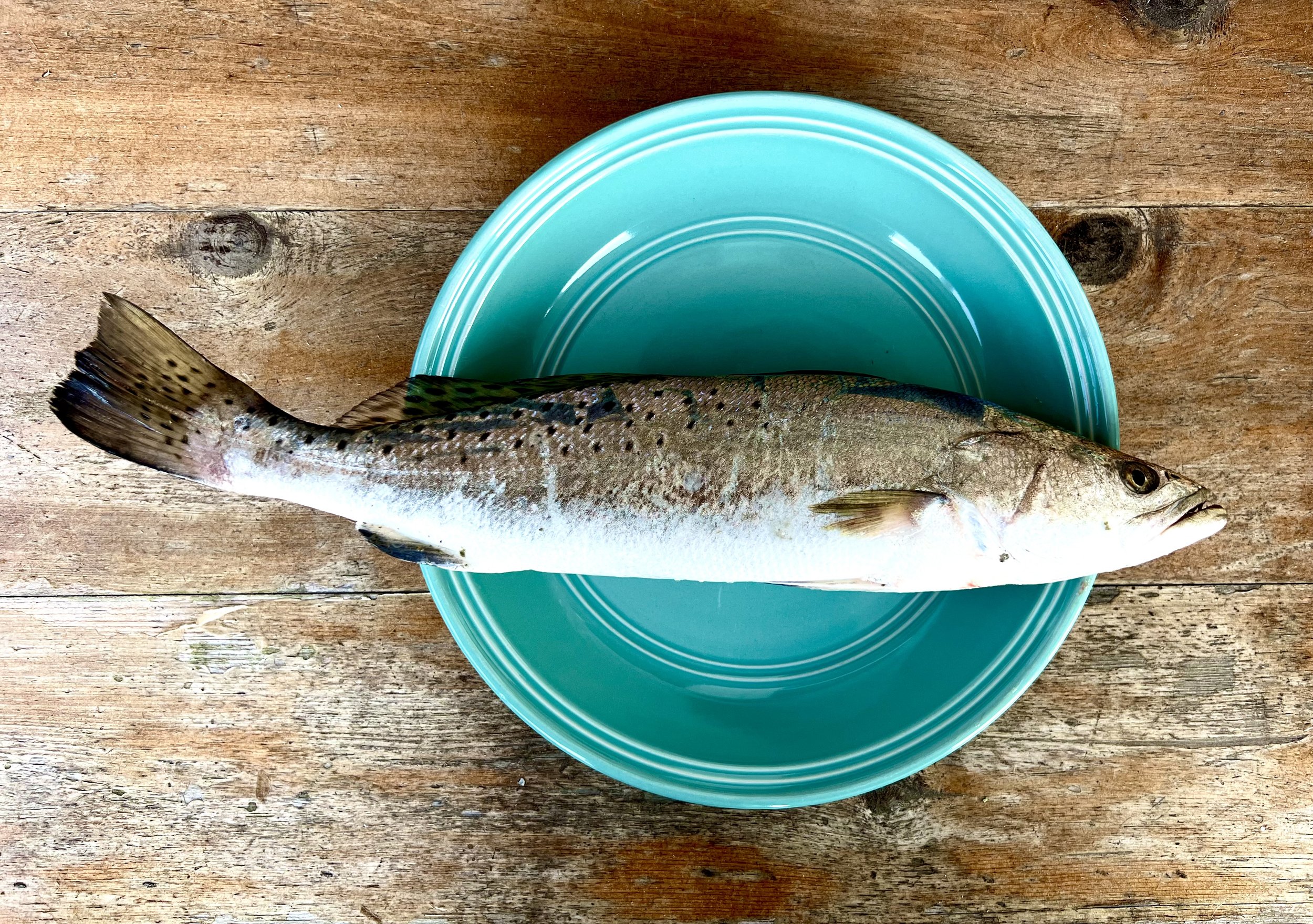
Speckled trout, or also known as spotted seatrout, are a slender bodied fish with distinguishing black spots dotting their dark grey or greenish body. They also have two very funny looking teeth. They kind of look like a vampire that went to the dentist and had all their teeth removed except the two sharp ones.

Speckled trout meat is much softer than other fish, and especially more so than freshwater fish. It is a mild flavored, white meat that is moderately flakey. I don’t want to call it a mushy fish, as that tends to be a negative term when describing meat, but it is most definitely not a firm meat that holds together in flakes when you pull it apart. It has more of the texture of a lobster tail.

Due to the tendency of developing a “mushiness,” the fish does not hold up well to being overcooked. This ruled out grilling or pan frying in my mind, as those methods can lead to easy overcooking and I wanted this fish to turn out good so badly. So, with the texture in mind, I decided to do a Speckled Trout Scampi.

Speckled Trout Scampi

For this Speckled Trout Scampi you need a lot of butter. Think Julie Child’s level of butter. Two whole sticks, or a full cup, of unsalted butter. I know, it’s a lot. This definitely isn’t a heart healthy or waist friendly meal, but it is such a fantastic use of the spotted seatrout that you should treat yourself with all that butter if you happen to be lucky enough to catch such a fish.

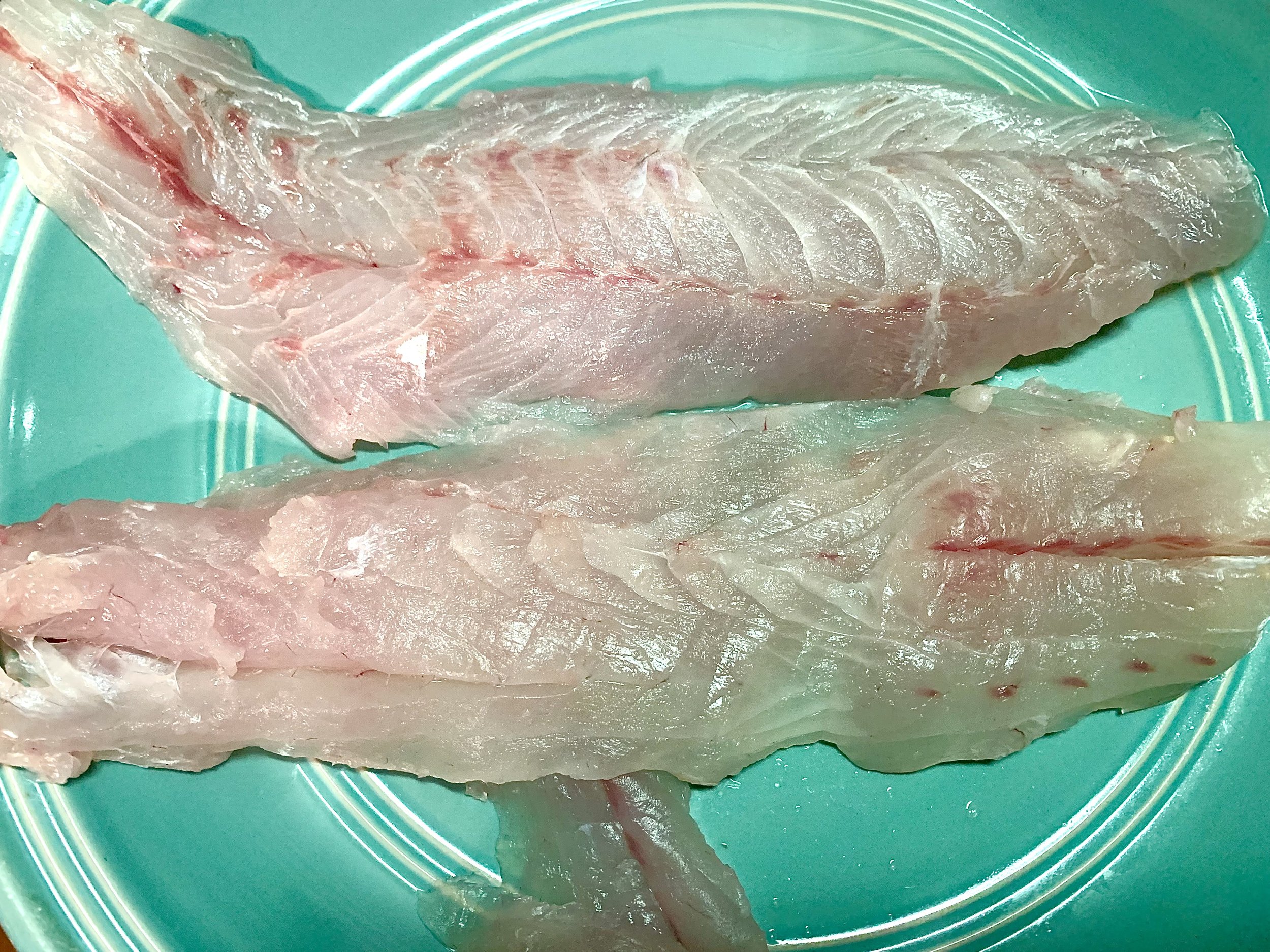
You want to take filets from the speckled trout, removing them from the bone and also taking off the skin. Check the filets for bones in the meat, and also remove anything that is just, I don’t know a better way to put it, yucky looking.

Set the filets in a baking dish and preheat the oven to 350 degrees.

Meanwhile, in a medium size sauce pan, add the two sticks of butter and start to melt over a medium heat. Add the chopped five cloves of garlic, a half cup of chopped scallions, the fresh chopped oregano, some dried dill, and a half teaspoon of salt. Let everything simmer lightly for a few minutes.

Remove the pot from the heat and add in a half cup of dry white wine. If you aren’t a wine person, you could also add a quarter cup of lemon juice or a few tablespoons of apple cider vinegar. You just want something to put a little acid in the sauce. 

Pour the butter mixture over the fish in the baking dish and place in the oven for 15 minutes.

As mentioned before, you don’t want to over cook the fish. I checked the first at about 12 minutes to make sure things weren’t getting too mushy. At 15 minutes the fish still held together but was just starting easily pull apart with a fork.

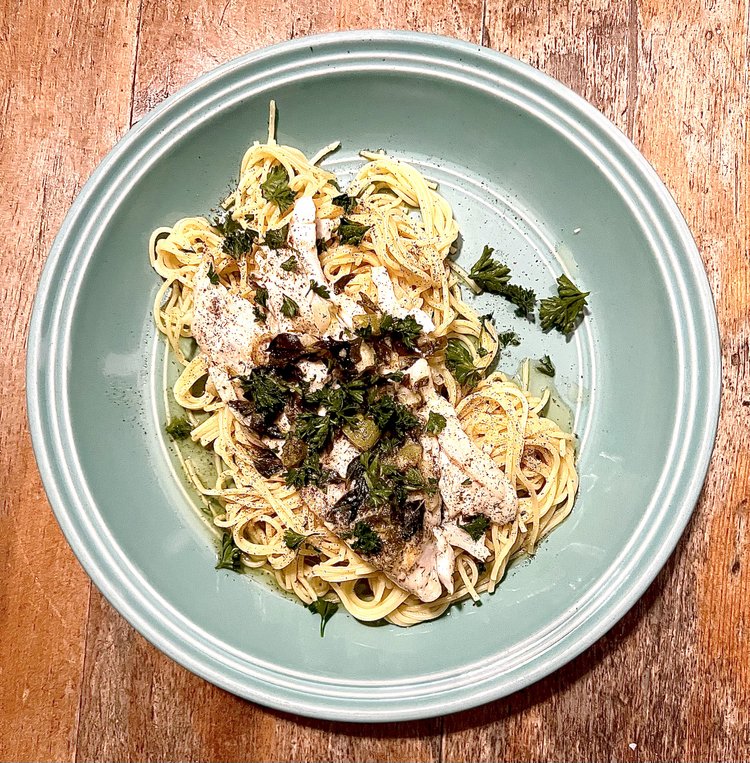
Serve the Speckled Trout Scampi over angel hair pasta. To plate, add a pile of noodles, place a fish filet on the bed of the noodles, and then drizzle a healthy pour of the butter sauce over the fish and noodles. Sprinkle with fresh minced parsley and fresh cracked pepper.

Enjoy!

Happy Fishing!  

Yield: 4
Author: a 12 Gauge Girl
Speckled Trout Scampi

Speckled Trout Scampi

( 0 reviews )
Mild and flakey speckled trout is slow cooked in a bath of butter, garlic, oregano, dill, and parsley.
Prep time: 10 MinCook time: 20 MinTotal time: 30 Min

Ingredients

  • 2 speckled sea trout, four filets total
  • 1 cup unsalted butter - 2 sticks
  • 5 cloves garlic, chopped
  • Several sprigs fresh oregano, minced
  • 1 teaspoon dried dill or 1 tablespoon fresh dill
  • 1 tablespoon fresh parsley
  • 1/2 cup dry white wine
  • Salt and Pepper
  • Pound angel hair pasta, cooked al dente

Instructions

  1. Preheat oven to 350 degrees Fahrenheit
  2. In a medium size sauce pan, melt the two sticks of butter.
  3. Add the chopped garlic, oregano, and dill. Cook for three to four minutes.
  4. Season with salt and pepper.
  5. Remove butter mixture from heat and add white wine.
  6. Place fish filets in a 9 x 13" baking dish. Pour the butter mixture over the fish filets.
  7. Place baking dish in oven and cook for 15 minutes.
  8. To serve, place pasta on plate and top with one fish filet. Pour a generous serving of butter sauce over fish and pasta. Sprinkle with fresh minced parsley.
Did you make this recipe?
Tag @a12gaugegirl on instagram and hashtag it # huntingandcooking

Sheepshead Fish Rice Dish with a Groundberry Macadamia Nut Topping

Sheepshead. So, what is it? I had the same question when I pulled this Jurassic looking fish with its zebra striped body and sharp bladed spines from the bottoms of a Bayside, Texas ocean flat. It was about the size of a large dinner plate with large eyes and almost human like teeth. “That’s a sheepshead,” the man fishing next to me said. “They are good eatin’!”

My interest beyond the oddities of the fish’s appearance extended to how I was going to prepare this fish. Since it was my first time encountering this fish, I had to research what the guy meant by “good eatin’!”

Sheepshead fish are common in the shallow waters of the Atlantic and the Gulf of Mexico. The rows of stubby flat teeth are used for crushing its prey, which include oysters and clams. The meat is described as firm, moist, and oily. Sounds like the perfect protein to me! Let’s get started on this Sheepshead Rice Dish with a Groundberry Macadamia Topping.

Grilling the Sheepshead

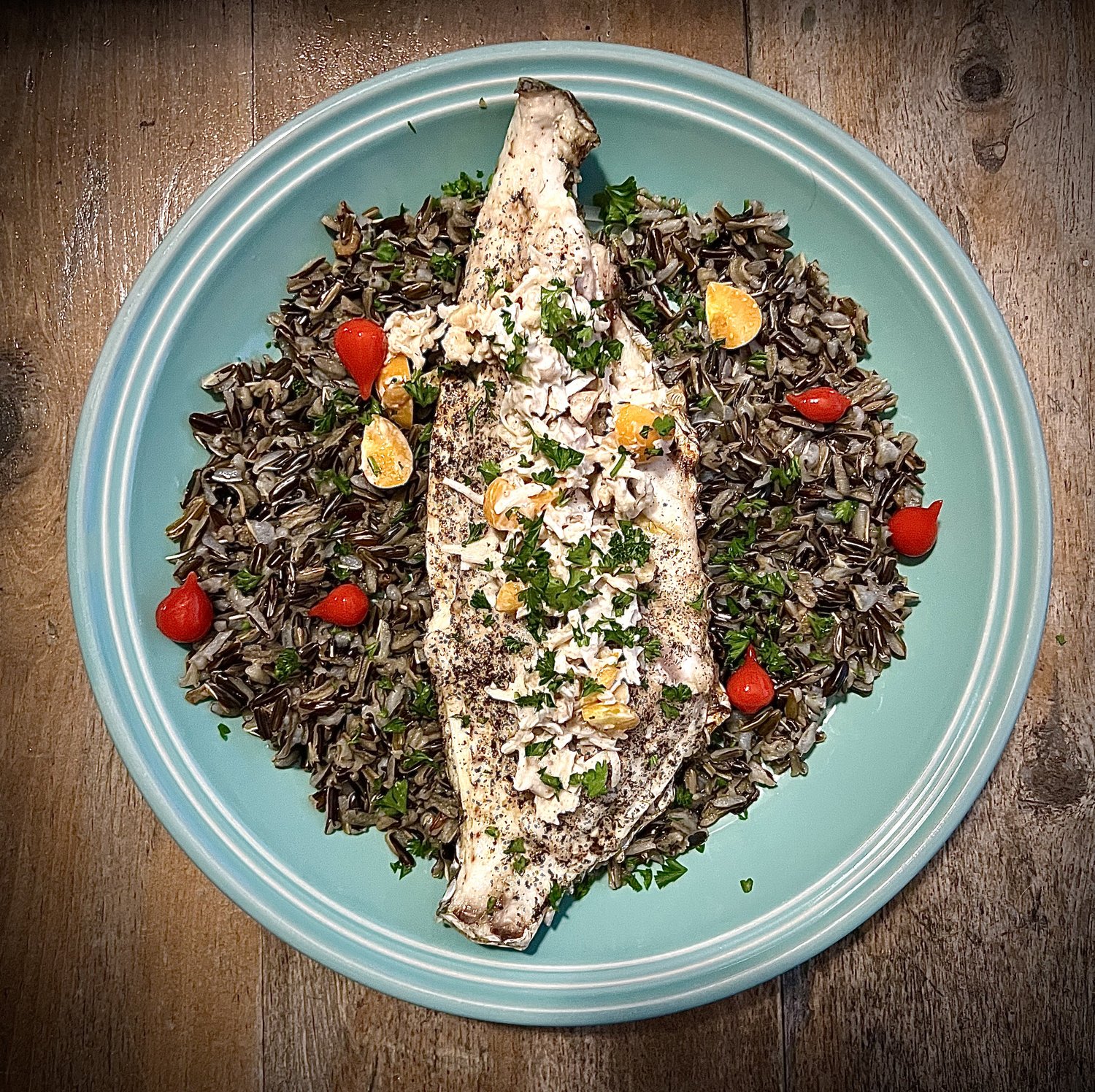
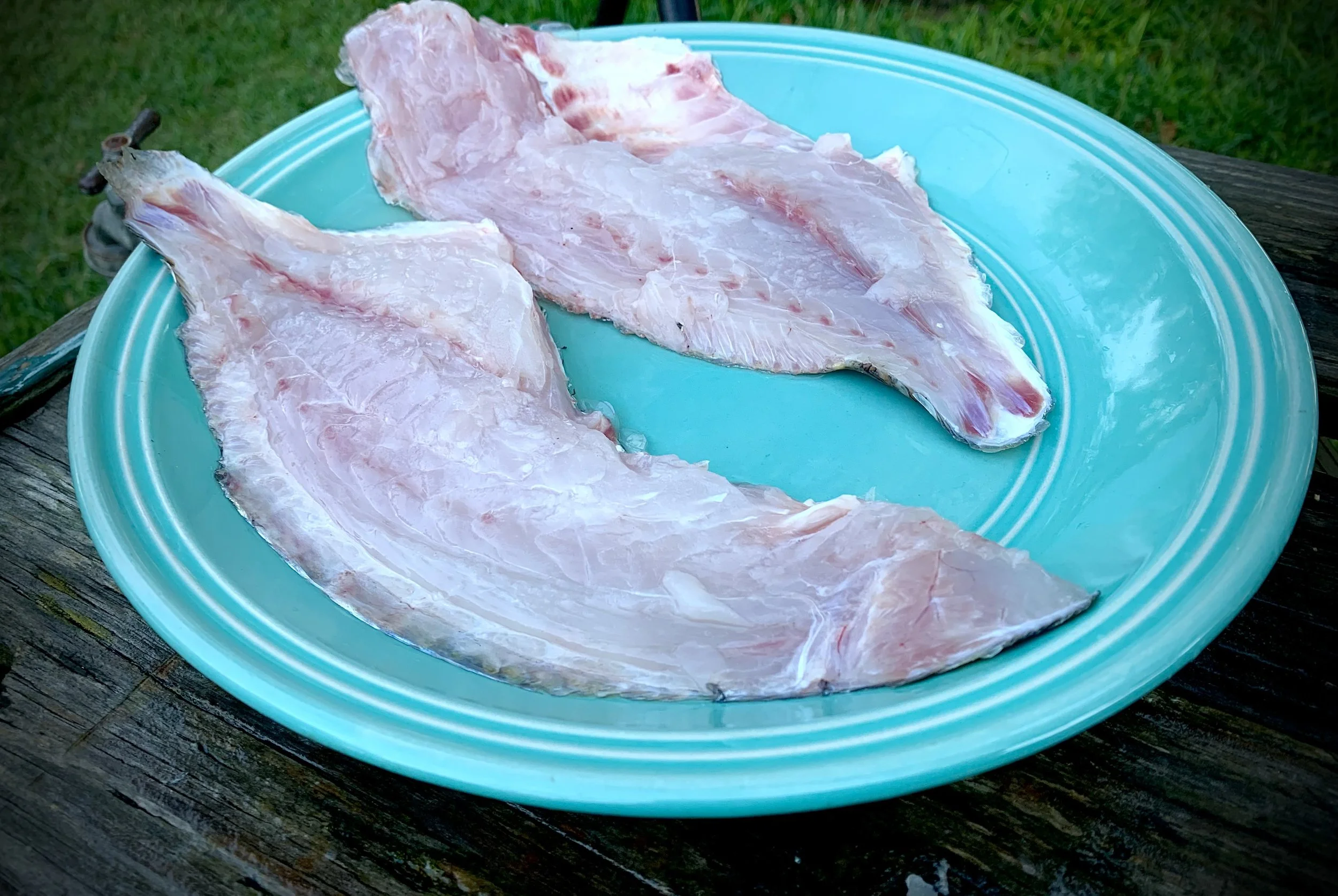
I decided to grill the fish. I simply filleted this fish by taking a long, flexible, sharp knife and running it the length of the fish to remove the filet. I started a cut right above the eye and against the backbone and then cut down around the front fin to the belly. I used this cut to then pull the knife back all the way to the tail, removing a beautiful and thick filet.

The only bones you need to remove are the pin, or Y bones, from the meat. This is easy to do with a pair of needle nose pliers.

For a better description on how to clean the sheepshead, check out this website: Hunting and Fishing Depot.

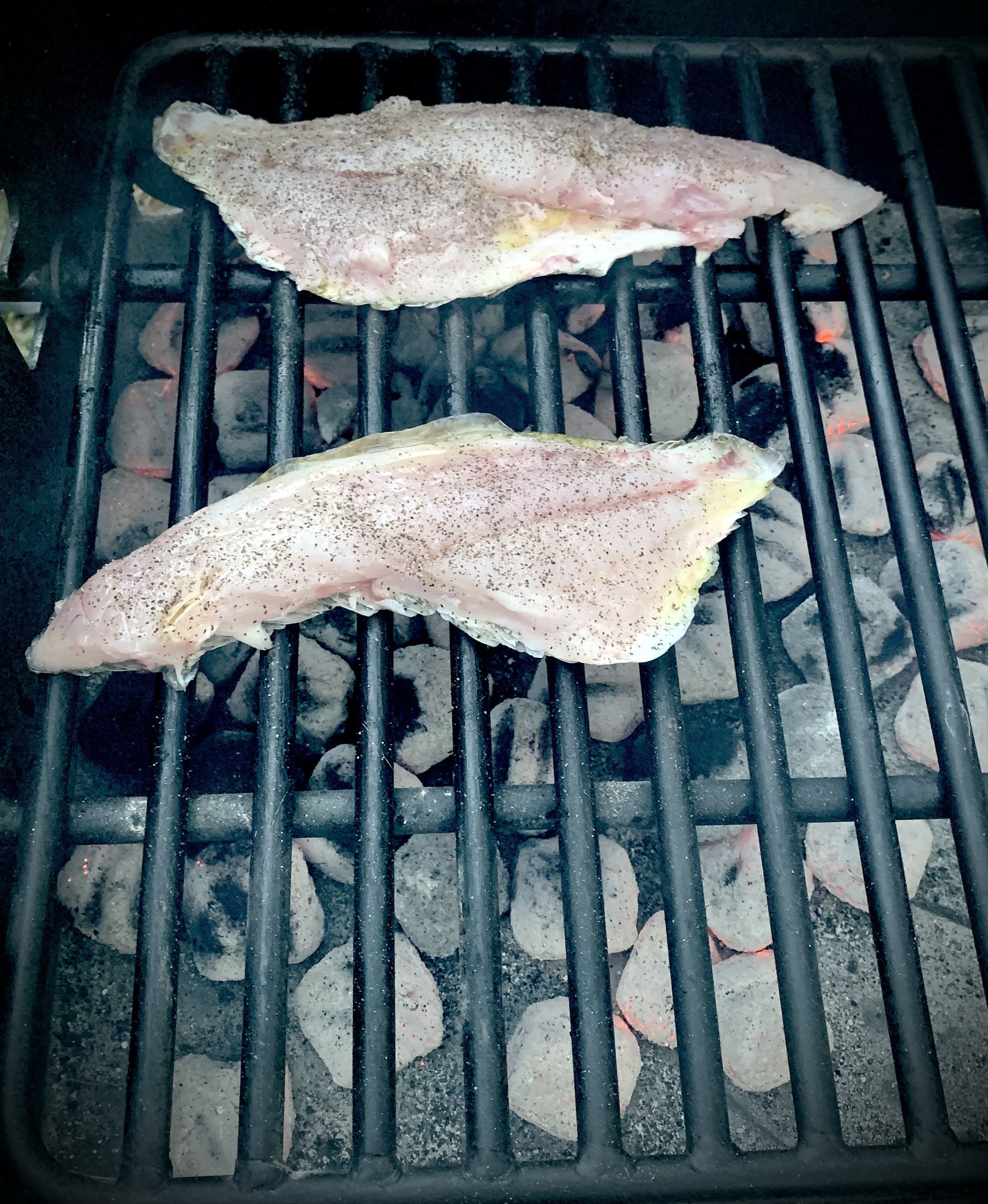
Since I was grilling outdoors and grills are notoriously dirty, well not dirty but they aren’t clean like a skillet, I left the skin on the fish. I did not even bother to remove the scales for this particular fish since I was grilling it. The skin added protection to the filets from becoming burnt on the underside.

Once the grill was nice and hot I simply seasoned the sheepshead with salt and pepper, added a little dash of oil, and let them grill for 8-10 minutes, depending on the thickness of the filets. I knew they were finished when the meat was a opal white color and the edges are starting to develop that beautiful golden grilled coloring. Another test for this fish is to cook until you can easily slide a butterknife through the meat without resistance. The meat should be firm but falling apart.

Preparing the Groundberry Macadamia Nut Topping

In a medium bowl mix together the ingredients for the topping. I chopped the macadamia nuts and groundberries into bite size pieces for the topping, but you can leave them whole if you are so inclined. I added unsweetened coconut for added texture and body in the topping, and then a little coconut milk to hold everything together. The mixture should be the consistency of oatmeal and not too runny.

Season the topping with a little salt and some coriander.

I used groundberries to add a little sweet to this dish. Groundberries are small orange fruits originating from South America and are a member of the nightshade family. They are known by a variety of names in different parts of the world, including ground cherry, poha, aguaymanto, and pichuberry.  

With a texture similar to the cherry tomato, groundberries are slightly sweet but also tart. They are popular in salsas and chutneys or over salads. They are also commonly added to desserts for not only their taste but also the aesthetic value they add to a dish.

Goundberries were perfect for topping this hearty sheepshead grilled fish with. The coconut, macadamia nuts, and groundberries give the dish a flair reminiscent of many Hawaiian dishes that are topped with pineapple. So, if you can’t find groudberries for the topping you could always substitute with pineapple, mango, or papaya.

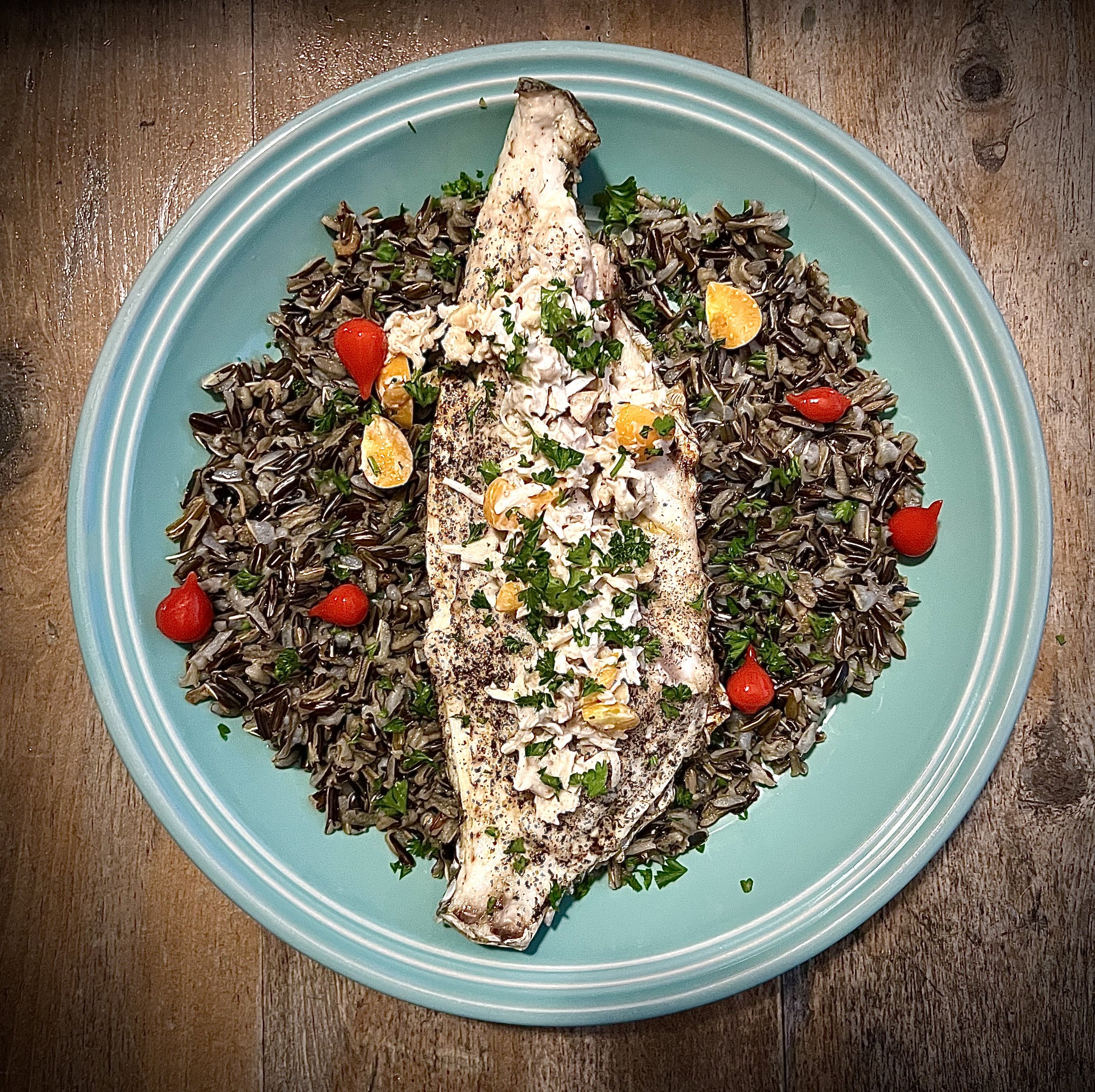
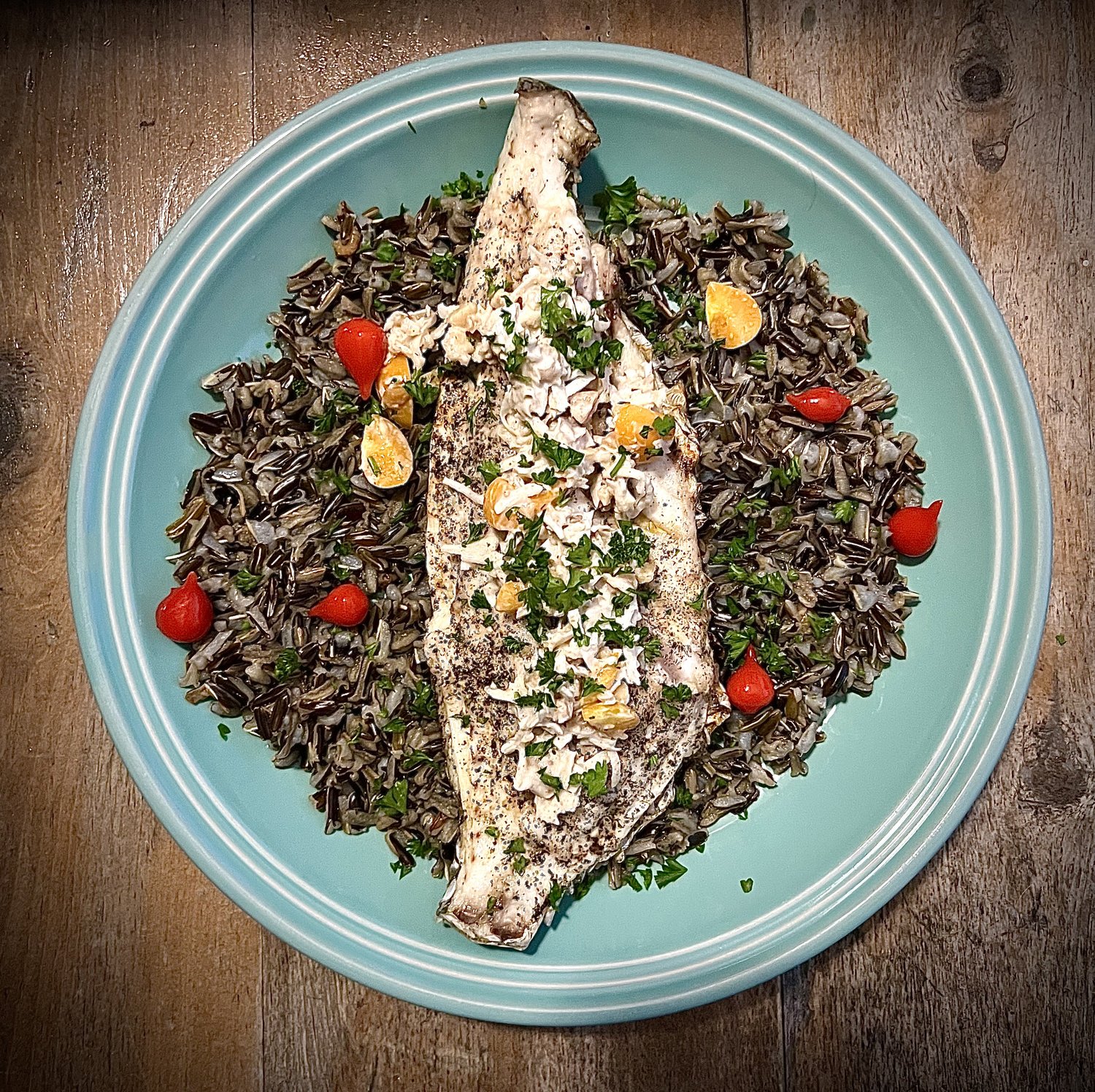
To plate, add a large scoop of wild rice to the plate and nestle the grilled sheepsheads filet on top. I decided to remove the skin for actual plating because it is somewhat fishy and I didn’t want to add that flavor to my rice. Then, top with a heaping spoonful of the groundberry macadamia topping. Sprinkle with a little fresh chopped parsley and enjoy!

Happy Fishing!

<
Yield: 4
Author: a 12 Gauge Girl
Sheepshead Fish with Groundberry and Macadamia Nut Topping

Sheepshead Fish with Groundberry and Macadamia Nut Topping

( 0 reviews )
Sheepshead is a firm, meaty, oil fish perfect for grilling. This grilled sheepshead is served on top of a bed of wild rice with a groundberry and macadamia nut topping.
Prep time: 10 MinCook time: 10 MinTotal time: 20 Min

Ingredients

  • 1 Sheepshead Fish - Filleted with skin left on
  • 1/4 cup olive oil
  • 1/2 to 1 cup coconut milk
  • 1 pint groundberries
  • 1 cup macadamia nuts, chopped
  • 1 cup shredded, unsweetened coconut
  • 1 teaspoon coriander
  • salt and pepper
  • Wild rice, prepared to instructions on box

Instructions

  1. Preheat the grill to high heat.
  2. Season sheepshead filets with the olive oil, salt and pepper
  3. With the skin on, place fish directly on grill, skin side down, and grill for 8-10 minutes or until the fish is white and firm. You can test the fish to see if it is done by pressing a butterknife into the meat. It should easily slide through the meat without much resistance.
  4. For the topping, in a medium size bow mix together the shredded coconut, chopping groundberries, and macadamia nuts.
  5. Add coconut milk slowly until the consistency holds together but is not too runny.
  6. Season to taste with salt, pepper, and coriander.
  7. Serve fish over a bed of wild rice and top with the groundberry macadamia nut topping.
Did you make this recipe?
Tag @a12gaugegirl on instagram and hashtag it # huntingandcooking

Dutch Oven Baked Pears and Cherries

When camping, dessert typically consists of such campfire classics as s'mores, fruit cobblers, and caramelized bananas or peaches. Don't get me wrong, these traditional camping delights are one of the main reasons I enjoy spending a night under the stars. I can't deny the nostalgia I get when roasting a marshmallow on the end of a long stick I spent an hour searching for through the dark, stumbling and tripping over fallen tree branches. Childhood quickly returns as one crunches into a gooey, chocolate and marshmallow graham cracker s'more. It is awesome.

JUMP TO RECIPE

However, since purchasing a dutch oven, I have discovered dessert can be more than something concocted over the flames of a fire on the end of a stick. Dessert can be something you find in a five-star restaurant, such as this baked pear with dried cherries.

While this dessert is decadently eye-catching, and smells sweet and rich, it is incredibly simple to put together. It requires very few ingredients, minimal prep time, and cooks quickly.

For this dessert, gather together a pear per person. For this time, I did three pears, but a 14 inch oven, like the one I used, will hold up to six. Some dutch oven recipes require a specific oven size in order to create a perfect cooking environment. One of the beauties of this dessert is it can be prepared in any size oven.


Other necessary ingredients include a bottle of your favorite semi-sweet white wine. I used a pinot grigio, but others such as a moscato or zinfandel would work great. Another option would be a semi-sweet red wine. A pinot noir would work nice or maybe a red zinfandel. Also needed for the recipe is some honey, ground cinnamon, nuts, and dried fruit. I used walnuts and dried cherries this time, but other great alternatives could include almonds or pecans for the nuts and currants or cranberries for the dried fruit. As you can see, it is a very flexible and diverse recipe.

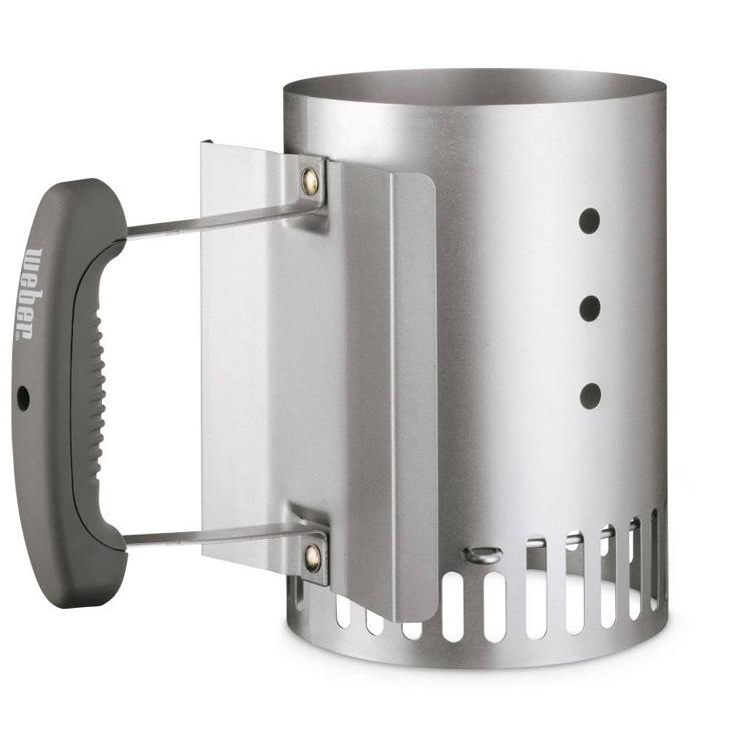
Before prepping the pears for cooking, start the cooking coals. The coals are easiest to start in a charcoal chimney. To do this, crumple up some newspaper and place it below the chimney, pour the desired amount of coals into the chimney, for this recipe you will need around thirty, and light the paper. Allow the coals to cook until the ones at the top of the chimney are just starting to turn grey. This can take awhile, so you want to start the coals a good time in advance, such as twenty minutes.

When making desserts, I like to line the inside of the dutch oven with aluminum foil. This helps to keep the pears from sticking to the bottom of the oven, and also makes clean-up easy.

To prepare the pears, begin by removing the peels. Cut the stem off from the top of the fruit, and then remove two thin slices from each side of the pear. Removing the thin slices creates a stable base for the pear to sit in the oven. Finally, cut the pears in half. Use a spoon to scoop out the seeds and coarse center for the fruit, which also creates a nice bed for the honey and cinnamon to settle into.

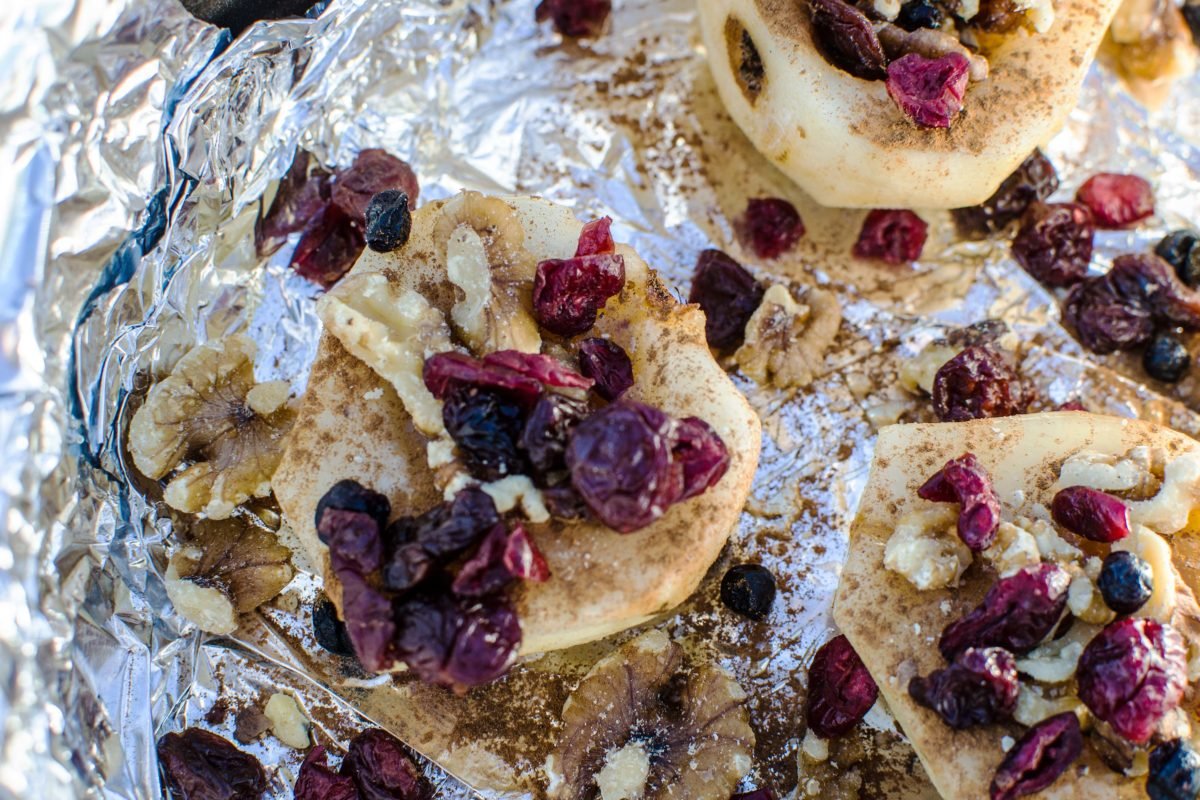
Lay the pear halves into the oven and drizzle them with honey. Sprinkle each pear with your desired amount of cinnamon. Drop in the dried cherries and nuts. It is okay if some of the ingredients end up in the bottom of the oven instead of on top of the pears, they will just cook down into the wine and create a syrup.

At this point, it is easiest to carry the oven over to the coals. Set the oven on top of about 10 to 12 coals. Slowly pour in your wine, being careful to not splash it over the pears. The amount of wine needed will depend on the size of your oven. I just kept pouring until there was about a half an inch of wine in the bottom of the oven. Cover the oven and place about ten coals on the top of the oven. Allow the pears to cook for twenty to thirty minutes, or until they are soft.

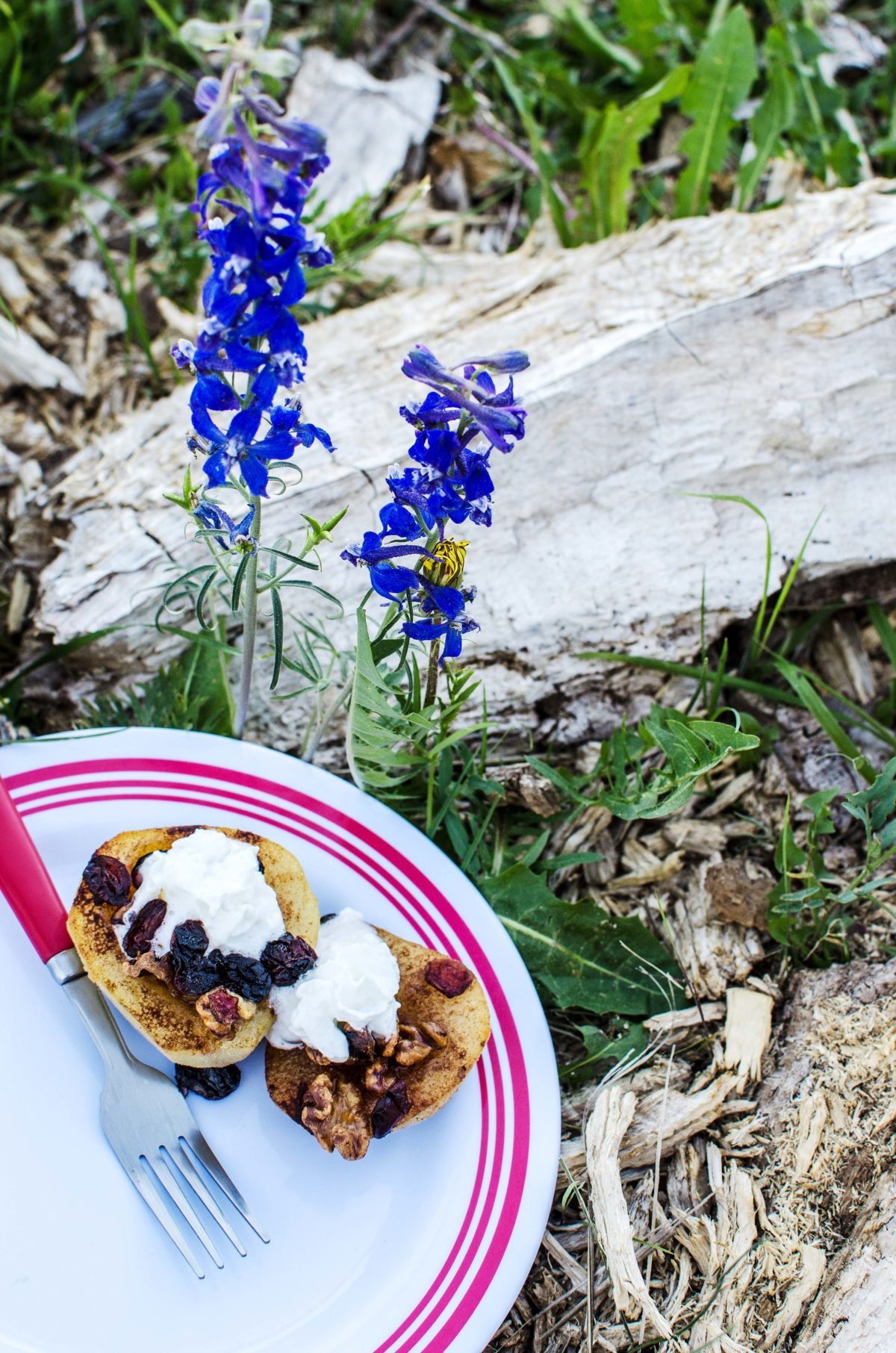
The sweet aromas of the pears and dried cherries may seem like this dessert is already enough, but it doesn't stop here! Plate up two halves of pear per person, making sure each serving is covered with a generous portion of cherries and walnuts. Drizzle the sticky, thin syrup from the bottom of the pan over each pear, and top everything off with a dollop of whipped cream. The warm pears and sticky honey will melt in your mouth, and everything is topped off with the sweet, cool taste of the whipped cream and a slight crunch from the walnuts! This dessert will make you simply sigh.

So, enjoy this decadent fruit dessert, but fear not, s'mores are still on the menu for all camping excursions.


Yield: 4-6
Author: a 12 Gauge Girl
Dutch Oven Baked Pears and Cherries

Dutch Oven Baked Pears and Cherries

( 0 reviews )
A fragrant and delicious dutch oven dessert that is sure to impress all your camping guests. Filled with pears, cherries, and stewed in a light white wine. Topped with nuts and fresh whipped cream.

Ingredients

  • Six bosc pears
  • Three tablespoons honey
  • One tablespoon cinnamon
  • One cup dried cherries or other dried fruit of choice
  • One cup of walnut or other nut of choice
  • Bottle of semi-sweet wine, such as pinot grigio, moscato, or zinfandel
  • Whipped cream for topping

Instructions

  1. Begin by preparing the coal briquettes in the charcoal chimney. Allow coals to cook for twenty to thirty minutes, until the top coals in the chimney start to turn grey.
  2. Line the oven with aluminum foil.
  3. Peel the skin from the pears, and cut the stem from the top.
  4. Take a small slice from two opposite sides of the pear, creating a flat bottom for the pear halves to sit on.
  5. Cut the pears in the half and scoop the seeds out.
  6. Lay the pear halves in the oven and drizzle with honey.
  7. Sprinkle on cinnamon.
  8. Drop in cherries and walnuts.
  9. Place the oven on top of 10 to 12 coals.
  10. Add the wine to oven, taking care to not splash it on the pears. Pour in until about a half inch of liquid is in the bottom of the oven.
  11. Cover and place 10 coals on the top of the oven.
  12. Bake for twenty to thirty minutes, or until the pears are soft.
  13. Top each portion with a healthy dollop of whipped cream!
Did you make this recipe?
Tag @a12gaugegirl on instagram and hashtag it # huntingandcooking

Coffee Crusted Elk Steak

This coffee crusted elk backstrap steak is a meal to write home about. The steak is crusted in an acidic and rustic dry rub of coffee and mushrooms and then drizzled with a rich stout glaze. The shoestring onions add a crunchy balance against the juicy elk backstrap steak.

The recipe was originally featured on Harvesting Nature, and a link to that recipe can be found here: Harvesting Nature Coffee Crusted Steak.

I have included a recipe card here as well! Enjoy!

Yield: 4
Author: a 12 Gauge Girl
Coffee Crusted Elk Backstrap Steak

Coffee Crusted Elk Backstrap Steak

( 0 reviews )
Coated in a light crust of coffee and mushrooms that seals in and adds flavor, this coffee crusted elk backstrap meal is perfect for date night. The steak is topped with crunchy onion shoestrings and drizzled in a rich stout glaze.
Prep time: 30 MinCook time: 40 MinTotal time: 1 H & 10 M

Ingredients

Ingredients for Fried Onion Shoestrings
  • 2 onions, thinly sliced
  • 2 cups buttermilk
  • 1 cup flour
  • Tablespoon salt
  • ½ Tablespoon cayenne
  • Black pepper to taste
  • 3 cups frying oil (vegetable, avocado, canola)
Ingredients for Stout Sauce
  • 2 Tablespoons butter
  • 1 medium shallot, minced
  • 12oz stout beer
  • 2 Tablespoons honey
  • 1 Tablespoon molasses
  • 1 Tablespoon Worcestershire sauce
Ingredients for Coffee Crusted Steaks
  • 4 elk backstrap steaks, about 2 inches thick each
  • 2 ounces dried porcini mushrooms
  • 2 ounces ground coffee
  • 1 Tablespoon cocoa powder
  • 1 Tablespoon cinnamon
  • 1 Tablespoon salt
  • 1 Tablespoon oregano
  • 2 -3 Tablespoons fresh sage, minced

Instructions

  1. Start with preparing your fried onion shoestrings. Thinly slice the onions. If you can use a mandolin to get a fine slice that is easiest, but you can just cut thinly with a sharp knife.
  2. Be sure to pull the onion slices apart and submerge completely in buttermilk. Let sit for at least one hour.
  3. In a large ceramic Dutch oven or deep fryer, heat a couple cups of a high temperature frying oil, such as avocado, canola, or vegetable, to 375 degrees.
  4. In a shallow bowl, mix a cup of flour, tablespoon of salt, fresh cracked black pepper, and ½ tablespoon of cayenne.
  5. Shake the excess buttermilk from the onion strings and coat completely in flour mixture. Shake excess flour from onion strings and immediately add to hot oil. Work in small batches to keep the oil temperature from dropping.
  6. Fry the onion shoestrings for one to two minutes, until the onions are a golden brown. Keep the onions separated from each other for optimal crispiness.
  7. Remove onion batch from oil and place on paper-towels to drain some of the oil off. Repeat with rest of onions.
  8. In a medium saucepan over medium low heat, add two tablespoons of butter. Once the butter is melted add a finely diced medium sized shallot. Cook for five minutes, until the shallot is soft.
  9. Add a bottle of stout beer, two tablespoons of honey, a tablespoon of molasses, and a tablespoon of Worcestershire sauce. Allow the mixture to simmer and reduce the liquid down by half, which should take fifteen to twenty minutes.
  10. Cut your wild game backstrap into two-inch-thick steaks. Let the steaks sit out at room temperature for about thirty minutes before cooking.
  11. While the steaks are coming to room temperature, prepare the coffee coating. In a spice blender or coffee grinder, mince up the one ounce of dried porcini mushrooms.
  12. Add the ground porcini mushrooms to a bowl along with 2 ounces of ground coffee, one tablespoon of cocoa powder, 1 tablespoon of cinnamon, a tablespoon of salt, and the dried oregano. Mix everything together.
  13. Coat the wild game back strap steaks completely in the coffee and mushroom mixture.
  14. Heat a large cast iron pan over medium high heat. Once the pan is heated, about two minutes, add the steaks to the hot pan.
  15. For a medium rare steak, cook the steak for six to seven minutes per side to an internal temperature of 145 degrees Fahrenheit.
  16. Let the steaks rest for five minutes before serving. To plate, pile a heaping serving of fried onion shoestrings on top of the coffee and mushroom crusted steak. Drizzle with the stout sauce and top with minced fresh sage.
Did you make this recipe?
Tag @a12gaugegirl on instagram and hashtag it # huntingandcooking

Dutch Oven Nachos

Dutch Oven Nachos have made me re-think campfire meals. I always struggled with dinner the first night of a hunting trip. Usually, we pull into camp after dark. Everyone knows how it goes. You have a long weekend planned full of camping, fishing, hunting, hiking, and recreating, but you can't leave until after work on Friday. And then when you get home from work, you realize you have to go grocery shopping for three days worth of food. And then you realize you have to load the truck. And the entire drive to camp you are remembering all the things you left at home, like a pillow or the coffee (Oh man! Don't even start with me on someone forgetting the coffee, talk about a camping nightmare!). When all is said and done, you pull into camp after dark, and you still have to set everything up!

"Life is a nacho. It can be yummy-crunchy or squishy-yucky. It just depends on how long it takes for you to start eating it." ~ John Updike

It is always at this point I realize dinner is going to be a midnight affair, if we are lucky. Usually I like to start my hunting trip with a memorable dinner to kick the weekend off right, but that plan always backfires, as it is too late to dutch oven anything in hopes it will be ready in a reasonable amount time for everyone to eat. We usually end up grumpily eating sandwiches, which were supposed to be for lunch the next day but have now replaced dinner. Everyone goes to bed a little disappointed at the start of the trip.

Well, this sad story will not be repeated for us anymore! I have found the PERFECT dutch oven meal for your first night at camp: Dutch Oven Nachos! They are quick, easy, delicious, and give that fun feel to the start of the weekend you are looking for, because hey, you are eating nachos in the outdoors and how fun is that? My favorite dutch oven meals are the ones that bring the unthinkable to the outdoor. Usually, nachos are made in the oven, or at least the microwave, and have a ton of ingredients so they don't really sound like a very easy camping meal. Don't be fooled, they are super easy!

The key to not having your nachos ready at midnight is to pull the charcoal chimney out when you first arrive at camp and light your briquettes. The briquettes will be ready to go by the time you are finished setting up the tent. Besides the coals, there is very little prep needed for this meal. Light the coals and allow them to heat until the top ones have just started to turn grey. I used to let them burn until the top ones were completely grey, but this resulted in the coals at the bottom of the chimney amounting to nothing more than dust.

The fun thing about nachos is you can top them with pretty much anything your heart desires. They can be filled with meat or vegetarian, spicy or mild, topped with a pile of veggies, have beans of several varieties, and so on. Anything the old heart desires!

I used a 12 inch Dutch oven for these nachos, but really any size will work. The temperature is not crucial to the success of this meal, like it would be if you were doing biscuits or some type of cake, so you can be flexible in the size of your oven. To start, I poured a very thin layer of nacho cheese sauce in the bottom of the oven. I felt that if I set my chips directly onto the bottom of the pan without a little bit of liquid they might burn. For those of you who might not know what nacho cheese sauce is, like I did not before making this meal, it is canned cheese found in the Hispanic food section of the grocery store. There were several varieties available out my grocery store, and I went with a queso fresco style, but you could get anything that catches your fancy. There were several varieties filled with different chilies or spices.

On top of the thin cheese layer, add a layer of chips. Everyone likes a different style of tortilla chip, and you can't change their mind once it is set. Trust me, I have experienced this with the loved ones in my life. No fight is ever as vicious as when someone pulls out a brand of tortilla chips that is different than my sister's or my dad's favorite brand. So, use whatever brand of tortilla chips you love, but my suggestion, and it is purely a suggestion, is the Mission Tortilla Rounds. I like to use these for nachos because they are a bit thicker than some of the other brands, which means they hold up a little better to the cheese or other ingredients that make nachos soggy.

To the tortillas, add a layer of shredded cheese. I used the Mexican cheese blend, but you could also use any variety of cheddar, Colby, or even Italian style cheese. Pepper jack cheese would add some nice spice and heat to your nachos. Next I poured half a can of black beans on top of the cheese. Again, there are several options of beans that could be added, including red kidney beans, pinto beans, or refried beans. At this point, you could also add meat. For this time around, I was looking to make a very quick meal and I did not add meat, but shredded chicken, pork, or steak would be amazing! You could also do chorizo or hot sausage. And that is something you could prepare at home and it would then be quick and easy to throw onto the nachos.

I added a couple more toppings to this pot of nachos, including pickled jalapenos, sliced black olives, and some diced tomatoes. You can create any flavor combination you want at this point. Other great toppings could include: diced pineapple slices, bell peppers of any color, red or white onion, zucchini (I know sounds, kind of weird but it is actually pretty good), shredded carrots, and whatever else you can dream up.

So, once you have all your toppings added, it is time for the second layer. Add another layer of tortilla chips, top with more cheese, the other half of the can of beans, and all the additional toppings you have decided to add. Top it with a final layer of chips and a sprinkling of whatever cheese is left over. To finish it off, pour the entire can of nacho cheese over the top of the nachos and let it run down through the mountain of chips and toppings you have created.

Place the lid on top of the oven and set over your hot coals. I did about ten coals on the bottom of the oven and added another eight coals to the top. Let the nachos cook for 15 to 20 minutes.

While the nachos are baking away, you can prepare the fresh toppings for your nachos. For this time around, I added shredded lettuce, salsa, diced avocado, and sour cream.

The nachos are ready once the cheese is all melted! Pile on your favorite toppings and enjoy around a crackling campfire!

Happy Hunting!

Dutch Oven Nachos

Dutch Oven Nachos

( 0 reviews )
Author: a 12 Gauge Girl
Prep time: 10 MinCook time: 20 MinTotal time: 30 Min
Nachos aren't the first meal that comes to mind when preparing the campfire, but these dutch oven nachos will change your mind! They are packed with melted cheese, jalapenos, beans, and the meat of your choice. And nothing is more fun around the fire then preparing your dutch oven nacho dinner!

Ingredients

  • 1 bag tortilla chips
  • 1 can beans, any style including black, red kidney, pinto, or refried
  • Half pound meat, your choice of chicken, pork, steak, chorizo, sausage
  • 2 cups shredded cheese
  • 1 can nacho cheese
  • !Additional topping suggestions
  • 1 can sliced black olives
  • 1 shredded carrot
  • 1 jar pickled jalapenos
  • 1 shredded zucchini
  • 1 can diced pineapple
  • 1 diced tomato
  • !Fresh ingredients
  • Cilantro
  • Sour Cream
  • Avocado
  • Salsa
  • Lettuce
  • Diced tomato

Instructions

  1. Heat charcoal briquettes in charcoal chimney until top briquettes are just starting to turn grey, about fifteen to twenty minutes.
  2. In a 12 or 14 inch Dutch oven, pour a very thin layer of nacho cheese in bottom of pan.
  3. Add single layer of tortilla chips.
  4. Top chips with layer of shredded cheese.
  5. Add half of the can of beans.
  6. Add meat, if desired.
  7. Add additional toppings such as sliced jalapenos or black olives.
  8. Create a second layer of chips, cheese, beans, meat, and other toppings.
  9. Finish nachos off with a single layer of chips, any remaining cheese, and the rest of the can of nacho cheese.
  10. Cover with lid and cook over coals for fifteen to twenty minutes. Cook with 8 to 10 coals on bottom of oven and 6 to 8 coals on the top.
  11. Serve with additional fresh toppings.
Did you make this recipe?
Tag @a12gaugegirl on instagram and hashtag it #huntingandcooking

Carne Asada Pronghorn

Carne Asada Pronghorn. When translated directly to English, carne asada means "grilled meat." However, the term in Spanish can mean several things. Carne refers to meat and asada refers to barbeque techniques as well as idea of social gatherings that occur when a barbeque is held. So the term can not only refer to the actual grilling of meats, but also to the idea of a social gathering to share and enjoy a family meal.

"My favorite memories growing up in North Carolina were hunting and fishing with my father and brothers. There, I developed a deep appreciation for protecting land and waterways. There, I learned outdoorsmanship." ~ Louis BaconCarn

I found this second definition particularly thought-provoking. Gathering to share a meal with good company is a universal language and a tradition important to many cultures. In the United States, we have holidays dedicated to just this tradition. At Thanksgiving, families and friends gather to share recipes, stories, and traditions around a table stuffed with turkey, mashed potatoes, and whatever casserole has been passed through the family for generations. In Mexico, families gather to show respect for the departed during Dia De Los Muertos (Day of the Dead) by constructing altars in their homes. The altars are adorned with the deceased's favorite foods, drinks, and treats. In Italy, the Feast of Seven Fishes is celebrated on Christmas Eve. This dining event, which dates back to Medieval times, hosts a seven course meal centered entirely around fish. The list is endless and includes all cultures.

Barbeques are just simpler versions of these usually oversized traditions. I know for myself, if I am going to fire up the grill I suddenly start inviting the entire neighborhood. It doesn't matter how last minute the plans are, or how simple the meal is going to be. If I am just throwing a couple of burgers on, I still feel the need to invite my parents over. If I am preparing some grilled kabobs, I am also calling my friends over to share in the event. Barbeque just begs for you to call up friends, share some stories, and enjoy an evening out in the backyard.

I had never made carne asada before. I have tried it several times in different restaurants, and it is always good. When I started looking for some different recipes on how to prepare the meat, I came across the origin and definition of the word carne asada. That translation of "social gathering" made the meal seem even more special. And in true barbequing fashion, I called my family and invited everyone over for an evening of carne asada, story sharing, and a break in the backyard from the rest of the world. Ahhhh, nothing like a backyard barbeque!

A little trick I learned awhile ago is when mincing garlic you can also just grate it with a plane file. This is a bit faster than mincing and you don't have to dirty an entire cutting board just for garlic.

Traditionally, carne asada is prepared from beef steak. The cuts used are usually the more tender steaks, such as skirt, flank, or flap steak. The meat marinades for at least 24 hours, but sometimes for a couple of days. It is grilled over an open flame at a high temperature in order to char the flavors of the marinade and seal in the juices. After searing the meat, it is cooked to well-done. It is typically served on a tortilla with salsa, guacamole, beans, and onions.

Putting the steaks in a Ziploc bag make for easy storage in the fridge. It also creates an easy way to really massage the marinade into the meat.

To create a twist on the traditional carne asada, I decided to make it using pronghorn! Pronghorn is an amazing meat to use for carne asada. It is extremely tender, and takes the marinade really well. For this recipe, I used two cuts of some backstrap and then also a flank steak. It was about two pounds worth of meat, perfect for sharing with a group of six.

The key to a great carne asada is allowing the meat plenty of time to marinade. I set my marinating meat in the fridge 24 hours before I was planning on grilling it. If you are pressed for time, or just decide you want to make this the morning before your barbeque, I think 12 hours would be fine. You could also go longer than 24 hours too.

There is no strict way to marinade carne asada. Different recipes call for different ingredients, and as with most marinades, you could also add things as you go along. I like to taste my marinades and then add to them as the flavors start to develop. Some marinades call for lemon and lime juice, Worcestershire sauce, and a variety of spice rubs. I like my carne asada to have a little heat to it, but also a subtle hint of sweetness.

For my marinade, I juiced two oranges, a lemon, and two limes. To the juice, I added half of cup of coconut aminos, which is where the little bit of sweetness comes from, four cloves of garlic, three tablespoons of chipotle sauce, chili powder, cumin, oregano, black pepper, and sweet paprika. I chopped up a handful of cilantro and then whisked in a half a cup of extra virgin olive oil. Set aside a cup of the marinade for serving alongside the meat. I placed the cuts of meat in a large freezer bag, poured the marinade in, gave everything a nice massage, and placed it in the fridge for the next day.

Preheat the grill really hot. I got mine up to about 550 Fahrenheit. I also have one other little tip before you throw the meat on the grill. Pull the meat out of the fridge about fifteen or twenty minutes before you are going to start cooking. Allow the meat to come to room temperature. This will take the cool from the fridge off the meat and allow you to get a more even heat throughout the steaks. Place the steaks directly on the heat source and cook on each side for one to two minutes. You are looking for grill marks and even a little char on the steaks.

After searing the steaks, move them to an area on the grill with less direct heat. This may be off to the side, away from the flame, or you may have an upper rack level on your grill. My grill has this upper rack, so I moved them there. Close the lid and allow the steaks to slow cook for a few more minutes. How long you allow them to cook will depend on the steaks' thickness. My steaks were about an inch to an inch and a half thick, so I cooked them for seven to ten minutes. Once the steaks reached medium, which I tested with a meat thermometer, I pulled them. Place aluminum foil over the steaks, creating kind of a tent with the foil, and allow them to sit for five more minutes. Allowing the meat to sit for a few minutes gives them a chance to finish cooking, which brought my steaks to about medium-well, and also helps to seal in the juices. If you cut the steaks immediately after pulling them off the grill, the juices rush out of the steak and that is a very sad thing! The meat will also be easier to cut if you let it cool down a bit, and you won't tear it with the knife.

Working across the grain of the meat, slice the steak into quarter-inch thick slices.

To serve the carne asada, lightly grill up some corn tortillas. You could also use flour if you prefer them. Place a few slices of meat on the tortilla and pile on your favorite toppings. I sliced up some fresh jalapenos for extra heat. I also offered more fresh cilantro, grilled bell peppers and onions, shredded cabbage, salsa, sour cream, guacamole, and queso fresco. Oh! And don't forget to spoon on some of that marinade you set aside!  It is an amazing little pop of flavor!

Happy Hunting!

Carne Asada Pronghorn
Yield 4-6
Author a 12 Gauge Girl
Prep time
10 Min
Cook time
12 Min
Inactive time
24 Hour
Total time
24 H & 22 M

Carne Asada Pronghorn

( 0 reviews )
Grilled Pronghorn steak is marinated in oranges, lemons and limes with a smoky chipotle finish. Perfect for tacos, fajitas, burritos, or salads.

Ingredients

For Marinade
  • 2 pounds pronghorn steaks
  • 2 oranges, juiced
  • 1 lemon, juiced
  • 2 limes, juiced
  • 1/2 cup coconut aminos (If you can't find this, you could also use soy sauce. It just won't add the slight sweetness coconut aminos will)
  • 4 cloves garlic, grated
  • 3 tablespoons chipotle sauce
  • 1 tablespoon chili powder
  • 1 tablespoon cumin
  • 1 teaspoon oregano
  • 1 tablespoon sweet paprika
  • 1 tablespoon black pepper
  • 1 cup chopped cilantro
  • 1/2 olive oil
Toppings for carne asada
  • Tortillas, corn or flour
  • Shredded cabbage
  • Salsa
  • Sour Cream
  • Guacamole
  • Grilled Onions
  • Grilled Bell Peppers
  • Queso Fresco
  • Chopped Fresh Cilantro
  • Sliced Jalapenos

Instructions

  1. Start your meat marinating 24 hours before you plan on grilling.
  2. For the marinade, add the orange juice, lemon juice, and lime juice to a medium size bowl. Add coconut aminos, grated garlic, chipotle sauce, chili powder, cumin, black pepper, paprika, and oregano to the bowl.
  3. Chop and drop in the cilantro.
  4. While whisking, slowly drizzle in the olive oil. Whisk until fully incorporated.
  5. Set aside one cup of the marinade for serving with the meat.
  6. In a large freezer bag, add the steaks and marinade. Massage gently and place in fridge for 24 hours.
  7. When ready to grill, set the meat out about fifteen minutes before hand.
  8. Preheat the grill to 550 degrees.
  9. Place steaks directly on heat source. Sear meat for one minute per side. You are looking for grill marks and char.
  10. Move the steaks to an area with less direct heat, such as the sides of the grill or an upper rack. Close the lid and allow to cook for seven to ten minutes, depending on the thickness of the meat and how well-done you desire the steaks.
  11. Remove the meat from the grill and tent with aluminum foil. Allow to sit for five minutes.
  12. Thinly slice steaks and serve with desired toppings on tortillas!
Did you make this recipe?
Tag @a12gaugegirl on instagram and hashtag it #huntingandcooking

Foil Wrapped Trout Packs

I am a planner. I like to know what lies ahead and how I am going to get there. I employ this attitude in almost everything I do in life. Stepping outside the plan is difficult for me, especially if I am not prepared for stepping outside the plan (somehow that doesn't even make sense, but if you are planner then you know what I am talking about!).

“The only real stumbling block is fear of failure. In cooking you've got to have a what-the-hell attitude.” ~ Julia Child

Camping is a planner's dream, or nightmare depending on how you look at it. I make lots of lists, trying to think of the unexpected popping up and how I will be prepared to tackle it. I try to cover everything I would could possibly need. Everything is broken down into lists, which have sub-lists, and then the lists are checked through, usually twice. For cooking, there is the master list of each meal: breakfast, lunch, dinner, dessert, and snacks. Then each meal is broken into two sub-lists: ingredients and tools. And then there is another list entirely for stocked items that I try to take everywhere. Things like cutting boards, knives that actually cut things (as opposed to most camping knives that tend to just tear things! I hate that!), extra bowls for mixing and such, spatulas, aluminum foil and Ziploc bags. The list is an ever evolving task that is added to each time a new hunting or camping trip happens.

With all that said, this past camping trip presented an unexpected. I never plan on catching fish. I consider myself a bad luck fisherman actually. Everyone around me can be reeling them in, and I will sit idly watching happy faces pull in beautiful fish. I would say it makes me sad, or jealous, or angry, or something, but I actually am used to it by now. So, you can imagine my surprise when this past weekend I limited out on rainbow trout two days in a row.

Since I never plan on catching fish, I never plan on cooking fish while at camp. This time was different. As I was cleaning the trout, I had this overwhelming urge to have fresh lake caught fish that night. I didn't know how it was going to happen, or if I had anything to prepare the fish with, but I knew it needed to happen. I needed to ditch the planned dinner and make a fish dinner.

Since supplies were limited, I decided to try and cook this fish in foil packets in the actual fire pit. I have done other meals this way before, usually ones filled with meat, potatoes, vegetables, and a gravy base. It is a quick way to make a fantastic tasting meal. It requires little preparation, little clean-up, and amazing results. I had never done fish this way before though.

Besides having no set way to cook this fish, I also had no recipe. So, this impromptu meal was going to have to be a "clean out the cupboard" type effort. I searched through bins for whatever spices and ingredients I could find. This recipe is what I came up with, and I have to say it was superb. I felt like I was eating at a five-star restaurant.

To start, you have to build a fire. This is usually a given at a campsite, but I thought I better mention it. If you aren't much a fire chef, which I can't say that I am one, you can also heat up some coals and just place the packets on top of the coals. I used my charcoal chimney for my dutch oven to heat up about ten coals and cooked over those. It worked great.

For this recipe, I left the fish on the bones. It makes for each fish cleaning, cooking, and the meat literally flakes off the bones once it is finished cooking.

To start, cut two pieces of aluminum foil about twice the size of fish. There needs to be enough foil to fold over the entire fish and other ingredients and then wrap the edges closed. The fish should be centered in the piece of foil with at least an inch of room around it. You want to use two pieces of foil to create a really good barrier between the heat of the fire and the fish. I have single layered the aluminum foil before and things tend to burn rather than steam.

Salt and pepper the fish. If you have some lemon pepper, which is a common seasoning used for fish, that would be great. You could also do my go-to favorite, Montreal Steak Seasoning. I put that on everything because I appreciate the balance of salt and pepper it has. Once the fish is seasoned, add thin slices of onion. Since this is an impromptu menu item, you might not have onions. You could also do minced garlic. Even dried onions or garlic would work, which is something many people leave stocked in their camping supplies. I tend to always take onions with me when camping because they can be added to many different dishes.

On top of the onion, places thin pats of butter. My slices were cut about a 1/16 of an inch thick. You could cut the pats thicker and just not place as many on top of the fish too. I ended up with about five mirco-thinly sliced pieces per fish. It was a good amount of butter. Oh, just a quick note. The butter I had was unsalted. If you used salted butter remember to not add more salt to packet or you could end up with a very salty dish.

Gently pour a good drizzle of Worcestershire sauce over the fish. It is okay if it just pools up below the fish. Once sealed, the packet will steam everything and the sauce will infiltrate the fish beautifully!

To create the packet, fold the foil over the top of the fish. Gently start rolling the edges of the foil towards the fish, taking care not to puncture or rip the foil. The foil has to be completely sealed or the juices will run out and things won't cook right. If you tear a whole, grab another piece of foil and add another layer to the packet. The best way to think about making packets is to just try and keep things pretty. The prettier the packet, the better things seem to hold together.

Cook the fish about five to seven minutes per side. This will ensure the fish is flaky and pink, the onions are soft and sweet, and the butter and Worcestershire have melted into a delicate sauce. When I was cooking, the packets actually puffed up when they were finished, which was also a good indicator that things were done. However, if there are any leaks in the packets, this won't happen so I would keep an eye on the timer.

For a quick side dish, I cooked up some cheesy dutch oven potatoes. Cube the potatoes into bite size pieces, season with salt and pepper (or as I did, because like I said I am crazy, you can add Montreal Steak Seasoning. I have a problem.), and cover with cheese. You could also throw in some onion if you have left-overs from the fish packets. Cook over coals, about ten to twelve on the bottom and eight to ten on the top, for twenty to thirty minutes, or until the potatoes are soft.

Happy Hunting!

Yield: 4
Author: a 12 Gauge Girl
Foil Wrapped Trout Packets

Foil Wrapped Trout Packets

( 0 reviews )
Buttery rainbow trout is steamed over hot coals in a packet of Worcestershire sauce, sweet onions, and Montreal steak seasoning.
Prep time: 5 MinCook time: 15 MinTotal time: 20 Min

Ingredients

  • 4 full trout, skinned and on the bone
  • 1 onion, cut into thin slices
  • salt and pepper
  • 1/4 stick butter
  • 4 tablespoons Worcestershire sauce

Instructions

  1. Light your campfire or charcoal coals.
  2. For each fish, cut two pieces of aluminum foil. Foil should be twice the size of the fish.
  3. Place fish in center of foil.
  4. Salt and pepper each fish.
  5. Place slices of onion along the fish.
  6. Cut butter into thin slices and lay atop the onion.
  7. Pour a tablespoon of Worcestershire over fish. Repeat with other three fish.
  8. Cook packets over the fire or coals and cook for five to seven minutes per side, flipping half way through the cook time, until fish are flakey and red. Onions should be soft and sweet. Enjoy!
Did you make this recipe?
Tag @a12gaugegirl on instagram and hashtag it #huntingandcooking

Pheasant Mushroom Soup

Pheasant Mushroom Soup. It’s creamy, hearty, and filling. I love a bowl of it on a cold evening, but even more so on an evening after a long day of pheasant hunting! Or deer hunting. Or elk hunting. Or even just afternoon of hunting around Netflix for new show to binge on a cold Saturday. Anyway, the point is, this is an amazing soup!

Pheasant Mushroom Soup

Pheasant hunting in Utah has been, ummm, I will say interesting for the last few years. Years ago, the state carried a healthy population of pheasants. My dad told me he remembered as a young boy standing in a line of hunters and dogs, anxiously waiting for the pheasant season to officially open. The clock hit 8:00 am and the entire line moved across the field, attempting to kick up roosters, and fill their bag limit of two birds.

Since then, the bird population has struggled. Multiple factors play into this decline, including habitat destruction, predation on birds, tough winters, and more. In southeastern Utah, where I live, the population has almost completely disappeared. There may be a few lone birds out in the once popular hunting areas, but I wouldn’t even go searching for them in fear that if I did find a rooster, I was taking the very last one.

The state department of wildlife has addressed the decline and implemented a release program for pen-raised roosters. During the pheasant season, they release about 10,000 birds over 54 different hunting areas throughout the state. The program has made it possible to hunt pheasant again around the entire state of Utah, which has been great!

Anyway, politics aside! Let’s make Pheasant Mushroom Soup

The Mushroom Stock

You could easily add vegetable or chicken stock to this recipe if you wanted. You could even probably find a mushroom stock at most grocery stores but making your own is really quick and easy. The few steps it takes to make a quick homemade mushroom stock really adds to the depth of flavor for your soup, so if you have the ingredients, I recommend this step.

In a small saucepan, add all the stems from your mushrooms. Cover with water, about four cups. 

Also add in a few, like two, roughly chopped up carrots, a little celery, some onion, and a bay leaf.  Season with a little salt and let reduce over medium low heat for at least thirty minutes.

Strain out all the solid and reserve the liquid for your pheasant mushroom soup.

The Pheasant Mushroom Soup

To help ensure that the pheasant is tender and easily shreds, I poach it first. In a large pot, I add enough water to cover the pheasant, which is still just on the bone at this point and poach it for one hour.

For poaching, add enough water to cover all the pheasant and bring the water to a boil. Once the water is boiling, place a lid on the pot, reduce the pot to a simmer over low heat and let the poaching begin.

I just use water for poaching because the mushroom soup is going to add all the flavor to the pheasant. You could use vegetable or chicken stock to poach in, but it is almost a waste of stock. This was a hard tactic for me to follow at first, in my bones I felt like I needed to flavor the pheasant while poaching. But I resisted! And saved my stock for another day.

Once the pheasant is finished poaching, you can shred it into bite size pieces and set aside for adding to the mushroom soup.

In a dutch oven or heavy bottomed pot, melt two tablespoons of butter and a tablespoon of olive oil over medium heat. Once the butter is melted, add the minced shallot and diced leeks, and cook for two or three minutes. Add your diced carrots, and add all the sliced mushrooms at this point, being sure to stir and coat the mushrooms in the oil and let cook down for ten minutes.

The mushrooms should be browned and softened by this point.

Sprinkle a little flour over the cooked mushrooms. This will be how we thicken the soup. A quarter of a cup should be good enough. Next, deglaze the pan with a half cup of marsala wine. I really liked the marsala wine in this recipe because it has kind of a sweet, musky flavor that dances wonderfully with the mushroom flavor. Let it simmer to cut some of the alcohol out and the develop the flavor of the mushrooms, maybe three to five minutes.

Now, add in your homemade mushroom broth! If you don’t have time to make your own mushroom stock, you can add vegetable or chicken stock at this point. Some homemade pheasant stock would also be fantastic!

Okay, now stir in your pheasant meat and let this pot gently boil for twenty minutes. No need to have a little jetted hot tub going on, just a gentle rolling boil will do.

Alright, we are almost done! I know you’re getting hungry! Add the can of coconut cream and a tablespoon of minced rosemary. Season to taste with a little salt and pepper. Let it warm on medium low heat for a little bit, just to give the mushroom flavor a little more time to infiltrate your pheasant and tango with the coconut cream.

Serve up piping hot bowls with some crusty bread and you will be one happy eater! Enjoy!

Happy Hunting!

Wild Game Bone Broth French Onion Soup

Wild Game Bone Broth French Onion Soup. After the sun has pulled the covers up and tucked itself in for the nigh and the cold starts to set in, does anything sound better than warm soup? I don’t think I feel happier and cozier than when I have my hands wrapped around a steaming bowl of French onion soup topped with gooey, melty gruyere cheese and homemade wild game bone broth.

JUMP TO RECIPE

Wild Game Bone Broth French Onion Soup

French onion soup is an OLD dish. Like think 8,000 years old. There are many different versions of how it first came around, but my favorite is the one where King Louis XV returns from deer hunting to bare cupboards. He rounds up some onions, butter, and champagne (which seems odd that his cupboards are bare, but champagne is around, but anyway), throws it all in a pot, and voila, French onion soup is born.

French onion soup was commonly considered the food of the poor because onions were cheap, easy to grow, and plentiful throughout Europe. The soup became popular in the 1960s in America along with the nation-wide trend of French cuisine in general.

To me, if French onion soup is the food of the poor, I don’t want to be rich. It’s one of my favorite meals. The ingredients are simple and easy to find, but the flavor developed from simply simmering caramelized onions in silky bone broth is downright amazing!

So, without wasting more time, let’s make Wild Game Bone Both French Onion Soup!

The Wild Game Bone Broth

You can make this recipe with store-bought beef broth, which is fine, but this is a wild game website, so I am going to share really quick (like the condensed, superfast version) how I make homemade wild game bone broth. I make a huge batch at one time from any of the bones I have in the freezer. Many times, the broth will be a combination of elk, deer, and pronghorn bones.

I roast the bones in a 400-degree Fahrenheit oven for one hour. I also do two or three onions, just cut in half and you don’t even have to remove the skin, and a couple of big chunks of ginger, I don’t even peel it.

After the bones are roasted, I put them, the onions, ginger, about six carrots, a bunch of celery, a couple of star anise pods, and a handful of whole cloves into a large stock pot. I cover everything with water, so this could end up being up to 24 cups of water if the pot is large like mine, and let it start simmering for hours. When I say hours, I mean like six. I reduce the liquid by about three quarters. Pour through a fine mesh sieve and scrape any fat from the top.

I don’t add salt to my bone broth. I just salt it when I use it so I can get it the way I like. Also, because it is so concentrated after hours of simmering, it doesn’t take up much room in the freezer. I freeze it in little pint-sized containers and then when I use for a recipe later, I add back in the water. So, for a pint of broth, I would add eight to twelve cups of water back in, depending on what I am doing.

Let’s Make French Onion Soup

Now that the broth is ready, it is time to start the onions. To a large skillet over medium heat, add a couple of tablespoons of olive oil, enough to coat the entire base of a ceramic dutch oven, and a tablespoon of butter. Once the butter is melted, add the onions. I slice the onion into long strips for this soup.

Spread the onions out and make sure they are coated in the oil. Let them cook for ten minutes, stirring often to keep them from sticking to the pan or burning. If they are cooking too quickly, you may need to reduce the heat a little. You are looking for a slow caramelization here.

After ten minutes, sprinkle a tablespoon of salt over the onions to develop even more flavor. I also add a teaspoon of sugar. It helps with caramelizing. Cook for twenty minutes more.

Once the onions are golden, and caramel-y, and smell like heaven, they are ready. Deglaze the pan with a cup of wine, red or white will work here, and be sure to scrape all that flavorful goodness from the bottom of the pot.

Add the pint of reduce wild game bone broth and eight to twelve cups of water. Bring to a gentle boil, and we will add even more flavor to this dish! Add two tablespoons of Worcestershire sauce, a tablespoon of Italian seasoning, and salt and pepper to taste.

Reduce the mixture for thirty minutes on a simmer. Add a quarter cup of sherry.

While your soup is doing its thing, toast sliced pieces of French baguette in the oven. I toast them under the broiler for five minutes. If you brush them with a little butter or olive oil first, you will get a beautiful, crunchy golden crust.

It’s time for the fun part: melting the cheese. Fill an oven safe ramekin with a cup or two of the French onion soup base. Nestle a few pieces of the toasted French bread into the soup, and then top it with shredded gruyere cheese. I do a ramekin per person.

Place the ramekins in the oven at 350 degrees for about ten minutes. The cheese should be melted and slightly browned (cue drool), and the broth slightly boiling. Aaaannnndddd…it’s time to eat!

Happy Hunting!

If You Like This Recipe, You Might Also Like…

Pronghorn Pumpkin Ale Chili

Venison Real Texas Chili

Elk Guinness Stew